


A4VSO Pump Replacement in a Four-Column Hydraulic Press
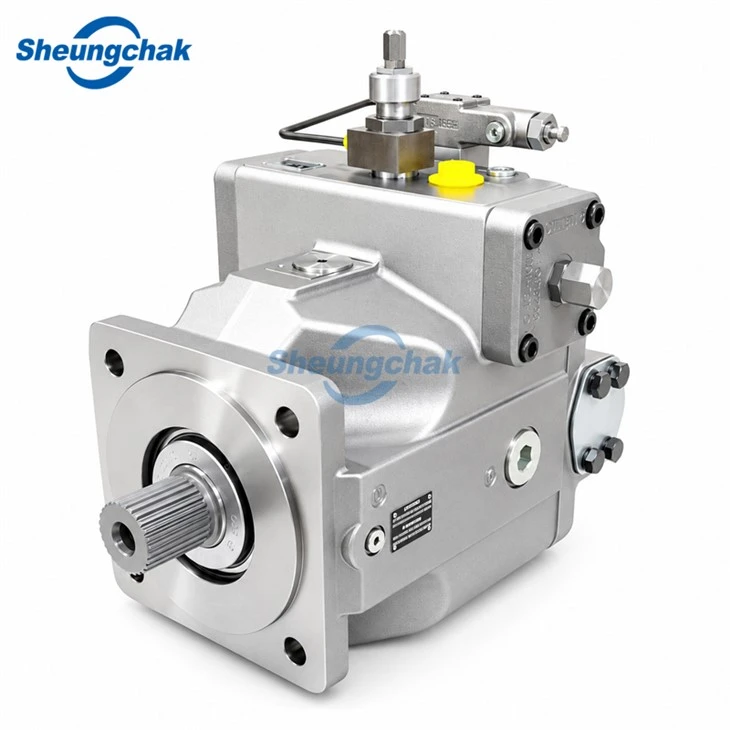
A four-column hydraulic press depends on a stable hydraulic power supply to move its main ram, develop forming force and complete each production cycle. Its A4VSO variable displacement axial piston pump must deliver sufficient flow during rapid approach, maintain the required pressure during forming and respond correctly when the cylinder enters its holding stage.
For an existing press, replacing the pump without changing the established hydraulic power unit requires more than matching displacement. The replacement must retain the original control function, motor drive connection, mounting dimensions and hydraulic port arrangement. Sheungchak supplies A4VSO replacement pumps from 40 to 500 cc/rev, with configurable control, shaft, rotation, port and sealing options for industrial press applications.
Equipment: Four-Column Metal-Forming Hydraulic Press
Hydraulic Circuit: Open-Circuit Hydraulic Power Unit
Main Actuator: Hydraulic Press Cylinder
Pump: A4VSO Variable Displacement Axial Piston Pump
Replacement Focus: Press Cycle Flow, Pressure Control and Mechanical Compatibility
Hydraulic System Arrangement of a Four-Column Press
The four guide columns keep the moving platen aligned during the pressing stroke. The main hydraulic cylinder supplies the force needed to compress, shape or form the workpiece. A hydraulic power unit supplies oil to the cylinder through a directional valve manifold and the associated pressure-control circuit.
In an open-circuit arrangement, the motor drives the A4VSO pump, which draws oil from the reservoir and delivers pressurized flow to the main hydraulic circuit. The pump's displacement changes through its swashplate mechanism, allowing its output flow to respond to the demand placed on the system.
| Hydraulic Component | Function in the Press |
| Electric Motor | Provides the rotational power required to drive the hydraulic pump. |
| A4VSO Variable Displacement Pump | Supplies adjustable hydraulic flow to the press circuit and regulates displacement according to its selected control function. |
| Directional Valve Manifold | Routes oil to the main cylinder for approach, pressing and return movements. |
| Pressure-Control Components | Establish the required system pressure limits and protect the hydraulic circuit. |
| Main Hydraulic Cylinder | Converts hydraulic pressure into the force required to move the press platen and form the workpiece. |
| Prefill Valve, Where Fitted | Allows additional oil to enter or leave the main cylinder during rapid movement, reducing the flow that must be supplied through the main pump. |
| Reservoir and Filtration System | Store, cool and filter the hydraulic oil before it returns to the pump inlet. |
The main hydraulic flow path runs from the reservoir through the suction line to the A4VSO pump, then through the pressure line and valve manifold to the cylinder. Return oil flows back through the machine's return circuit to the reservoir. Pump case leakage has a separate drain connection that must return to the tank under the permitted housing-pressure conditions.
Where a prefill valve or accumulator is installed, it supplies part of the cylinder's oil demand during the rapid approach or other designated operating stages. The A4VSO displacement must therefore be selected according to the flow required from the main pump, not simply the total cylinder volume.
How the A4VSO Supports the Pressing Cycle
A four-column press does not operate at one constant pressure and flow condition. Its hydraulic demand changes as the platen approaches the material, develops forming force, holds pressure and returns to its starting position.
Rapid Approach: Supplying the Flow Required for Ram Movement
Before the platen contacts the workpiece, the main cylinder needs sufficient oil flow to achieve the required approach speed. The pump must provide the flow assigned to it by the hydraulic circuit at the installed motor speed.
In a press equipped with a gravity-fed prefill valve, the cylinder can receive additional oil directly from the reservoir during rapid downward movement. This reduces the main pump's flow requirement compared with a circuit in which the pump supplies the entire cylinder volume.
The A4VSO's variable displacement allows its output to be adjusted to the required flow. This helps avoid selecting an unnecessarily large pump solely to satisfy the cylinder's maximum theoretical filling requirement when another circuit component supplies part of that volume.
Pressing: Maintaining Flow as Hydraulic Pressure Increases
When the platen contacts the workpiece, the resistance to cylinder movement increases and system pressure rises. The hydraulic pump must now supply the pressure and flow required by the forming operation.
The A4VSO's pressure-control configuration is important at this stage. With a DR pressure controller, the pump reduces displacement when the set pressure is reached, limiting further pressure rise at the pump outlet within the controller's operating range.
For a press using a flow-control arrangement, a DFR configuration combines pressure and flow regulation. Its flow-control function responds to the external metering orifice, while the pressure controller limits the pump outlet pressure. This arrangement is relevant when the existing hydraulic circuit is designed around that flow-control signal.
The replacement must retain the pressure-control behavior required by the press rather than simply use whichever regulator is available.
Pressure Holding: Reducing Unnecessary Pump Output
During pressure holding, the main cylinder may remain stationary while the machine maintains the required forming force. The pump's required output depends on how the holding circuit is arranged.
If directional and load-holding valves isolate the cylinder, the pump may destroke or enter its pressure-compensated operating condition while the valve circuit maintains cylinder pressure. If the circuit requires continuous pressure replenishment, the pump must provide the flow needed to compensate for leakage and maintain the specified pressure.
This distinction matters when replacing the original pump. The holding pressure at the cylinder is not automatically the same as the pressure and flow operating point at the pump. The valve arrangement and pressure-control settings determine the actual pump duty.
Return Stroke: Matching the Reverse Cylinder Movement
When the press finishes forming, the directional valve routes oil to the opposite cylinder chamber and the platen returns. The required pump flow depends on the effective area of that chamber, the desired return speed and the circuit's flow path.
Where a prefill valve is used, its switching sequence must also be considered during the return movement. The replacement pump must support the original return function without changing the valve sequence or exceeding the motor's available drive power.
The Replacement Challenge: Retaining the Existing Press Power Unit
When an existing A4VSO pump is removed for replacement, the equipment owner usually wants to retain the electric motor, coupling, mounting position, hydraulic manifold and established pipework wherever their condition and dimensions permit.
A pump with the same displacement designation can still introduce installation or operating problems if its regulator, shaft, rotation or port arrangement differs from the original unit.
For a four-column press, four areas deserve particular attention.
There is also a failure-related consideration. Low flow, excessive oil temperature, abnormal noise or shaft-seal leakage may originate from restricted suction, contaminated oil, incorrect case-drain routing or drive misalignment. Replacing the pump without correcting these conditions can expose the new unit to the same problems.
Selecting the Sheungchak A4VSO Displacement for the Press
Sheungchak A4VSO variable displacement axial piston pumps are available in 40, 71, 125, 180, 250, 355 and 500 cc/rev sizes. The 125 and 180 cc/rev sizes provide practical mid-range options for hydraulic press power units, while the 250 and 355 cc/rev sizes cover higher-flow industrial applications.
For a medium-flow four-column press, the A4VSO125 and A4VSO180 are useful starting points for evaluating the main pump requirement.
| Model | Geometric Displacement | Reference Speed | Theoretical Flow at Full Displacement | Press Application Consideration |
| A4VSO125 | 125 cc/rev | 1,500 rpm | 187.5 L/min | Medium-flow press power units where the main pump's calculated flow demand fits the available operating range. |
| A4VSO180 | 180 cc/rev | 1,500 rpm | 270 L/min | Press power units requiring a higher pump-side flow capacity. |
Theoretical flow is calculated from displacement multiplied by shaft speed. Actual delivered flow is lower according to volumetric efficiency and the pump's operating pressure, speed and fluid conditions. The required size must therefore be checked against the measured pump-side demand throughout the press cycle.
Choosing a larger displacement is not automatically an improvement. At the same pressure, increasing displacement also increases the torque required to drive the pump. If the motor is retained, the selected size must match its available power and the actual operating duty.
Pressure Rating for Press Forming Operations
The Sheungchak A4VSO product range is specified for 350 bar continuous working pressure and up to 400 bar peak pressure. The 350 bar rating is the continuous-pressure reference; 400 bar is for short-duration peak operation, not a normal continuous press setting.
During replacement, the maximum pressure required by the forming operation must be compared with the rating of the selected pump configuration. Pressure at the pump outlet, pressure losses through the valve manifold and pressure at the main cylinder should be considered separately.
Where the press operates near the upper pressure range, the exact pump execution, port configuration and permitted peak duty must be confirmed before the replacement is approved.
Choosing the A4VSO Control Configuration for the Press
The regulator must reproduce the required pump behavior within the press hydraulic circuit. Sheungchak A4VSO configurations include pressure, pressure-and-flow, remote pressure, power, manual and electro-proportional control options, subject to the selected model and build availability.
| Control Code | Control Function | Press Application |
| DR | Pressure controller | Suitable where the pump needs to limit outlet pressure and reduce displacement after reaching the selected pressure setting. |
| DFR | Pressure and flow controller | Suitable where the press circuit uses an external metering orifice to determine pump flow while retaining pressure limitation. |
| DRG | Remotely operated pressure control | Allows pressure adjustment through an external remote-control arrangement when the machine requires it. |
| LR1 / LR2 | Power controller with hyperbolic characteristic | Limits absorbed drive power according to the selected power setting, helping coordinate pump loading with the motor capacity. |
| MA | Manual displacement control | Allows continuous displacement adjustment through a handwheel where manual setting is required. |
| EP | Electro-proportional control | Supports electrical displacement control where the corresponding machine signal and control interface are provided. |
For a conventional pressure-compensated press power unit, DR is a suitable configuration to evaluate when the pump's primary requirement is pressure limitation. DFR is relevant when the circuit also requires flow regulation through an external metering arrangement. LR1/LR2 is worth considering when the available motor power is a key design constraint.
DRG is relevant when the pressure setting needs remote adjustment. MA is intended for manual displacement setting, while EP is suited to applications requiring proportional electrical control. These options serve different hydraulic functions and must not be substituted for one another without reviewing the press circuit.
Mechanical Configuration for Direct Replacement
Keeping the original motor and hydraulic connections is often important when a press power unit is being refurbished. Sheungchak A4VSO replacement pumps can be specified with model-dependent shaft, mounting, rotation and port configurations to match the existing installation.
| Interface | Sheungchak A4VSO Configuration | Replacement Benefit |
| Mounting flange | ISO 3019-2 metric four-bolt configuration. | Matches the original mounting arrangement where the locating and bolt dimensions agree. |
| Drive shaft | SAE C, D or E; splined or keyed according to model. | Allows selection according to the existing motor coupling and bellhousing. |
| Rotation | Clockwise or counter-clockwise. | Matches the original drive direction. |
| Inlet port | SAE flange, 1-1/4 in to 1-1/2 in, depending on model. | Supports matching the existing suction pipe connection. |
| Outlet port | SAE flange, 1 in to 1-1/4 in, depending on model. | Supports matching the existing pressure line connection. |
| Case drain | G 3/4 BSP. | Provides a defined housing drain connection for the return-to-tank line. |
Before a direct replacement is confirmed, compare the shaft profile, shaft length, locating pilot, bolt pattern and port orientation with the original pump. A matching flange standard does not automatically guarantee that every mounting dimension is identical.
Where all interfaces match, the original motor coupling and pipe connections can often be retained without introducing adapter plates or unnecessary pipework changes.
Hydraulic Oil and Sealing Configuration for Press Duty
Industrial press hydraulic systems operate through repeated pressure and temperature cycles. The replacement pump's fluid and seal configuration must suit the oil already used in the power unit.
| Parameter | Sheungchak A4VSO Specification | Application Relevance |
| Hydraulic fluid | Mineral oil HLP ISO VG 32–68. | Matches common industrial hydraulic oil grades when the selected viscosity is suitable for the operating temperature. |
| Preferred viscosity | 16–36 mm²/s. | Supports the required lubrication and pump operating conditions. |
| Fluid temperature | -20°C to +90°C. | Defines the stated fluid temperature operating range. |
| Filtration | ≤25 μm absolute, β25 ≥75. | Helps control contamination that can damage precision pump surfaces and affect regulator operation. |
| Seal material | FKM standard, NBR optional. | Allows the sealing arrangement to be matched to the hydraulic fluid and operating environment. |
| Housing | Ductile iron. | Provides the pump housing construction for industrial installation. |
For a press running mineral hydraulic oil, FKM sealing is the standard configuration. If the system uses another fluid or operates under a different temperature condition, the seal material should be confirmed before ordering. NBR should only be selected when its compatibility with the specified fluid and temperature has been established.
The case-drain line must also remain unrestricted and within the permitted housing-pressure limit. A blocked or undersized drain can cause pressure to accumulate inside the pump housing and contribute to seal leakage.
Manufacturing and Testing of the Sheungchak A4VSO Replacement Pump
The replacement pump must correspond to the approved displacement, control and mechanical configuration. Sheungchak machines and laps its axial piston pump rotating groups in-house, then assembles the pump according to the specified build requirements.
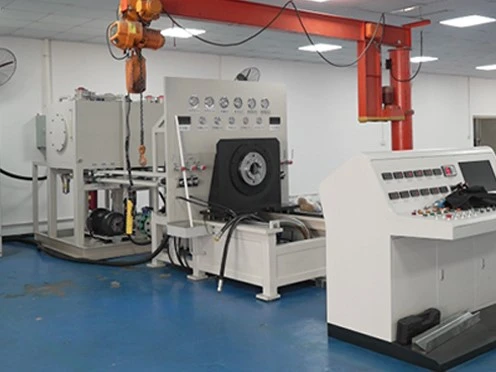
For a press replacement, the important manufacturing and inspection points include:
Rotating group machining: Cylinder block, pistons and valve plate surfaces are precision-machined and lapped to support the pump's operating clearances.
Control assembly: The selected pressure, flow, power or displacement control is fitted according to the ordered configuration.
Mechanical dimensions: Shaft and mounting interfaces are checked against the applicable dimensional drawing.
Hydraulic performance testing: The assembled pump is run on the factory test bench under the specified test conditions.
Product documentation: The supplied unit is accompanied by its corresponding test report, certificate of conformity and dimensional drawings, matched to its serial number.
This gives press maintenance teams the information needed to compare the delivered pump with the approved replacement specification, check the installation dimensions and review the pump's recorded factory test results before installation.
Verifying the Replacement Through the Press Operating Cycle
After installation, the replacement pump should be checked under the press's normal operating sequence. Testing only at unloaded conditions does not confirm that the pump can meet the changing flow and pressure requirements of the machine.
| Press Stage | Verification Point | What It Confirms |
| Initial start-up | Rotation, oil supply, abnormal noise, leakage and case-drain conditions. | Correct pump installation and initial hydraulic operation. |
| Rapid approach | Pump-side flow, ram movement time and prefill valve operation where fitted. | Whether the available flow supports the required approach speed. |
| Pressing | Pressure response, required flow and motor loading. | Whether the pump meets the forming-stage operating requirements. |
| Pressure holding | Cylinder pressure retention, pump displacement response and leakage. | Whether the pump and valve circuit maintain the intended holding function. |
| Return | Return speed, flow availability and valve sequencing. | Whether the reverse movement operates as required. |
| Repeated cycles | Oil temperature, pressure stability, noise and leakage. | Whether the hydraulic power unit operates consistently through repeated production cycles. |
These checks distinguish a pump-output problem from a valve, cylinder, motor or hydraulic-line problem. If the original press has experienced excessive temperature or repeated pump damage, the suction line, oil cleanliness, cooling system and case-drain arrangement should also be checked before returning the machine to full production.
Sheungchak A4VSO Replacement for Press Maintenance and OEM Supply
For hydraulic press maintenance, the value of a replacement pump lies in retaining the machine's required flow, pressure-control function and installation arrangement. A pump with the correct displacement but an incompatible regulator or shaft connection can create additional downtime during installation and commissioning.
Sheungchak A4VSO replacement pumps address these requirements through:
For equipment manufacturers and hydraulic distributors, the same configuration details can also be retained for repeat A4VSO replacement orders and OEM supply programs.
For further product details, visit the Sheungchak A4VSO Variable Displacement Axial Piston Pump page.
Request an A4VSO Pump Replacement for Your Hydraulic Press
Send the original pump nameplate and available press information to Sheungchak to identify a suitable replacement configuration.
For a more accurate quotation, provide:
Complete A4VSO type code, nameplate photograph and serial number.
Required pump flow, working pressure and drive speed.
Electric motor power and shaft coupling dimensions.
Original regulator code and hydraulic circuit diagram.
Photographs or drawings of the mounting flange and hydraulic ports.
Hydraulic oil type, operating viscosity and temperature.
Required quantity and delivery destination.
If the original pump is damaged or its complete type code is no longer readable, photographs of the pump housing, regulator, shaft and mounting flange can help establish the replacement configuration. The remaining dimensions and hydraulic operating requirements can be confirmed before the order is finalized.
Need a configured A4VSO replacement pump for your four-column press? Contact Sheungchak with your original pump details and press operating requirements for a replacement review and quotation.
OEM and ODM Hydraulic Pump Manufacturing
Sheungchak supplies non-OEM A4VSO-type replacement pumps and is not affiliated with Bosch Rexroth. A4VSO is used to identify the pump family and intended replacement application.