

A4VG71 Closed-Circuit Pump Replacement Case
An A4VG71 replacement for a road roller has to match the travel drive's control response, charge circuit and mounting interfaces. Sheungchak reviews the original pump code and installation details against the proposed configuration before quoting.
Representative application case. Consider a roller with an identified A4VG71 travel pump that loses pulling power after warm-up. The replacement review starts with the travel circuit and the evidence behind the fault.
Where the Pump Sits in a Roller Travel Drive
In this arrangement, the engine drives the pump through a coupling or drive housing. The A and B working lines connect the pump to the travel motor. The motor turns the drum or axle through the machine's drive assembly. The main flow circulates between the pump and motor.
The travel command changes the pump's swashplate angle to vary displacement. Moving the swashplate across neutral reverses the commanded flow. Charge oil replenishes the low-pressure side of the loop. Oil that leaks internally leaves through the case drain and follows the machine's return routing.
The illustration shows the travel and vibration drives as separate functions. Use the machine schematic and pump connections to identify the driven motor on the actual roller. See A4VG applications in road rollers for the wider application context.

What to Establish Before Replacing the Pump
Separate pump output from the travel load
Warm oil can make leakage-related loss of performance more apparent. A travel motor, a brake that does not release fully, or an incorrect command can also reduce pulling power. Use the machine's service record and schematic to identify which function changes and whether the fault appears in one direction or both.
Compare charge supply and main loop behavior
Have the service team record oil temperature, travel command, charge pressure, main-loop pressures and relevant case-drain readings under the OEM's specified conditions. Compare with the machine limits and record which component was measured. A charge supply problem can affect both loop replenishment and displacement control.
Specify replacement once the evidence points to the pump
If the diagnosis locates the fault in the pump, carry the complete pump identification and any confirmed system issues into the replacement review. Address contamination or supply faults before an approved unit is fitted. For additional diagnostic context, see the A4VG pressure loss and overheating guide.
The Configuration Checks That Decide Fit
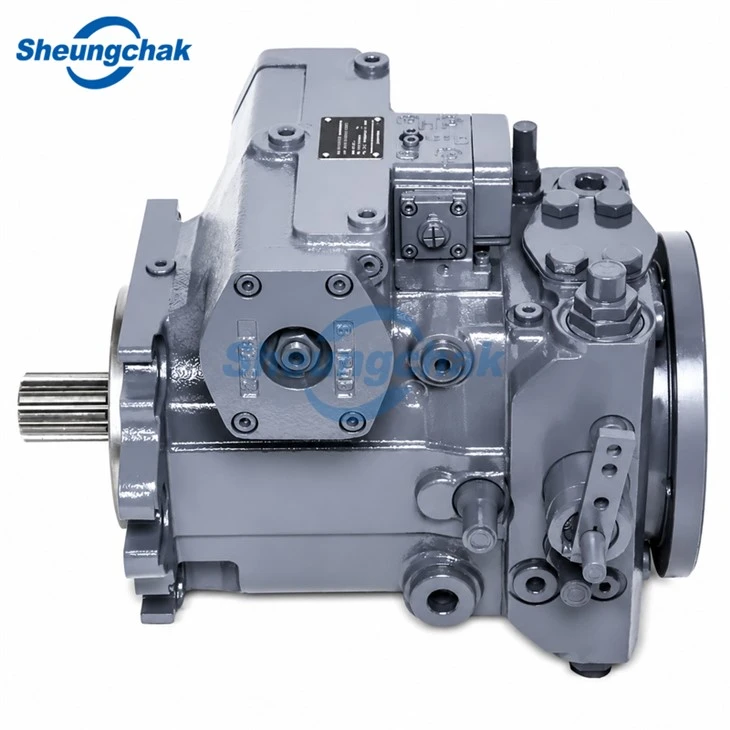
The Sheungchak A4VG71 closed-circuit pump has a main displacement of 71 cm³/rev. The version with an integrated boost pump uses a separate charge stage. The listed 400 bar nominal and 450 bar time-limited maximum describe the pump class. The machine's approved working conditions and protective settings govern its travel circuit.
A legible nameplate and the pump drawing give Sheungchak the basis for a configuration comparison. The A4VG model code guide explains how different fields identify the pump build.
| Check | What to compare | Why it matters |
|---|---|---|
| Series and full code | Record the complete type code, material number and machine pump part number where available. | The size identifies displacement. The rest of the code identifies the build to compare. |
| Travel control | Match the control suffix and command interface. For electrical versions, compare voltage, connector and control characteristics. | The controller or pilot circuit must produce the intended direction and response. |
| Motor-side connections | Compare both working-port positions, sizes and hose clearances with the installation drawing. | The original A/B routing must remain consistent with the machine's travel logic. |
| Charge and drain | Identify integrated or external charge supply, filtration routing and the housing drain connection. | The charge circuit and case drain have different functions and connection requirements. |
| Drive and mounting | Compare input rotation, shaft and coupling, locating pilot, bolt pattern and envelope. | A matching displacement can still leave a pump that cannot be mounted or driven correctly. |
| Through drive and settings | Where fitted, compare the rear pad, coupling and auxiliary torque requirement. Confirm pressure settings for the offered build. | The rear pump and protective functions have to remain compatible with the machine. |
When the review confirms a pump fault and the interfaces match, Sheungchak can quote a size-71 replacement against the agreed configuration. A change to the control, charge supply or through drive requires an application review before a substitute is accepted.
How to Confirm the Replacement on the Machine
Before installation, compare the quoted configuration with the removed unit and approved drawings. Resolve any difference in the control, charge routing, shaft or rear drive with the machine service team before final approval.
Qualified service personnel use the machine's procedures for filling, commissioning and acceptance. Verify neutral behavior, travel direction, low-speed response and loaded operation with oil at the specified temperature. Record charge pressure and other acceptance readings against the applicable machine limits before return to service. Bosch Rexroth's A4VG Series 32 instruction manual covers installation and commissioning for the original series.

Request an A4VG71 Replacement Review
Send Sheungchak a clear photo of the original nameplate or the full type code, along with the roller's model and serial number. Photos or drawings of the shaft end, flange, regulator, A/B ports and rear drive help confirm the interfaces. Include the required quantity, delivery country and any receiving-document requirements.
For repeat or OEM pump orders, send the approved drawing and control requirements. Sheungchak can review the configuration and discuss nameplate and packing options for the order.