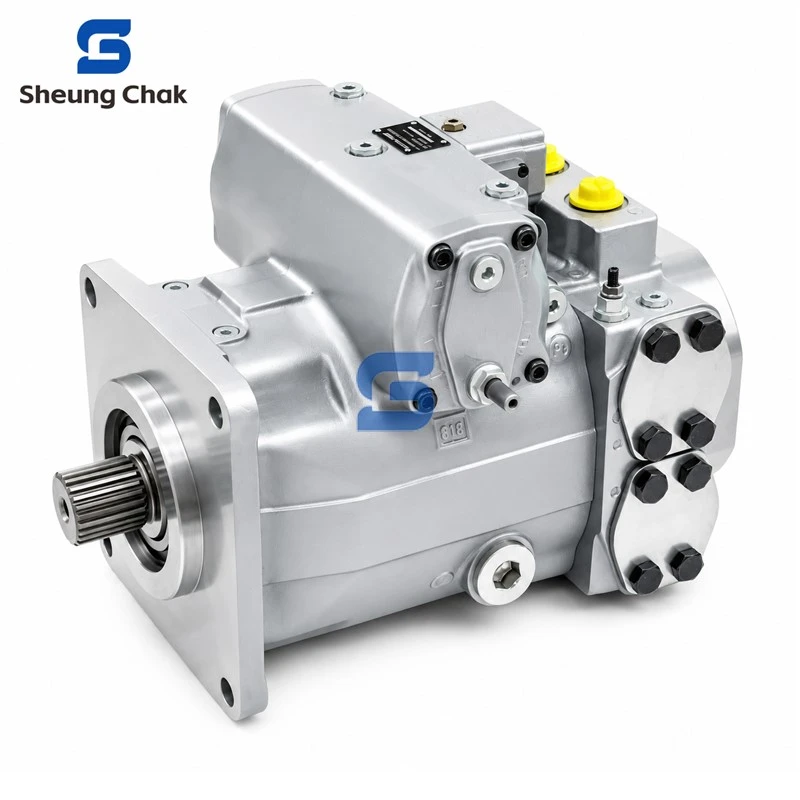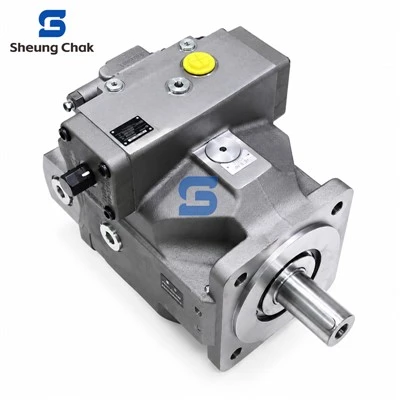

When the rotor of a vane pump rotates, the tips of the vanes, under the action of centrifugal force and pressurized oil, press tightly against the inner surface of the stator. The working volume formed by the two vanes, the rotor, and the inner surface of the stator first increases in volume to draw in oil, then decreases in volume to discharge oil. One rotation of the vanes completes one cycle of oil intake and discharge.
Working Principle of a Single-Acting Vane Pump
The inner surface of the stator is a cylindrical bore. There is an eccentricity between the rotor and the stator. The vanes can slide flexibly within the rotor slots. Under the centrifugal force of the rotating rotor and the pressurized oil flowing through the vane roots, the vane tips press tightly against the inner surface of the stator. Thus, sealed working cavities are formed between two adjacent vanes, the distribution plate, the stator, and the rotor.
Working Principle of a Double-Acting Vane Pump
Its working principle is similar to that of a single-acting vane pump, the only difference being that the stator surface consists of eight parts: two long-radius circular arcs, two short-radius circular arcs, and four transition curves. Furthermore, the stator and rotor are concentric. With the rotor rotating clockwise as shown in the diagram, the volume of the sealed working chamber gradually increases at the upper left and lower right corners (the suction zone) and gradually decreases at the lower left and upper right corners (the pressure zone). A sealing zone separates the suction and pressure zones. Each sealed working chamber completes two suction and two pressure actions per rotor revolution, hence the name double-acting vane pump. The two suction zones and two pressure zones are radially symmetrical, and the hydraulic pressure acting on the rotor is radially balanced, therefore it is also called a balanced vane pump.