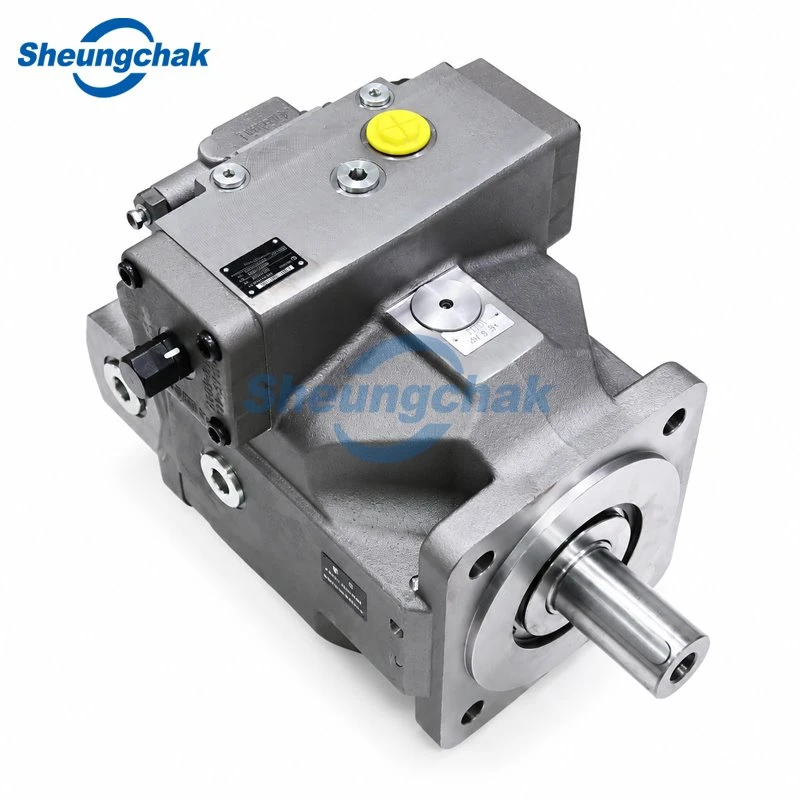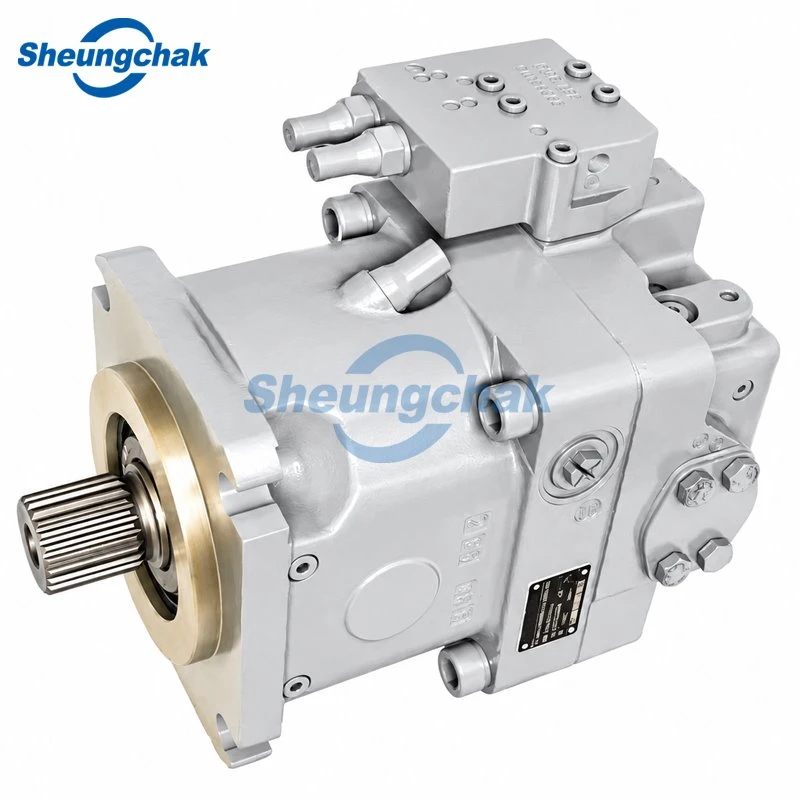

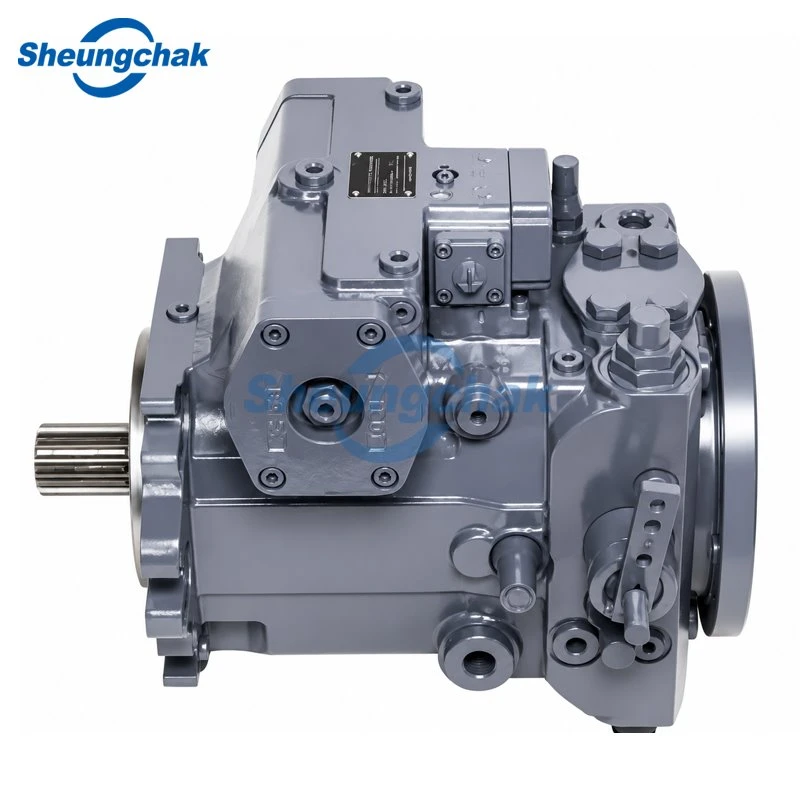
Guangdong Sheungchak Hydraulic Technology Co., Ltd. is one of the leading manufacturers and suppliers of a4vg56 in China. With abundant experience, we warmly welcome you to buy high-grade a4vg56 for sale here from our factory. All customized products are with high quality and competitive price. Contact us for quotation.
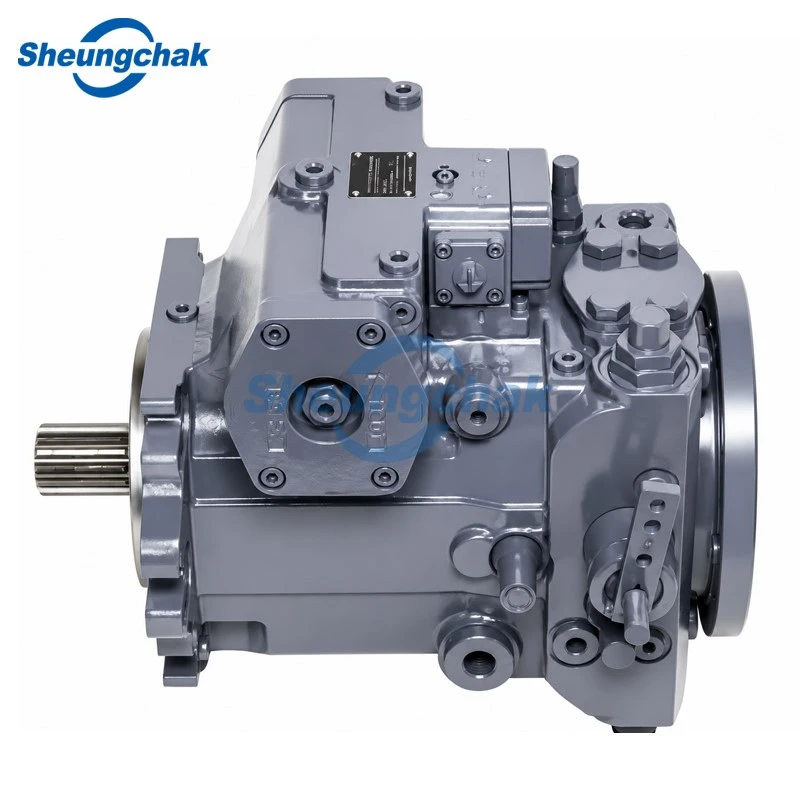
A4VG56 is not a general hydraulic power-pack pump. It belongs in a closed hydrostatic drive. Port A and port B swap high- and low-pressure roles as the swashplate passes through neutral, so the drive can change direction without routing the main flow back through a conventional open-circuit directional valve.
The 56 frame is interesting because it sits between the 40 and 71 sizes without carrying the extra mass of the larger pump. Maximum geometric displacement is 56 cc/rev. The internal boost section adds another 11.6 cc/rev. At the Series 32 rated point-3,600 rpm and full displacement-the theoretical main-pump flow is about 202 L/min. Bare pump weight is around 38 kg.
What normally decides the order is not the "56" cast into the product family. It is the rest of the build. HD and HW pumps do not behave like EP or DA versions. Port plate direction matters. So does shaft spline. A pump can have the correct displacement and still be completely wrong for the machine. That is why our replacement check starts with the complete code, then the controller side, rear housing and drive shaft.
Key Features & Benefits
56 cc/rev main displacement
At 3,600 rpm, the theoretical full-stroke delivery is about 202 L/min.
11.6 cc/rev internal boost section
Charge and pilot oil come from a pump driven on the same shaft instead of a separate external unit.
400 / 450 bar pressure envelope
400 bar is the nominal system-pressure level; 450 bar is a limited maximum condition rather than a continuous target.
Flow reversal through neutral
Moving the swashplate across center reverses the main-loop flow direction inside the pump.
3,900 rpm limited speed window
Full-displacement nominal speed is 3,600 rpm; the limited maximum rises to 3,900 rpm under the stated operating conditions.
357 Nm theoretical shaft torque at 400 bar Δp
That number gives a much clearer picture of drive loading than calling the pump "high torque."
Pressure cut-off and loop protection built around the unit
The Series 32 platform uses high-pressure relief, boost-pressure regulation and pressure cut-off functions around the main rotary group.
NV, HD, HW, DG, DA, EP, EZ and ET control routes
Hydraulic, mechanical-servo and electrical control builds can be matched to different propel-drive strategies.
[Talk to Our Engineers About Your Application →]
Technical Specifications
A4VG56 Series 32 - Core Operating Data
|
Item |
A4VG56 Series 32 |
|
Circuit type |
Closed hydrostatic circuit |
|
Pump design |
Variable axial piston, swashplate |
|
Main displacement |
56 cc/rev |
|
Integrated boost-pump displacement |
11.6 cc/rev |
|
Nominal system pressure |
400 bar |
|
Maximum system pressure |
450 bar |
|
Single maximum-pressure event |
Up to 10 s |
|
Total accumulated maximum-pressure time |
300 h |
|
Nominal speed at Vg max |
3,600 rpm |
|
Limited max. speed |
3,900 rpm |
|
Intermittent speed limit |
4,500 rpm |
|
Minimum speed |
500 rpm |
|
Theoretical flow at 3,600 rpm |
202 L/min |
|
Theoretical power at 400 bar |
134 kW |
|
Theoretical torque at 400 bar Δp |
357 Nm |
|
Torque at 100 bar Δp |
89 Nm |
|
Rotary-group inertia |
0.0066 kg·m² |
|
Maximum angular acceleration |
24,000 rad/s² |
|
Housing oil volume |
1.5 L |
|
Approx. weight, no through drive |
38 kg |
The speed, flow, torque, power, inertia and weight values above are the Series 32 size-56 reference envelope. Actual delivered flow and shaft input differ once volumetric and mechanical losses are included.
Pressure, Charge and Inlet Limits
|
Circuit Point |
Working Limit |
|
Nominal high-loop pressure |
400 bar |
|
Maximum high-loop pressure |
450 bar |
|
Maximum pressure-change rate |
9,000 bar/s |
|
Minimum high-pressure side |
25 bar |
|
Minimum low-loop pressure |
10 bar above case pressure |
|
Boost pressure, nominal |
25 bar |
|
Boost pressure, maximum |
40 bar |
|
Charge-pump suction, continuous |
≥ 0.8 bar absolute |
|
Charge-pump suction, cold start |
≥ 0.5 bar absolute, <3 min |
|
Maximum pressure at S port |
5 bar absolute |
|
Minimum control pressure, EP/HD/HW |
20 bar above case pressure |
|
Minimum control pressure, DA/DG/EZ/ET |
25 bar above case pressure |
These numbers matter during installation. A pump can have plenty of main-loop pressure capacity and still fail early because the charge inlet is restricted or the low side is allowed to collapse.
Fluid, Temperature and Filtration
|
Item |
Operating Window |
|
Preferred oil type |
HLP mineral hydraulic oil |
|
Optimum viscosity |
16–36 mm²/s |
|
Continuous viscosity range |
10–400 mm²/s |
|
Cold-start viscosity limit |
Up to 1,600 mm²/s |
|
Short-term minimum viscosity |
7 mm²/s |
|
Typical component temperature ceiling |
115°C |
|
Normal cleanliness target |
ISO 4406 20/18/15 or cleaner |
|
Hot / low-viscosity cleanliness target |
ISO 4406 19/17/14 or cleaner |
|
Suggested filtration reference |
β20 ≥ 100 |
|
FKM shaft-seal temperature |
−25°C to +115°C |
|
NBR low-temperature option |
−40°C to +90°C |
ISO 4406:2021 defines the coding method used to express particle contamination in hydraulic fluid; the Series 32 operating envelope calls for 20/18/15 in ordinary service and tighter 19/17/14 cleanliness when viscosity falls below 10 mm²/s or oil temperature becomes very high.
Ports, Shaft and Installation Interface
|
Position |
A4VG56 Detail |
|
Working ports A / B |
SAE J518, 3/4 in |
|
A/B port fastening |
M10 × 1.5, 17 mm deep |
|
Working-port pump limit |
450 bar |
|
Charge suction S |
M33 × 2, 18 mm deep |
|
Case drains T1 / T2 |
M22 × 1.5 |
|
Air bleed R |
M12 × 1.5 |
|
Control X1 / X2 |
M12 × 1.5 |
|
Boost-pressure port G |
M14 × 1.5 on common layout |
|
Mounting flange |
SAE J744, 127-2 (C) |
|
Common DIN spline |
W35 × 2 × 16 × 9g |
|
ANSI spline option |
1-1/4 in, 14T, 12/24 DP |
|
Additional spline option |
1-3/8 in, 21T, 16/32 DP |
|
Flange pilot diameter |
Ø127 mm, tolerance 0 / −0.063 mm |
The 3/4-inch A/B working-port geometry uses SAE J518. For hose and flange selection, do not casually treat the pump's 450-bar short peak as a 450-bar continuous hose-assembly rating: current SAE J518/2 Code 62 defines a 42 MPa class, and the finished assembly must be rated by its weakest component.
The mounting-flange and shaft-end interface also sits within the established hydraulic-pump dimensional system covered by ISO 3019-1, with involute spline interfaces referencing SAE J744 practice.
A4VG56 vs Neighboring Series 32 Sizes
|
Item |
A4VG40 |
A4VG56 |
A4VG71 |
|
Main displacement |
40 cc/rev |
56 cc/rev |
71 cc/rev |
|
Boost pump |
8.6 cc/rev |
11.6 cc/rev |
19.6 cc/rev |
|
Nominal speed |
4,000 rpm |
3,600 rpm |
3,300 rpm |
|
Full-stroke flow |
160 L/min |
202 L/min |
234 L/min |
|
Power at 400 bar |
107 kW |
134 kW |
156 kW |
|
Torque at 400 bar |
255 Nm |
357 Nm |
452 Nm |
|
Case volume |
1.1 L |
1.5 L |
1.3 L |
|
Approx. weight |
31 kg |
38 kg |
50 kg
|
Moving from size 40 to 56 adds 42 L/min theoretical flow at each frame's nominal speed and roughly 102 Nm of theoretical torque at 400 bar. Moving from 56 to 71 gains another 32 L/min and 95 Nm, but pump mass rises by about 12 kg.
A4VG56 vs Same-Class Closed-Loop Market Reference
|
Comparison Point |
A4VG56 Series 32 |
Same-Class 53.8 cc Market Reference |
|
Geometric displacement |
56 cc/rev |
53.8 cc/rev |
|
Rated speed |
3,600 rpm |
3,400 rpm |
|
Maximum speed |
3,900 rpm limited |
3,500 rpm |
|
Nominal / max working pressure |
400 bar nominal |
380 bar max working |
|
Short maximum pressure |
450 bar |
400 bar |
|
Approx. pump weight |
38 kg |
41 kg |
|
Minimum loop pressure |
10 bar above case |
10 bar |
|
Circuit |
Closed loop |
Closed loop |
The comparison shows why displacement alone is a poor purchasing shortcut. The two pumps sit in roughly the same capacity class, yet their pressure, speed, weight and interface limits differ materially. The 53.8 cc reference pump is rated at 3,400 rpm, 380 bar maximum working pressure and about 41 kg.
[Request Quote for Your Displacement & Control Type →]
How It Works
1) Shaft speed sets the basic output
The A4VG56 moves 56 cm³ per revolution at full stroke. At 3,600 rpm, that is about 202 L/min in theory. The 11.6 cc charge pump is driven from the same shaft and keeps oil available on the low-pressure side.
2) The swashplate changes both flow and direction
Bring the swashplate back toward neutral and flow drops. Move it through zero and the direction changes, so A and B swap their high- and low-pressure roles.
No separate reversing valve is needed in the main closed loop.
3) The charge pump keeps the loop supplied
Some oil is always lost through leakage, flushing and cooling. The charge circuit replaces it and also supplies the control system.
Charge pressure is normally around 25 bar, with a maximum of about 40 bar. If the charge side is starved, slow or unstable swashplate movement can show up before the main pump itself has a serious problem.
Model Range
Series 32 Size Position
|
Model |
Displacement |
Nominal Speed |
Theoretical Flow |
Weight |
Typical Selection Step |
|
A4VG28 |
28 cc/rev |
4,250 rpm |
119 L/min |
29 kg |
Small hydrostatic drives |
|
A4VG40 |
40 cc/rev |
4,000 rpm |
160 L/min |
31 kg |
Compact propel systems |
|
A4VG56 |
56 cc/rev |
3,600 rpm |
202 L/min |
38 kg |
Mid-size travel and drive circuits |
|
A4VG71 |
71 cc/rev |
3,300 rpm |
234 L/min |
50 kg |
Higher torque / flow demand |
|
A4VG90 |
90 cc/rev |
3,050 rpm |
275 L/min |
60 kg |
Heavy mobile drive |
|
A4VG125 |
125 cc/rev |
2,850 rpm |
356 L/min |
80 kg |
Large hydrostatic transmission |
All six frames use the same 400-bar nominal / 450-bar maximum Series 32 pressure class, but their speed, boost-pump displacement, shaft loading and housing mass are different.
Control Variants
|
Control |
How It Is Used |
|
NV |
No external control module |
|
HD |
Pilot-pressure proportional displacement |
|
HW |
Mechanical-servo hydraulic control |
|
DG |
Direct hydraulic displacement command |
|
DA |
Engine-speed-related automatic control |
|
EP |
Proportional electric command |
|
EZ |
Electric two-position command |
|
ET |
Direct electric control |
For EP and EZ builds, 12 V and 24 V versions exist depending on the complete configuration.
Applications & Industries
|
Industry |
Equipment Examples |
What the Pump Does |
|
Construction Machinery |
Compact loaders, trenchers, crawler machines |
Sends reversible flow directly to the travel motor |
|
Road Machinery |
Rollers, pavers, compact road equipment |
Runs propel or vibration circuits without an open-return main loop |
|
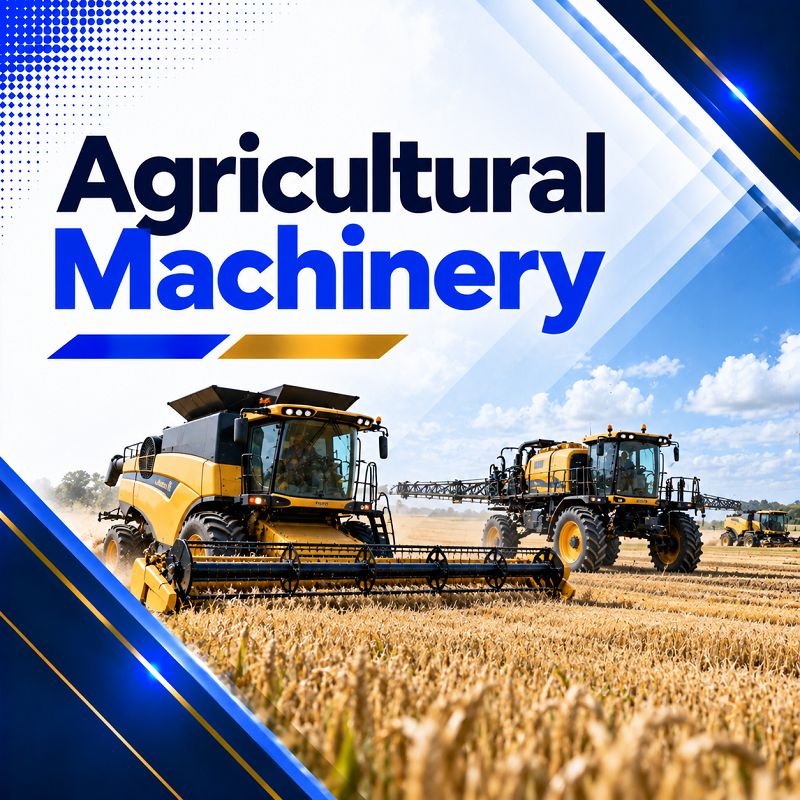
Agricultural Machinery |
Harvesters, self-propelled field machines |
Changes travel speed and direction through pump displacement |
|
Material Handling |
Telehandlers, compact carriers, mobile handlers |
Feeds traction drives where low-speed torque and reversing both matter |
|
Forestry Equipment |
Forwarders, harvesters, tracked forestry carriers |
Keeps the travel loop supplied as terrain load changes |
|
Special Vehicles |
Sweepers, utility carriers, off-highway platforms |
Packages propel control, charge oil and loop protection around one pump |
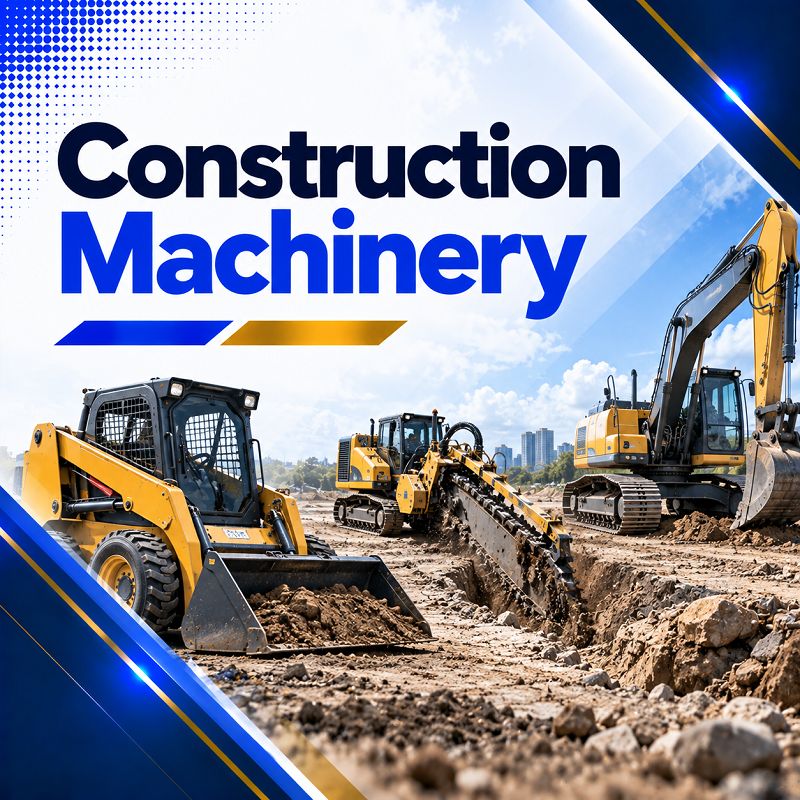
Construction Machinery

Road Machinery
Agricultural Machinery

Material Handling

Forestry Equipment

Special Vehicles
About Us
SheungChak manufactures hydraulic piston pumps and motors under our own OEM supply program. A4VG56 units leave our production line as SheungChak products.
The part we spend time on is usually not the painted housing. It is the code check before assembly. A 56 cc pump can use a different shaft. Different control. Different port plate. Even the same EP control can arrive in another voltage or connector arrangement.
For replacement work, send the whole pump-not literally, of course. Send enough photos that we can see it: shaft end, both working ports, controller side, rear housing and nameplate. That normally saves more time than a long email.
Factory experience: 20+ years
Main production: piston pumps, piston motors and related hydraulic parts
Export markets: Europe / South America / Middle East / Southeast Asia / Africa
MOQ: 1 Pc
Sample policy: 1 Pc
Production lead time: 1-2 days
OEM support: code matching, drawing checks, sample build, batch production

Certifications
Certificate name
Certificate name
Certificate name
Certificate name
Certificate name
Our Factory & Quipment


cooperative partner
We are looking for a cooperative partner to expand our business.







FAQ Display Content
1) Is A4VG56 an open-circuit pump?
No. It is a closed-loop hydrostatic pump. Ports A and B connect into the drive loop, and either side can become the high-pressure side when pump displacement passes through neutral.
2) Does A4VG56 always produce 202 L/min?
No. The 202 L/min figure is theoretical flow at 56 cc/rev and 3,600 rpm. Lower shaft speed or smaller swashplate angle reduces delivery. Real measured flow is also slightly lower because the pump has volumetric losses.
3) Why does the pump have an 11.6 cc boost section?
A closed loop loses some oil through leakage and flushing. The boost pump replaces it and provides charge / pilot supply. For the size-56 unit, boost-pump displacement is 11.6 cc/rev.
4) Can I run it continuously at 450 bar?
No. The normal design-pressure level is 400 bar. The 450-bar figure is a maximum condition with individual events limited to 10 seconds and a total accumulated period of 300 hours in the defined envelope.
5) Can another pump be mounted behind A4VG56?
Yes, selected through-drive versions allow another pump to be mounted behind the main unit, including combinations up to the same nominal size. The coupling and total drive-shaft loading still need checking before we approve the combination.
6) What oil cleanliness should I keep?
ISO 4406 20/18/15 or cleaner is the normal target. At high temperature or when viscosity drops below 10 mm²/s, the tighter target becomes 19/17/14. This matters more than many buyers expect; the controller and rotary group both see the contamination.
7) How is A4VG56 different from an open-circuit variable piston pump?
The main difference is the circuit. An open-circuit pump draws from the tank and normally returns oil to the reservoir after the actuator. A4VG56 sends its main flow directly around a closed pump-to-motor loop. Reversing the swashplate reverses the loop direction.
8) What do you need before quoting a replacement pump?
Send the complete code first. Then photos of the shaft, A/B ports, control block and rear housing. We also need rotation, control voltage where applicable, machine type and quantity. If the old label is missing, a mounting drawing helps far more than guessing from the paint and housing shape.
[Have a Question Not Listed Here? Contact Our Engineers →]
Hot Tags: a4vg56, China a4vg56 manufacturers, suppliers, factory, A17FO, A4VG125, AP2D36, hydraulic piston pump, hydraulic pump, K3V112