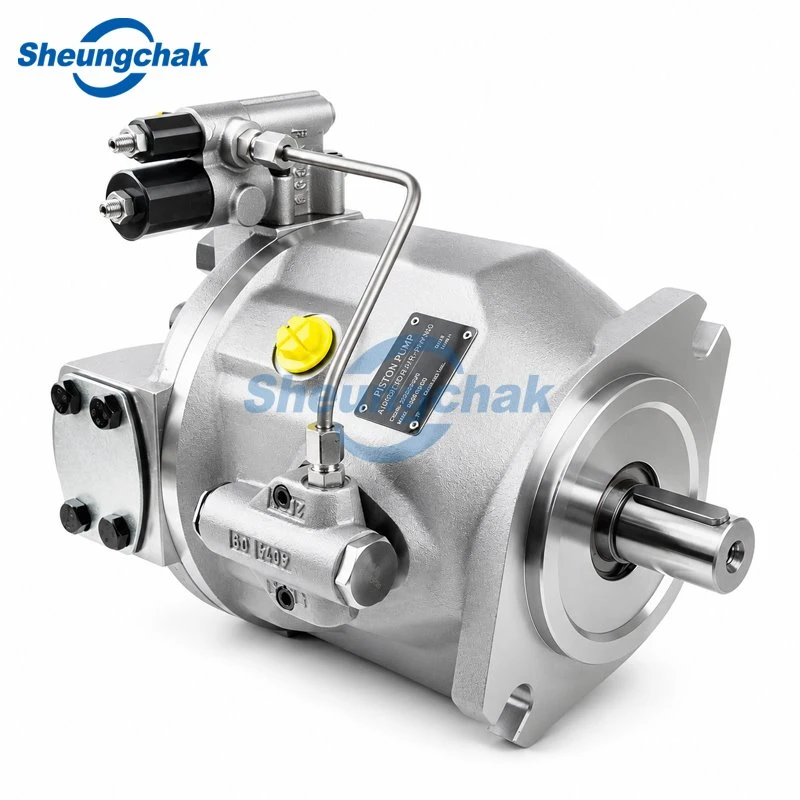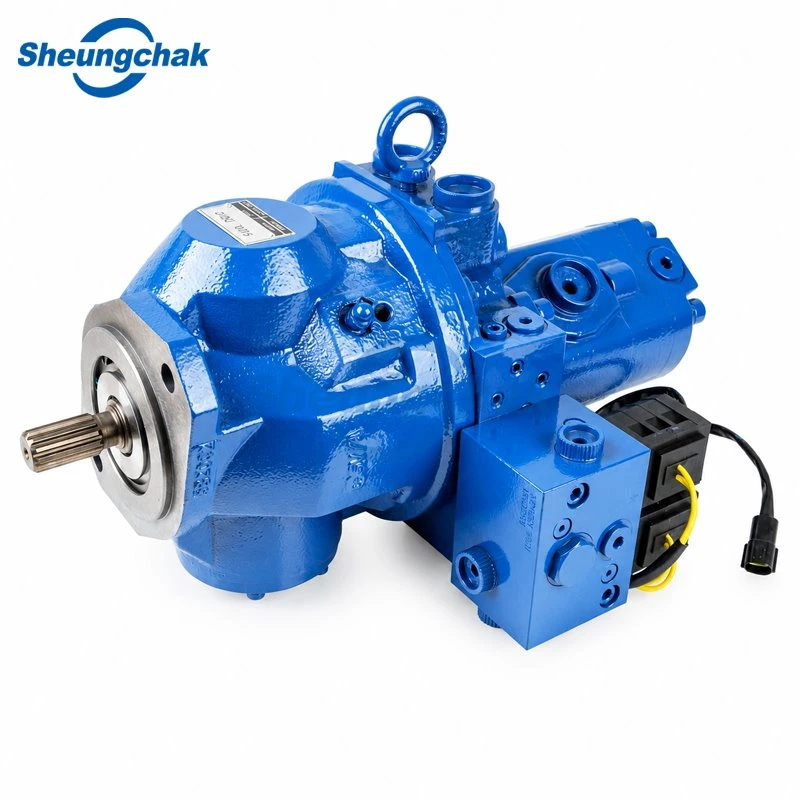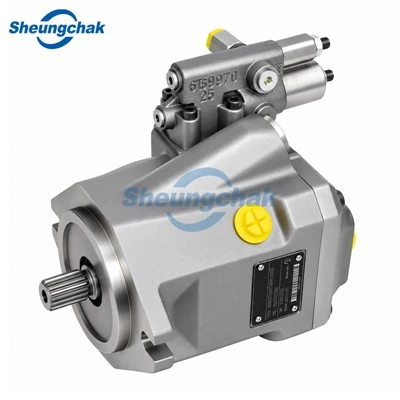

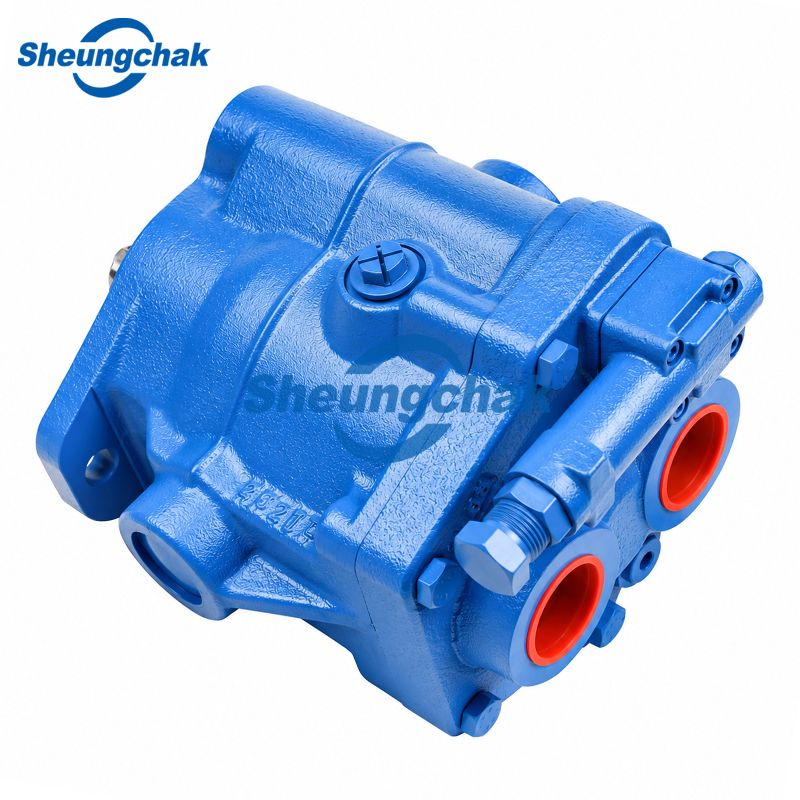
Guangdong Sheungchak Hydraulic Technology Co., Ltd. is one of the leading manufacturers and suppliers of pvb29 in China. With abundant experience, we warmly welcome you to buy high-grade pvb29 for sale here from our factory. All customized products are with high quality and competitive price. Contact us for quotation.
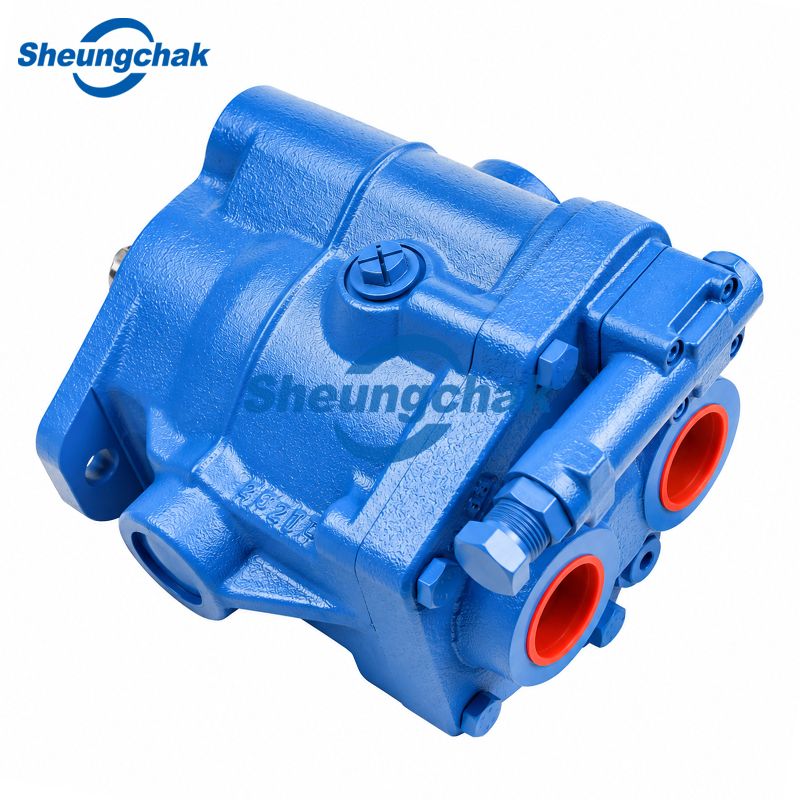
PVB29 sits in the open-circuit, variable-piston category. At full stroke, one shaft revolution moves 61.6 cm³ of oil. At 1,800 rpm that works out to roughly 109.7 L/min. The swashplate does not stay at one angle, though. Once system pressure reaches the control setting, the pump can destroke instead of continuing to push full flow across a relief valve.
There is another number worth watching: 140 bar. That is the PVB29 outlet-pressure limit normally used with anti-wear hydraulic oil. Water-glycol and water-in-oil versions are generally kept to 100 bar. Do not confuse a compensator's adjustment range with the safe pressure rating of the size-29 rotary group. Some C-control listings show a wider adjustment mechanism, but replacement specifications for PVB29 explicitly limit operation to 2,000 psi.
Where does it normally end up? Industrial power packs, presses, injection-molding equipment, conveyors, machine tools and auxiliary plant hydraulics. Not because those industries need a certain name on the nameplate. They need roughly 29 GPM at common electric-motor speed, variable output, and a package that still fits an SAE C mounting interface.
Features
61.6 cc/rev rather than a vague "high-flow" claim - full-stroke delivery is about 109.7 L/min at 1,800 rpm.
140 bar mineral-oil pressure ceiling - enough for medium-pressure industrial circuits without pretending this is a 300-bar pump.
C and CM pressure-compensator ranges - C versions are normally set within the PVB29 2,000 psi limit; CM versions cover roughly 250–1,500 psi.
Maximum-volume-stop versions exist - useful when the machine should never use all 61.6 cc/rev.
Remote pressure adjustment can be built in - the pump pressure can be piloted from another point in the hydraulic circuit.
SAE C 2-bolt mounting - common replacement builds use a 5 in / 127 mm pilot class and roughly 7.13 in bolt spacing.
1-1/4 in keyed input shaft - the usual straight-shaft replacement has a 5/16 in key.
#20 main ports and #8 case drain on common builds - less guesswork when an older power unit is being replaced.
[Talk to Our Engineers About Your Application →]
Technical Specifications
PVB29 Operating Data
|
Item |
PVB29 Working Reference |
|
Pump type |
Variable axial piston pump |
|
Hydraulic circuit |
Open circuit |
|
Geometric displacement |
61.6 cc/rev / 3.76 in³/rev |
|
Rated shaft speed |
1,800 rpm |
|
Theoretical / rated flow |
Approx. 109.7 L/min / 29 GPM |
|
Max. pressure, anti-wear oil |
140 bar / 2,000 psi |
|
Max. pressure, water glycol |
100 bar / 1,500 psi |
|
Max. pressure, water-in-oil emulsion |
100 bar / 1,500 psi |
|
Reference input power |
29.4 kW / 39.5 hp at rated pressure and speed |
|
Standard rotation choices |
CW or CCW, viewed from shaft end |
|
Standard mounting |
SAE C, 2-bolt |
|
Common shaft |
1-1/4 in straight keyed |
|
Shaft key |
5/16 in |
|
Common shaft extension |
Approx. 2.32 in on replacement configuration |
|
Main inlet / outlet |
#20 SAE O-ring ports on common rear-port builds |
|
Case drain |
#8 SAE O-ring |
|
Approx. mass |
About 26–28 kg depending on control/port build |
|
Mineral-oil temperature |
Up to about 80°C |
|
Water-containing fluid temperature |
Up to about 54°C |
|
Ambient reference |
About −20°C to +70°C |
|
Recommended viscosity window |
Approx. 13–220 cSt |
|
Legacy cleanliness callout |
ISO 18/14 |
|
Common seal material |
Buna-N |
|
Housing reference |
Cast iron |
|
End-cover reference |
Ductile iron |
Control Options - The Part Buyers Often Miss
|
Build |
Control Function |
Useful Range / Detail |
|
C |
Pressure compensator |
Common PVB29 replacement setting up to 140 bar / 2,000 psi |
|
CM |
Lower-range pressure compensator |
Approx. 17–100 bar / 250–1,500 psi |
|
CC / CMC |
Compensator + max displacement stop |
Limits maximum pump stroke mechanically |
|
CG |
Pressure compensator with remote pilot |
Pressure setting can be controlled remotely |
|
Load-sensing build |
Pressure + flow demand response |
Confirm complete code before replacement |
|
Mechanical lever |
Manual displacement command |
Application-specific |
|
Handwheel |
Manual displacement setting |
Used where automatic compensation is not required |
The CMC code combines the lower-range compensator with a maximum-displacement adjustment, while CG identifies a remote-pressure arrangement.
Mounting & Interface Detail
|
Interface Point |
PVB29 Common Build |
Engineering Check |
|
Front flange |
SAE C, 2-bolt |
Approx. 127 mm pilot class |
|
Mounting bolt circle |
Approx. 181 mm / 7.13 in |
Measure old mounting before machining adaptor |
|
Input shaft |
1.250 in keyed |
5/16 in key |
|
Main ports |
#20 SAE O-ring |
Rear or side-port build can differ |
|
Case drain |
#8 SAE O-ring |
Must return with low restriction |
|
Port sealing style |
O-ring boss |
Check thread and spotface condition |
|
Rotation |
R or L |
Viewed from shaft end |
The SAE C 127-2 interface commonly uses a 127 mm pilot and 181 mm bolt circle.
PVB29 vs Neighboring Pump Sizes
|
Item |
PVB20 |
PVB29 |
PVB45 |
|
Displacement |
42.8 cc/rev |
61.6 cc/rev |
94.5 cc/rev |
|
Flow at 1,800 rpm |
75.7 L/min |
109.7 L/min |
170.3 L/min |
|
Flow class |
20 GPM |
29 GPM |
45 GPM |
|
Max. mineral-oil pressure |
210 bar |
140 bar |
210 bar |
|
Rated speed |
1,800 rpm |
1,800 rpm |
1,800 rpm |
PVB29 vs Modern 57 cc High-Pressure Market Reference
This table is for duty-point comparison, not direct interchange.
|
Comparison |
PVB29 |
Modern 57 cc Reference |
|
Displacement |
61.6 cc/rev |
57.4 cc/rev |
|
Rated / max speed |
1,800 rpm |
2,400 rpm |
|
Flow at rated point |
109.7 L/min |
About 134 L/min |
|
Pressure class |
140 bar |
250 bar |
|
Approx. weight |
26 kg |
36 kg |
|
Pressure port |
#20 ORB common build |
1 in SAE flange |
|
Suction port |
#20 ORB common build |
2 in SAE flange |
|
Best reason to choose |
Existing PVB29 replacement interface |
Higher-pressure new-system design |
The comparison shows the real trade-off. PVB29 is lighter and carries slightly more displacement, but a newer 57 cc design can run considerably faster and at much higher pressure.
[Request Quote for Your Displacement & Control Type →]
How It Works
1) The shaft gets everything moving
The shaft and cylinder block turn together. Because the swashplate sits at an angle, the pistons keep sliding in and out as the block rotates.
At full stroke, the pump moves 61.6 cc per revolution. At 1,800 rpm, that works out to about 109.7 L/min in theory.
2) Oil follows the piston movement
When a piston pulls back, oil enters from the suction side. As the block turns farther, that piston comes in again and pushes the oil toward the pressure port.
The flow then goes to the valve block, cylinder or motor.
3) Pressure can pull the pump back
The pump does not need to stay fully stroked.
Once pressure reaches the compensator setting, the swashplate starts to move back. Piston travel gets shorter and flow falls with it.
If pressure drops, the pump can open up again and deliver more oil.
Model Range
PVB Variable Pump Range
|
Model |
Displacement |
Flow at 1,800 rpm |
Max. Mineral-Oil Pressure |
|
PVB5 |
10.55 cc/rev |
18.9 L/min |
210 bar |
|
PVB6 |
13.81 cc/rev |
22.7 L/min |
140 bar |
|
PVB10 |
21.1 cc/rev |
37.5 L/min |
210 bar |
|
PVB15 |
33.0 cc/rev |
59.4 L/min |
140 bar |
|
PVB20 |
42.8 cc/rev |
75.7 L/min |
210 bar |
|
PVB29 |
61.6 cc/rev |
109.7 L/min |
140 bar |
|
PVB45 |
94.5 cc/rev |
170.3 L/min |
210 bar |
|
PVB90 |
197.5 cc/rev |
348 L/min |
210 bar |
Common PVB29 Build Codes
|
Build Direction |
Example |
What Changes |
|
Right-hand, pressure compensator |
PVB29-RS-20-C-11 |
CW rotation, standard pressure control |
|
Left-hand, pressure compensator |
PVB29-LS-20-C-11 |
CCW rotation |
|
Lower pressure range |
PVB29-RS-20-CM-11 |
250–1,500 psi control range |
|
Max. volume stop |
PVB29-RS-20-CMC-11 |
Maximum stroke can be mechanically limited |
|
Remote pressure |
PVB29-RS-20-CG-20 |
External pressure pilot |
|
Special suffix |
PVB29-…-Sxxx |
Drawing/code check required |
Applications & Industries
|
Industry |
Equipment Examples |
What the Pump Does |
|
Hydraulic Power Units |
Factory HPUs, auxiliary stations |
Supplies up to roughly 29 GPM, then destrokes near the pressure setting |
|
Metal Forming |
Small presses, shears, forming machines |
Gives full approach flow and reduces delivery as pressure builds |
|
Plastics Machinery |
Injection and clamping equipment |
Feeds changing hydraulic demand during different machine stages |
|
Machine Tools |
Cutting, clamping, fixture systems |
Holds pressure without continuously sending maximum pump volume |
|
Material Handling |
Conveyor lines, transfer systems |
Powers cylinders and hydraulic drives in repeated production cycles |
|
Mining & Process Equipment |
Auxiliary skids, plant machinery |
Provides medium-pressure open-circuit oil supply from an SAE C pump package |
These are established application areas for the PVB family, including hydraulic power supplies, machine tools, presses, injection molding, conveyor systems, mining and metalworking equipment.
About Us
SheungChak manufactures hydraulic piston pumps, motors and replacement components under our own OEM program. A PVB29 order from us is built and supplied as a SheungChak product.
We spend quite a bit of time on old replacement pumps because the nameplate is not always the full story. One pump may have rear ports. Another has side ports. C and CM controls look similar from a distance. Rotation can be wrong even when every mounting bolt lines up.
So the usual check is simple: model code first, then photos. Shaft end, controller, ports and rear cover. For old machines with no readable tag, dimensions are better than guessing.
Factory experience: 20+ years
Main production: piston pumps, piston motors and hydraulic replacement parts
Main export markets: Europe / South America / Middle East / Southeast Asia / Africa
MOQ: 1 PC
Sample order: 1 PC
Production lead time: 1-2 days
OEM work: code matching, reverse measurement, drawing check and batch production.

Certifications
Certificate name
Certificate name
Certificate name
Certificate name
Certificate name
Our Factory & Quipment


cooperative partner
We are looking for a cooperative partner to expand our business.










FAQ Display Content
1) Why is PVB29 61.6 cc/rev if the model says 29?
Because the 29 refers to the pump's approximate GPM class at rated speed, not displacement in cubic centimeters. Maximum geometric displacement is 61.6 cc/rev.
2) Is PVB29 a fixed or variable pump?
Variable. The swashplate angle changes, so piston stroke and output flow change while the shaft keeps turning.
3) Can PVB29 run at 210 bar?
For the normal size-29 mineral-oil rating, no. Use 140 bar / 2,000 psi as the pump outlet limit. A control mechanism may have a wider adjustment capability, but that does not raise the safe pressure of the rotary group.
4) What is the difference between C and CM controls?
C is the standard pressure-compensator direction. CM limits the adjustment range to roughly 17–100 bar / 250–1,500 psi. CMC adds a maximum-volume stop.
5) Can PVB29 use water-glycol fluid?
Yes, but the pressure and temperature limits change. A practical reference is 100 bar maximum with water glycol, and fluid temperature should generally stay below about 54°C.
6) What filtration does the pump need?
Older specifications often call for ISO 18/14 cleanliness and roughly 6-micron filtration. Current ISO 4406:2021 uses the modern coding method for solid contamination, so for a new system we recommend defining an actual three-number cleanliness target with the filter beta ratio rather than copying an old two-number code blindly.
7) How is PVB29 different from a modern high-pressure piston pump?
PVB29 trades pressure and speed for an older SAE C replacement interface. A modern 55–60 cc pump may run at 240–315 bar and higher rpm, but that does not make it a direct replacement. Shaft, flange, ports and controller often require redesign.
8) What do you need for a quotation?
Send the full code if it is readable. Also send the shaft-end photo, mounting flange, inlet/outlet side, controller and rotation. For an old power unit, add motor rpm, normal working pressure and required flow. Those three numbers usually tell us quickly whether the original PVB29 duty point still makes sense.
[Have a Question Not Listed Here? Contact Our Engineers →]
Hot Tags: pvb29, China pvb29 manufacturers, suppliers, factory, A10VSO140, A4VG, A4VG71, A4VG90, hydraulic piston pump, K3V112