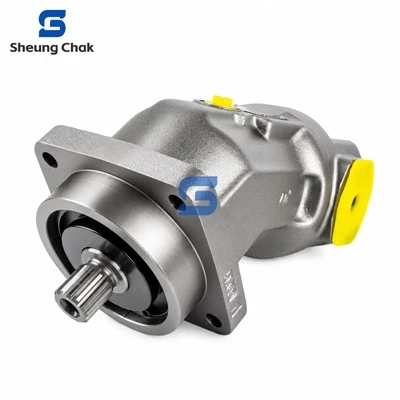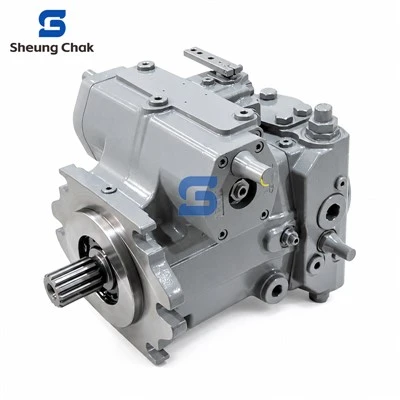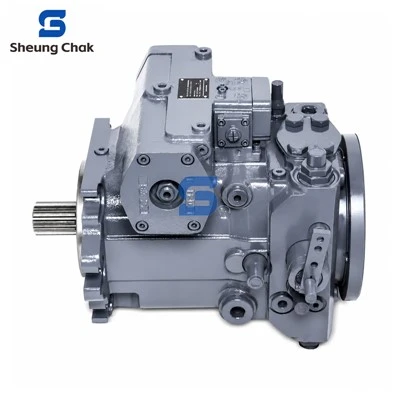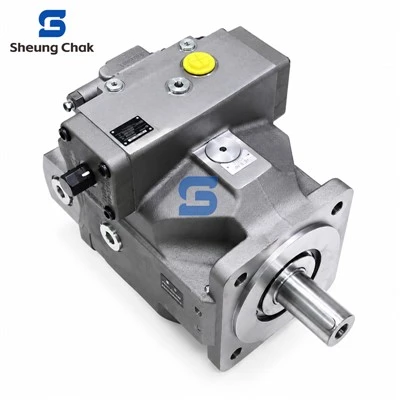

Both are swashplate axial piston variable pumps for open circuits, both trace back to the same Rexroth design lineage, and both are widely second-sourced. That makes the choice look like a coin toss at 71 cc/rev, where the two families overlap almost exactly. It is not. Four things settle it: the pressure your circuit actually holds, where the required flow sits against each family's speed ceiling, the flange and shaft already bolted to the machine, and whether you need a control mode only one family offers.
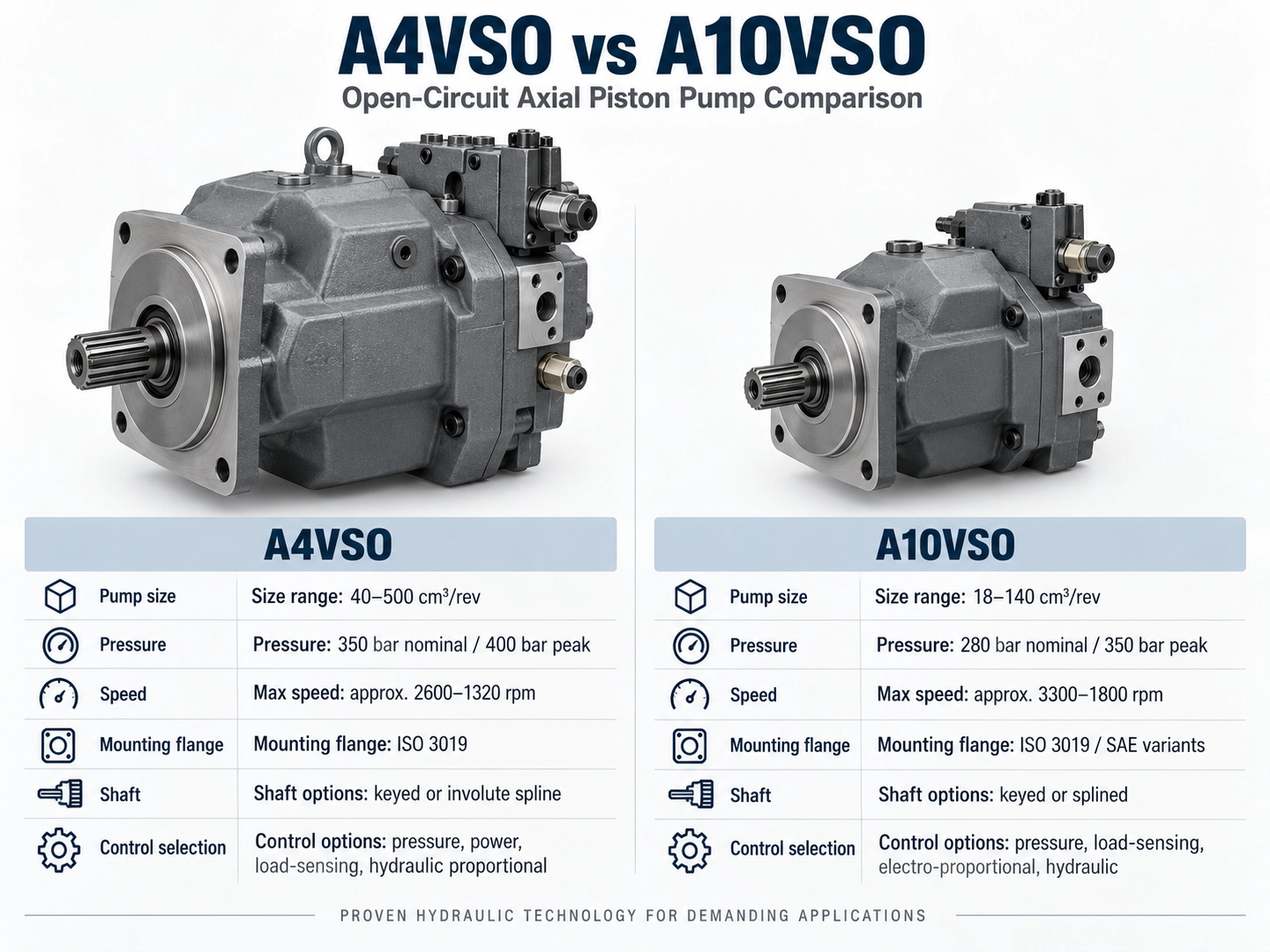
Pressure rating is a duty-cycle question, not a relief-valve setting
The A10VSO Series 31 is rated 280 bar nominal with 350 bar maximum (Bosch Rexroth data sheet RE-A 92711). The A4VSO is rated 350 bar nominal with 400 bar peak (Bosch Rexroth data sheet RA 92050-A).
The trap is reading "maximum" as the number to size against. Nominal pressure is the continuous rating; maximum or peak is intermittent. A press that dwells at 300 bar for four seconds of every cycle is not seeing a peak - it is running continuously above the A10VSO's nominal rating, even though 300 bar sits comfortably under its 350 bar maximum. The useful question is what pressure the pump holds for the largest share of the cycle time, and how much of the cycle is spent there.
A workable split:
| 1 | Continuous working pressure at or below roughly 250 bar, with the relief set no higher than 280 bar: the A10VSO range covers it with headroom. |
| 2 | Continuous working pressure above 280 bar, or frequent excursions toward 350 bar: the A4VSO's 350 bar nominal is the rating you need, and its 400 bar peak treats a die closing onto a cold billet as normal operation rather than an overload event. |
One caution on the comparisons circulating elsewhere. Several supplier pages quote volumetric efficiency percentages and MTBF hour ranges for each series as if they were published values. Neither Rexroth data sheet above contains them, and no test basis is given for where they came from. Do not carry those numbers into a sizing calculation or a specification document.
Where the displacement ranges overlap, speed breaks the tie
The A10VSO Series 31 is listed in sizes 18, 28, 45, 71, 88, 100 and 140 cc/rev. The A4VSO is listed in 40, 71, 125, 180, 250, 355, 500, 750 and 1,000 cc/rev. Outside 40–140 cc/rev the decision makes itself: below 40 cc/rev only the A10VSO exists, and from 180 cc/rev upward only the A4VSO does.
Inside the overlap, drive speed usually decides. The A10VSO's nominal speeds run from 3,300 rpm at size 18 down to 1,800 rpm at size 140, with size 45 at 2,600 rpm and size 71 at 2,200 rpm. The A4VSO's permitted speeds run from 2,600 rpm at size 40 down to 1,000 rpm at size 1,000, and Sheung Chak rates its own A4VSO 71 build at 1,800 rpm.
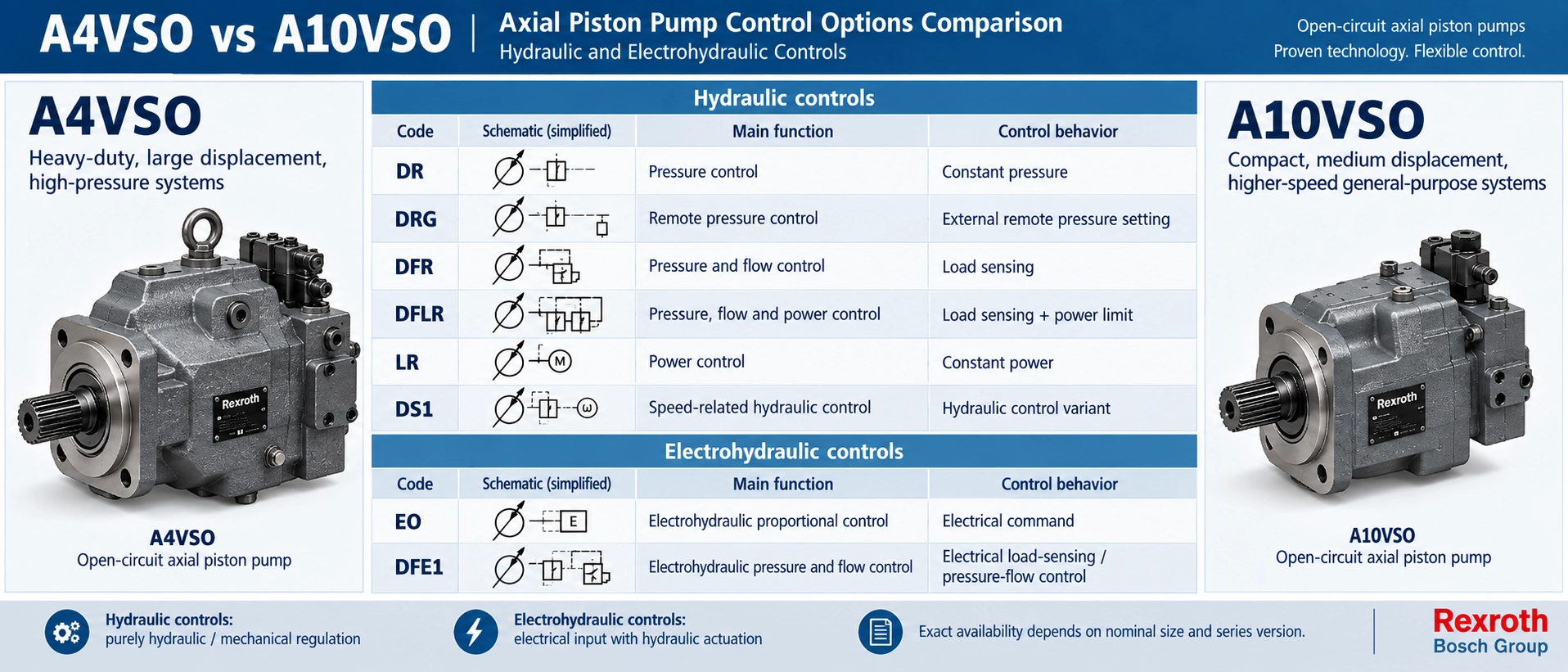
That difference has a cost consequence. Flow is displacement times speed, so a higher speed ceiling lets a smaller pump do the same job:
90 L/min at 1,500 rpm (four-pole motor, 50 Hz) needs roughly 60 cc/rev, which rounds up to a size 71 in either family.
The same 90 L/min at 2,200 rpm needs roughly 41 cc/rev, which an A10VSO 45 covers.
On Sheung Chak's own build data an A10VSO 45 weighs about 21 kg against 33 kg for an A10VSO 71, so the faster drive removes roughly a third of the pump mass and a frame size from the power pack. If the machine is driven by a two-pole motor, an engine PTO or a gearbox output in the 2,200–3,000 rpm band, and the flow requirement is modest, the A10VSO turns that speed into a smaller installation. If the drive is a four-pole motor at 1,500 or 1,800 rpm, the speed advantage disappears and the choice falls back to pressure and interface.
Full size-by-size figures are on the A10VSO Series 31 displacement and control listing and the A4VSO displacement, pressure and weight tables.
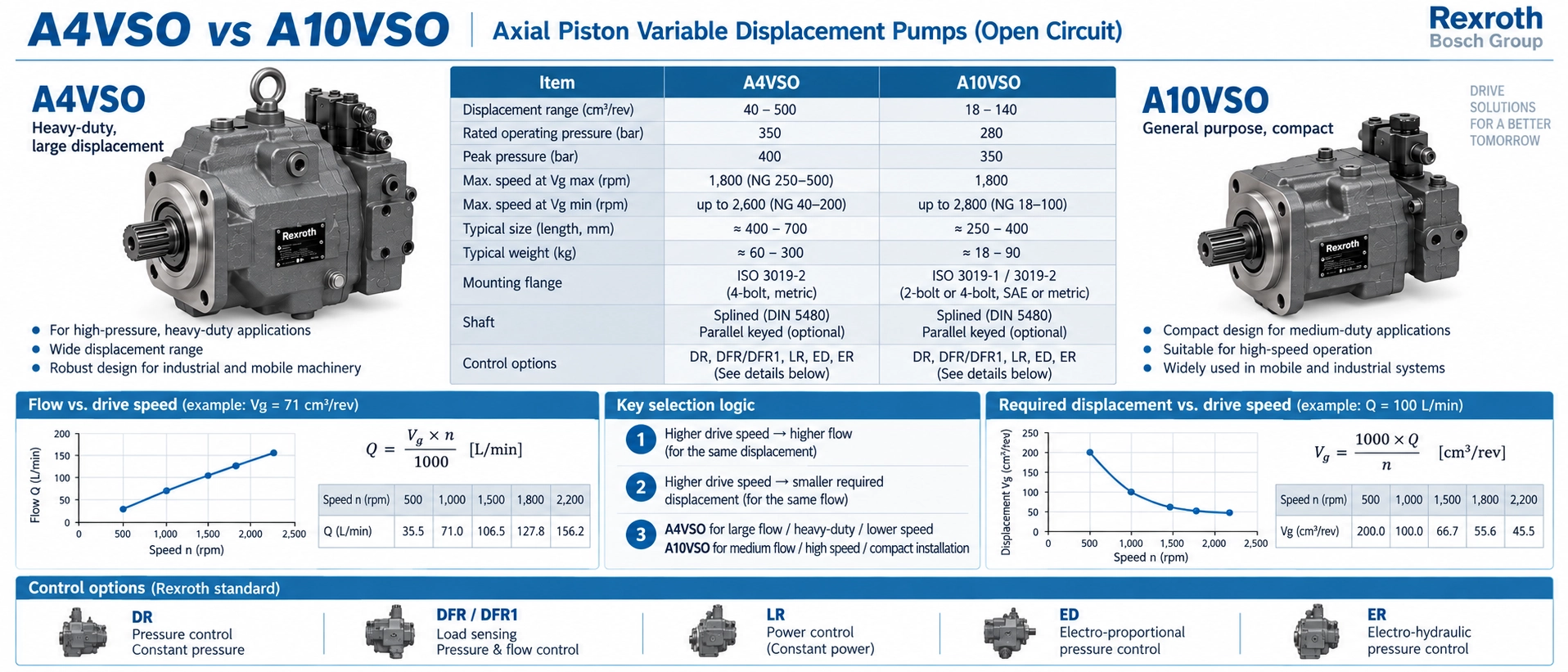
The mounting flange decides whether this is a swap or a rebuild
This is the point most comparisons leave out, and it is the one that turns a two-hour pump change into a machining job.
The A10VSO Series 31 data sheet specifies an ISO 3019-1 mounting flange, with splined shafts to SAE J744 or a parallel keyed shaft to ISO 3019-1. The A4VSO data sheet lists both SAE J744 four-bolt flanges and metric ISO 3019-2 eight-bolt flanges, and Sheung Chak supplies its A4VSO on a metric ISO 3019-2 flange with SAE C, D or E shafts by displacement class.
The practical consequence is that substitution is not symmetric. An A4VSO can be ordered to sit on either an inch-pattern or a metric bellhousing, so moving up from an A10VSO to an A4VSO on an existing machine is usually a matter of specifying the right flange and shaft at order stage. Moving the other way - putting an A10VSO where a metric-flanged A4VSO used to be - means an adapter plate, a new coupling and a realignment, and the saving on the pump is often smaller than the cost of the bracket.
Before either decision is final, three details need to be on the order: flange pattern, shaft end and spline or key form, and rotation. Rotation in particular is set per unit and cannot be changed in the field. If you are replacing a failed unit, the nameplate code carries most of this; how to read an A4VSO model code walks through which characters hold the shaft and rotation information.
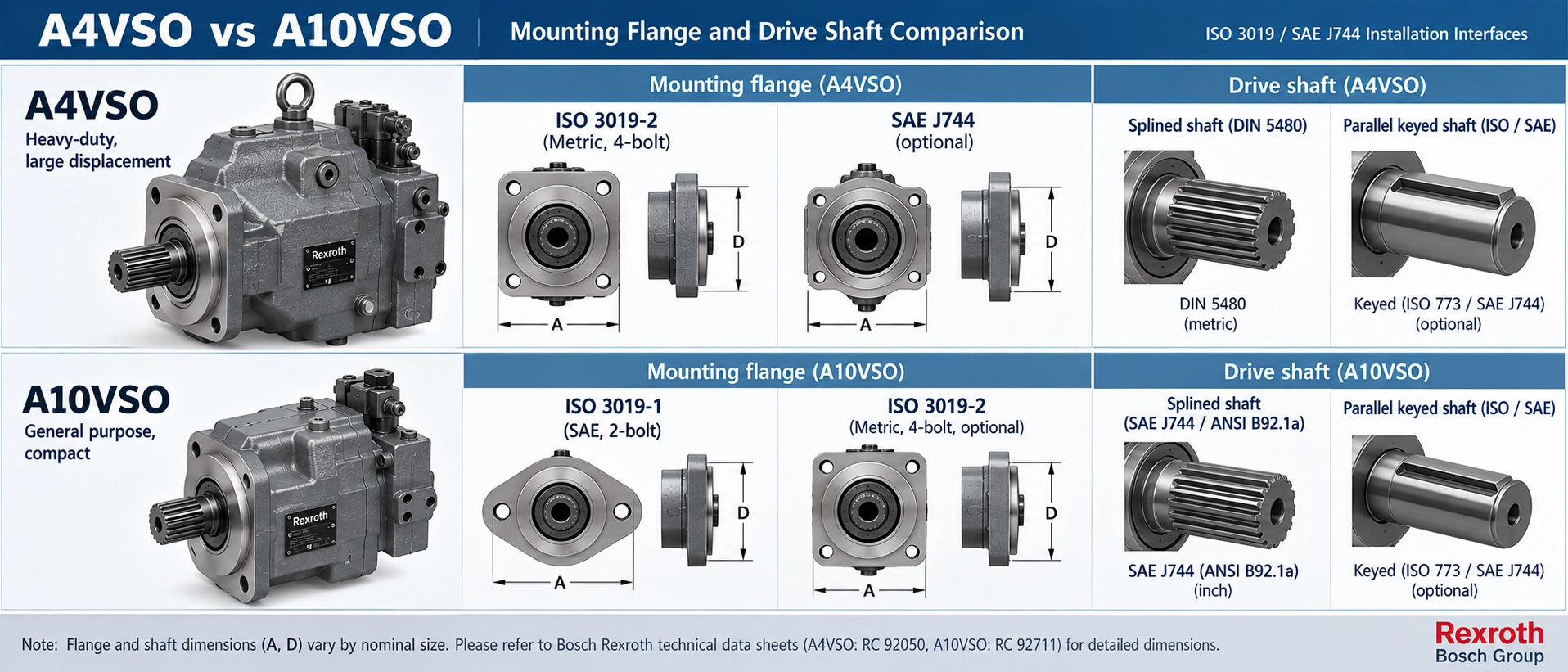
Control options: the overlap is narrower than it looks
Both families offer the common open-circuit controls - pressure compensator (DR), remote-controlled pressure (DRG), and combined pressure and flow (DFR). Beyond that they diverge, and the divergence is what should decide a borderline case.
The A10VSO Series 31 data sheet adds a two-point control (DG), a combined pressure, flow and power controller (DFLR), and electrohydraulic pressure controls in negative and positive characteristic (ED71/ED72, ER71/ER72). DFLR matters if you need pressure, flow and input power limiting in a single compact controller under 140 cc/rev.
The A4VSO data sheet adds power control with a hyperbolic characteristic (LR), manual control (MA), separate pressure and flow controls (DP, FR), hydraulic controls (HD, HM, HS), electronic control (EO), secondary speed control (DS1) and electrohydraulic control with integrated electronics (DFE1). Secondary control and closed-loop electronic pump control are the ones with no A10VSO equivalent; test rigs, wind turbine pitch circuits and any application where the pump itself is the controlled element land on the A4VSO for that reason alone, regardless of pressure.
Multi-pump stacks and through-drive
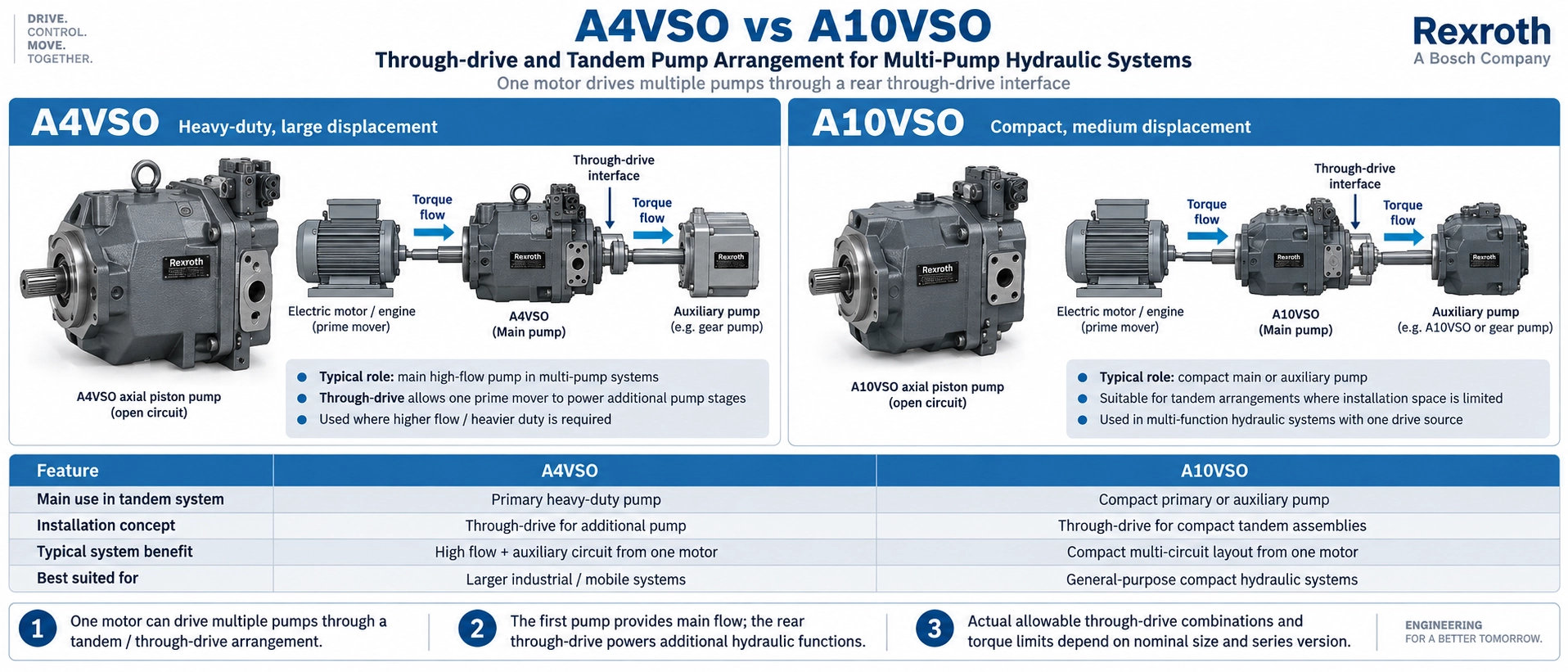
If the machine needs a second pump driven from the same motor, check the through-drive before the displacement. The A4VSO data sheet lists through-drive options under K and U designations with defined torque limits per size, which is what allows a cascaded arrangement without a second drive. For A10VSO tandem arrangements the through-drive code has to be confirmed against the specific size and control combination rather than assumed from the family.
Get this settled early. Adding a through-drive to an already-quoted pump usually changes the rear cover, the overall length, and sometimes the bearing selection.
Fluid and filtration are not a differentiator
Both data sheets specify a minimum inlet pressure of 0.8 bar absolute and a minimum fluid cleanliness of 20/18/15 to ISO 4406. The A4VSO sheet gives a continuous operating viscosity range of 16–100 mm²/s with an optimum of 16–36 mm²/s. Sheung Chak's A4VSO build specifies filtration of 25 µm absolute (β₂₅ ≥ 75), which most plants already meet with their existing element.
So if you were hoping that one family would let you relax the filtration spec, neither will. Whichever you choose, the filter selection and the suction line design stay the same, and a marginal inlet condition will shorten the life of either pump.
A short selection check before you commit
| 1 | What pressure does the circuit hold for the majority of the cycle, not what is the relief set to? |
| 2 | What flow is required, and at what drive speed will the pump actually turn? |
| 3 | What flange pattern, shaft end and rotation are already on the machine? |
| 4 | Which control behaviour does the circuit need - constant pressure, load sensing, power limiting, or closed-loop electronic? |
| 5 | Does a second pump need to run off the same shaft? |
Answers to one through three usually narrow it to a single family and one or two displacement classes. Answer four occasionally overrides the rest. Answer five changes the physical length of the unit, so it belongs in the first conversation rather than the last.
If you have those five answers, Sheung Chak's engineers will size the unit against them and tell you which family the duty cycle actually lands on - including the cases where the smaller, cheaper option is the correct one. The full variable axial piston pump range, with displacement, pressure and control tables is there if you would rather work through it first. Send the duty cycle, or a photo of the nameplate on the pump you are replacing, and you will get a quoted build and a lead time back rather than a catalogue link.