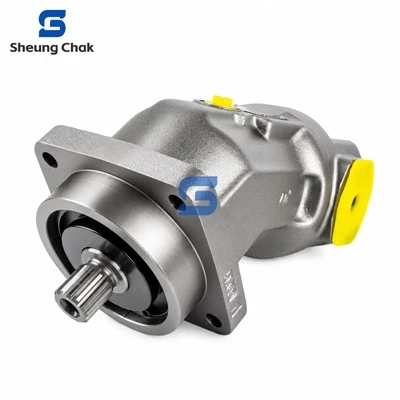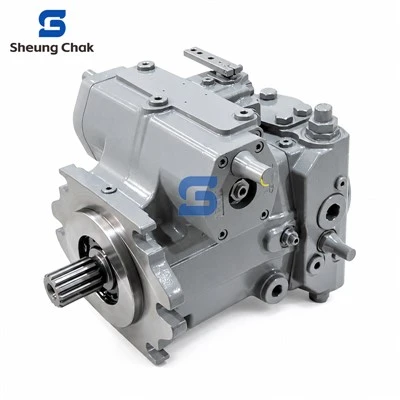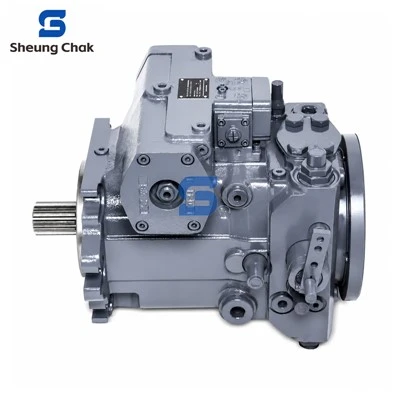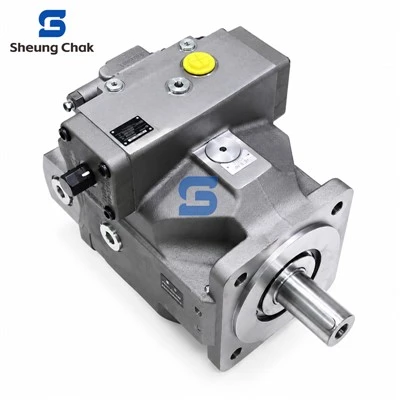

When a pump fails or a spare is due, the choice between an original and an aftermarket hydraulic pump is rarely about which one is "better" in general. It comes down to four things you can check:
- whether the replacement matches your unit's configuration;
- what evidence the supplier gives that your pump performs;
- what the warranty contract says;
- whether the seller is legitimate.
A fifth factor decides whether any new pump survives: the condition of the system it goes into.
This guide sets out what to compare and what to ask each supplier to prove. It does not rank brands.
Disclosure: Sheungchak supplies new non-OEM replacement pumps and is not affiliated with Bosch Rexroth or other original manufacturers. Model names in this article are the trademarks of their owners and are used only to identify compatibility.
What "original" and "aftermarket" actually mean
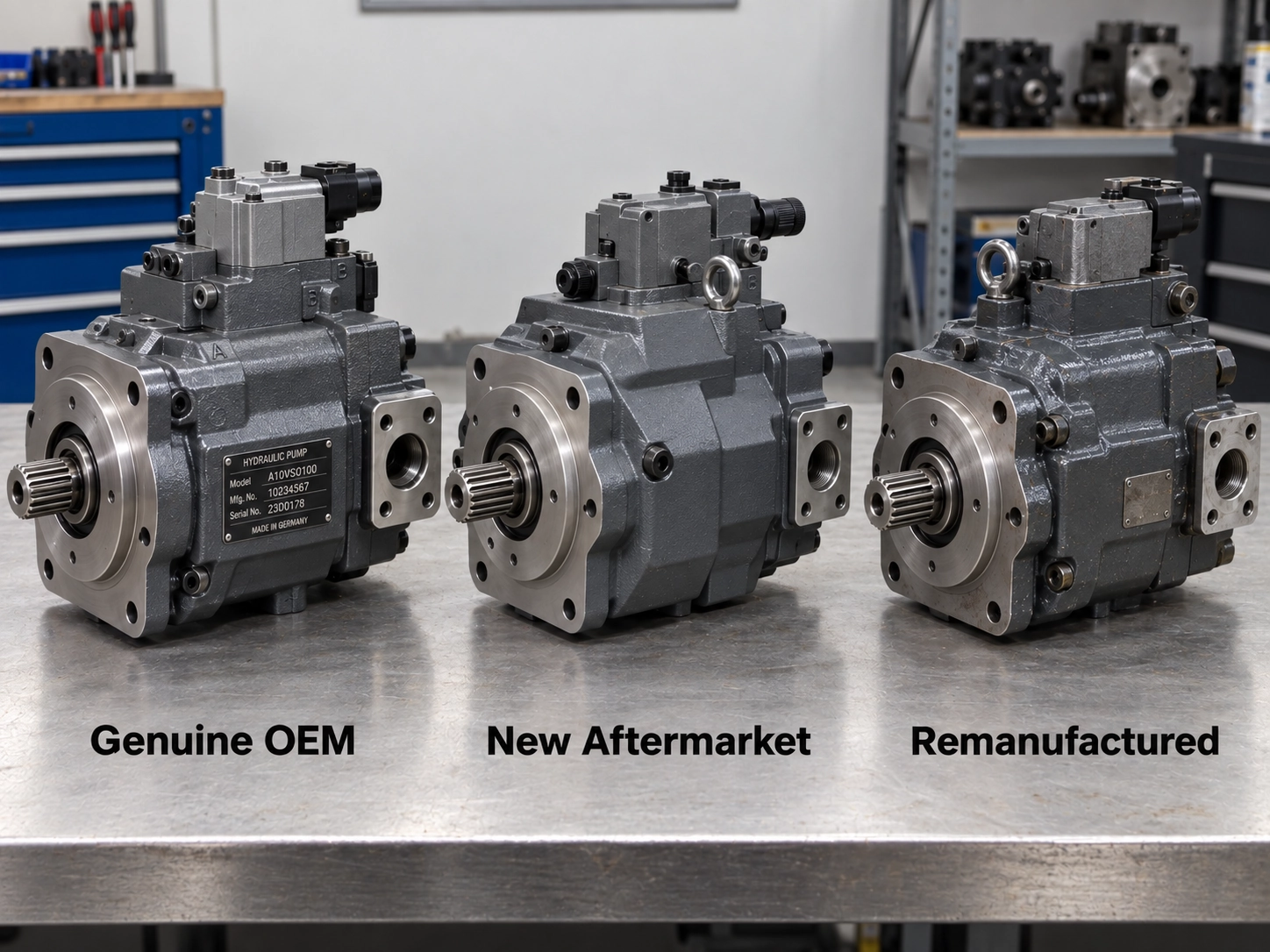
The two labels cover at least four different products. Buyers often compare quotes that describe different things.
| Category | What it is | How it's branded | What to ask for |
|---|---|---|---|
| Genuine OEM | Built by or for the original pump manufacturer | Manufacturer's brand, packaging and documents | Purchase through the manufacturer or an authorized distributor |
| New aftermarket (interchangeable / will-fit) | New pump made by another company to fit the same installation | The maker's own brand, with the OEM model given only as a compatibility reference | Configuration check, unit test data, written warranty |
| Remanufactured / rebuilt | A used core restored to service | Varies by shop | A written scope of work: what was replaced, machined and tested |
| Counterfeit | A copy that imitates the original brand and documents | Fake OEM markings | Nothing. Avoid. |
The most important line runs between legitimate aftermarket products and counterfeits. Bosch Rexroth warns that counterfeit products are made with inferior materials and advises caution when a price looks too good to be true (Bosch Rexroth). Mission Hydraulics draws the same distinction. A counterfeit copies another company's branding and paperwork without the engineering behind it. A legitimate aftermarket supplier sells compatible parts under its own name (Mission Hydraulics).
"Remanufactured" and "rebuilt" have no single industry definition. A 2009 Power & Motion article treats them as different levels of work (Power & Motion). A 2016 Fluid Power World piece uses them largely interchangeably (Fluid Power World). Ask for the scope of work in writing rather than relying on the label. A useful scope of work lists:
- which wear parts were replaced;
- which surfaces were machined or lapped;
- whether the unit was tested after assembly.
Start with the nameplate: what has to match
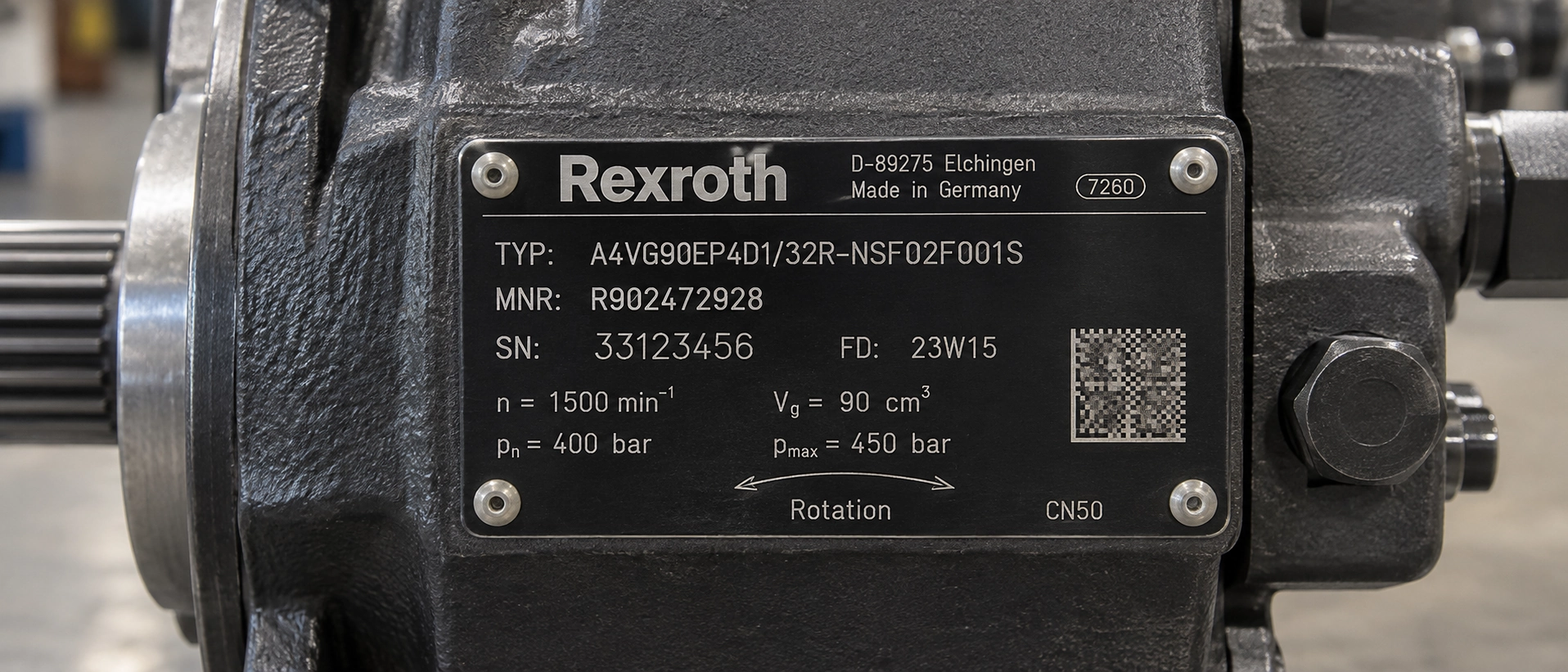
An aftermarket pump that looks identical can still be the wrong pump. The type code on the nameplate records the options the pump was ordered with. Some of those options cannot be changed after the pump is built. Others change how the pump behaves on your machine.
Fields that must match as ordered
Direction of rotation. On Rexroth's A11VO series, rotation is specified when the pump is ordered. It is not something to adjust on site. Rotation is normally stated as seen looking at the drive shaft, so confirm that you and the supplier use the same viewpoint.
Drive shaft. The shaft type and its spline or key standard must match the coupling on your drive. Examples include DIN 5480 and SAE J744 / ANSI B92.1 involute splines. Two splines can look alike yet differ in tooth count, pitch or pressure angle.
Mounting flange. SAE J744 flanges and metric ISO 3019-2 flanges are not interchangeable. Within SAE, the flange size (A, B, C and so on) and bolt pattern (2-bolt or 4-bolt) must both match.
Control device and its settings. Control codes (for example pressure, pressure-flow, power or electro-proportional control) determine how the pump responds. A pump with the right displacement but the wrong control will fit and then behave wrongly. Setpoints matter too, such as compensator pressure or power curve. So does the solenoid voltage on electrically controlled units.
Series. Codes are not read the same way across generations. For the A11VO, Series 1x and Series 40 use different coding systems, so similar-looking strings can mean different things.
Our guide on how to read an A11VO model code walks through each field against Rexroth data sheet RE 92500. Use it alongside this section if your pump is from that family.
Fields that need a drawing check
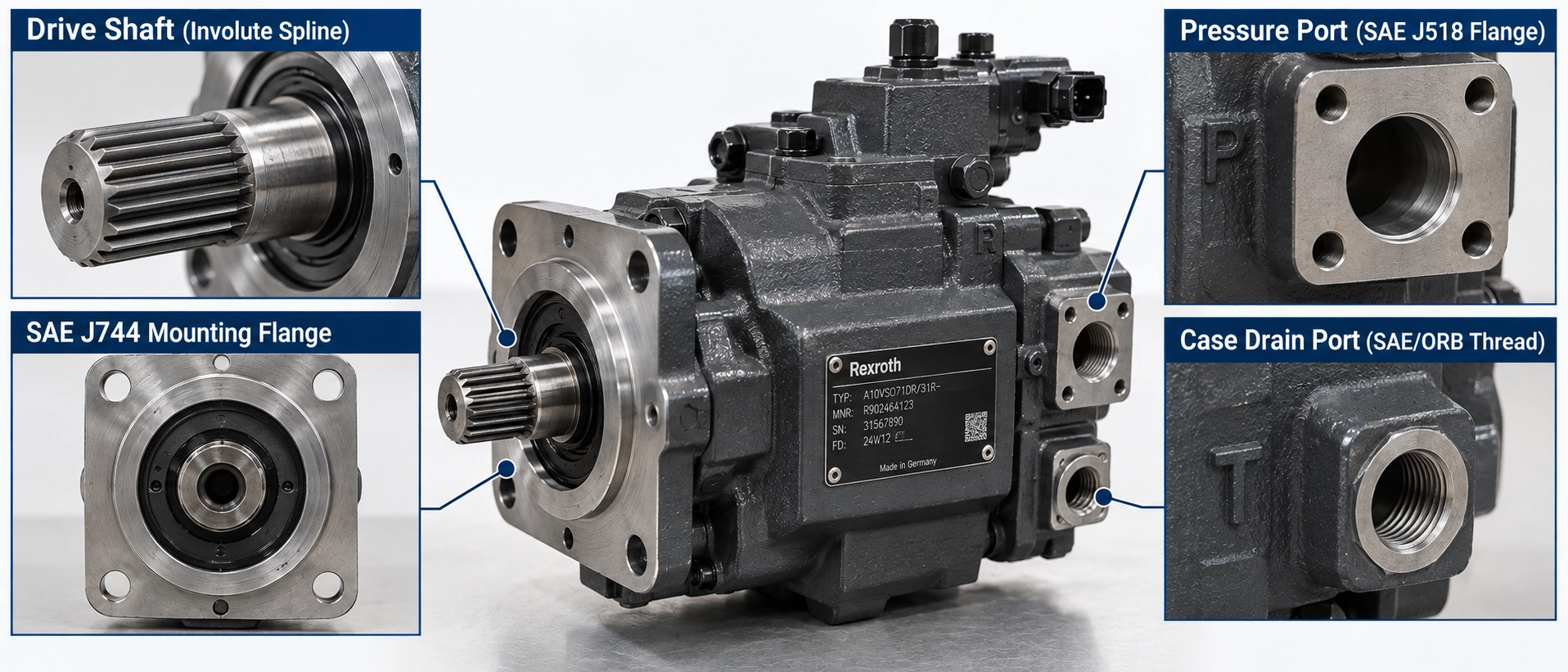
A code read off a worn nameplate does not fully describe every interface. Ask the supplier for a dimensional drawing and check it against the installation:
- port positions, sizes, and thread or flange standard (for example SAE J518 split-flange ports versus threaded ports);
- through-drive and auxiliary pump mounting, if fitted;
- overall length and the space taken by the control;
- case drain port location, so the drain line can still reach the highest point of the housing.
Configuration mismatches in the shaft, rotation or ports are a common and avoidable reason replacement pumps get sent back, as noted on our A4VSO product page. Whoever supplies the pump, a configuration check before ordering is the cheapest risk control you have.
Ask for performance evidence, not adjectives
"OEM quality" and "fully interchangeable" are claims. A test document is evidence, but only if it describes the pump you are buying.
Unit test report vs type-test certificate
A type-test certificate shows that a design passed testing at some point. A unit test report tied to a serial number shows that the pump in the crate was tested before it shipped. Only the unit report tells you about your pump. Ask which one you will receive, and ask for a sample before you order.
What a useful test sheet shows
A test sheet you can rely on includes:
- the serial number, matching the nameplate;
- the test conditions: drive speed, pressure points, fluid type, and oil temperature or viscosity;
- measured results at stated pressures, such as delivered flow, volumetric efficiency or case drain leakage;
- a check of the control setting where a control is fitted (for example the pressure-compensator setpoint);
- the acceptance criteria the results were judged against;
- the test method referenced, the date, and who signed it off.
How to read the numbers
Two figures tell you the most about a piston pump's internal condition:
Volumetric efficiency is actual delivered flow divided by theoretical flow (displacement × shaft speed). It falls as internal leakage rises. It means little without the pressure, speed and oil temperature it was measured at, because leakage grows with pressure and with thinner oil.
Case drain flow is oil that leaks internally past the pistons, valve plate and bearings and returns through the housing. On a new pump it is a baseline. In service, a rising case drain flow at the same pressure and temperature is one of the clearest early signs of wear. Keep the test sheet and measure against it later.
If two suppliers quote figures measured under different conditions, the numbers are not comparable. ISO 4409:2019 sets out methods for steady-state performance testing of positive displacement pumps and motors and for presenting the results (ISO). Not every supplier tests to it. Asking which method was used, and under what conditions, tells you whether two sets of numbers can be compared.
Sheungchak's A4VSO product page states that each pump ships with a serial-matched test report, a certificate and a dimensional drawing. You can ask us for a sample before you order, as you should with any supplier.
Total cost: price, lead time and downtime
The purchase price is usually the smallest number in the decision. A more useful comparison is:
Total cost = pump price + freight and duties + installation labor + (downtime hours × cost per downtime hour) + cost of rework if the pump doesn't fit
Some terms in this formula often decide the outcome:
Lead time drives downtime. A cheaper pump that arrives later can cost more once the machine sits idle. Get lead time in writing from both suppliers for your exact configuration. Lead time for a stock model is not the same as lead time for your control and shaft combination.
Rework risk is a cost. An unconfirmed configuration adds a real chance of a second shipment and a second downtime window.
Warranty value depends on the terms. A longer warranty with broad exclusions may be worth less than a shorter, clearer one (see the next section).
Downtime cost is usually known internally. Maintenance or production planning can normally give an hourly figure: lost output, idle crews, rental equipment or contract penalties. Put a number on it before comparing quotes.
When repair beats replacement
If the old pump can be rebuilt, repair is a third option. One industry rule of thumb holds that repair is worth it only when it costs no more than roughly 60–70% of a new unit (Fluid Power World). Treat that as a starting point, not a threshold. A repair with a long queue or an undefined scope can lose on downtime even when it wins on price. A spare that stays in stock can also be worth more than its purchase price if the machine is critical.
Warranty and liability: read the contract, not the label
Buyers are often told that fitting an aftermarket part voids the machine warranty. The accurate answer depends on where you are and what you signed. The example below uses U.S. law to show the principle. Readers elsewhere should check their own jurisdiction's consumer and contract law.
In the United States, the Magnuson-Moss Warranty Act generally prevents a warrantor from making coverage conditional on the use of a particular brand of parts. A manufacturer cannot deny warranty coverage simply because another company's part was used. It can still deny claims for damage that the part caused (FTC). The Act applies only to consumer products, meaning tangible property normally used for personal, family or household purposes (FTC, Businessperson's Guide to Federal Warranty Law; 15 U.S.C. § 2301). For excavators, industrial power units and similar B2B equipment, the purchase or service contract usually governs.
Before choosing, check:
- whether the machine is still under the equipment manufacturer's warranty or a service agreement, and what it says about non-original parts;
- what the pump supplier's warranty covers, for how long, and what it excludes (system contamination is a common exclusion);
- who assesses a failed pump, and how disputes are handled;
- whether the warranty requires records such as oil analysis, filter change dates or a start-up log. Keep them either way.
This section is general information, not legal advice. Check contract terms with the equipment owner or your legal adviser.
How to tell a legitimate aftermarket pump from a counterfeit
A legitimate aftermarket supplier has no reason to hide what it is. Watch for these red flags:
- the pump carries the original manufacturer's logo or nameplate but comes from a non-authorized source;
- the documents are missing, generic, or don't match the serial number;
- the packaging imitates the original brand;
- the price is far below every other quote, with no explanation;
- the seller won't check your configuration, won't provide a drawing, or won't state in writing that the unit is non-OEM.
If you need a genuine unit, Bosch Rexroth recommends buying through authorized channels and checking the security features, original packaging and complete documentation (Bosch Rexroth). If you choose aftermarket, the supplier's own branding and a clear non-affiliation statement are signs of legitimacy, not weakness.
Why replacement pumps fail regardless of who made them
This matters for the original-versus-aftermarket decision. If the real cause of failure is in the system, switching pump source won't fix it, and you may blame the wrong supplier.
A new pump, original or aftermarket, will not survive a contaminated system. Danfoss states that more than 70% of hydraulic system problems can be traced to the condition of the oil. It also notes that every 8 °C above 60 °C roughly halves the oil's service life (Danfoss, Tips on Hydraulics, originally published 1994, reissued 2019). Danfoss gives no sample or method for the 70% figure, so read it as an experienced manufacturer's estimate, not a measured rate.
When a replacement fails early, the pump brand usually gets blamed first. One forum thread describes a Kobelco SK130-8 main pump that failed repeatedly after a dealer repair, once after about 10 hours. The discussion focused on oil condition, suction filtration and case drain routing. The original poster later reported that a filter bypass valve had been installed the wrong way round (Heavy Equipment Forums). That diagnosis is the owner's own account and was not independently verified, so it shows the pattern exists, not how often it happens. It does show that the cause was found in the system, not in the pump.
Common system causes to rule out
Before the replacement goes in, check the usual causes that kill pumps from any maker:
Contamination. Particles from the failed pump, weld spatter or dirty new hoses score valve plates and pistons.
Suction problems. A collapsed or undersized suction line, a blocked strainer, a low tank level or a closed suction valve can starve the pump and cause cavitation. Cavitation usually sounds like gravel in the pump.
Aeration. Air drawn in at loose suction fittings or through a poor tank return foams the oil and damages the pump much like cavitation does.
Case pressure. A restricted, undersized or wrongly routed case drain line raises housing pressure and can damage shaft seals and internal parts.
Wrong fluid or temperature. Oil that is too thin at operating temperature raises leakage and wear. Overheating also shortens oil life, as the Danfoss figure above shows.
Flush, fill and start up correctly
Before and during installation:
Find out why the old pump failed. Inspect it, or have it inspected, before discarding it. Scored parts, burnt components or a broken shaft each point to different system causes.
Flush lines and replace filters. Rexroth's A11VO operating instructions call for flushing lines before connecting the pump. They warn that contamination such as weld spatter and metal chips damages the unit (Rexroth RE 92500-01-B, hosted by ManualsLib).
Meet the cleanliness class. For A11VO Series 1x, Rexroth's data sheet specifies at least ISO 4406 20/18/15, tightened to 19/17/14 under the conditions it states (summarized in our A11VO model code guide). The three ISO 4406 numbers are codes for particle counts per millilitre at ≥4 µm, ≥6 µm and ≥14 µm. Each step down in a code roughly halves the allowed count. Other pump families have their own limits, so check the data sheet for yours. An oil sample before start-up confirms whether you meet the limit.
Fill the housing and check case drain routing before start-up, following the pump's operating instructions. A dry housing can damage bearings and the rotating group in the first seconds of running.
Start gently and watch. Run at low pressure first and listen for cavitation noise. Check for leaks and watch case and oil temperature. Recheck filters after the first hours of operation, when any remaining debris gets caught.
When an original pump is the safer call, and when aftermarket makes sense
| Situation | Leaning |
|---|---|
| Machine is under an OEM warranty or service contract that specifies genuine parts | Original |
| You can't confirm the full configuration (unreadable nameplate, no drawing, unknown modifications) | Original, or identify the configuration first |
| The application needs certification or traceability the aftermarket supplier can't document | Original |
| Out of warranty, and the OEM lead time means unacceptable downtime | Aftermarket worth evaluating |
| Full type code confirmed and interfaces checked against a drawing | Aftermarket worth evaluating |
| Supplier provides serial-matched test data, a written warranty and a non-OEM disclosure | Aftermarket worth evaluating |
| The old pump failed early and the cause is unknown | Fix the system first; the source of the pump won't solve it |
Neither option is safe by default. An original pump bought through an unverified channel carries counterfeit risk. An aftermarket pump with no configuration check carries fit risk. What protects you is a comparison built on evidence.
Common questions
Does using an aftermarket pump void my machine warranty?
It depends on your contract. In the U.S., the Magnuson-Moss Warranty Act limits brand-specific parts requirements, but only for consumer products. Commercial and industrial equipment is usually governed by the purchase or service agreement. Check that agreement before you buy.
Is an aftermarket pump the same as a counterfeit?
No. A legitimate aftermarket pump is sold under its maker's own brand, with the OEM model named only as a compatibility reference. A counterfeit imitates the original manufacturer's markings, packaging and documents.
What should a supplier send before I order?
Confirmation of every configuration field, a dimensional drawing, a sample of the test document you'll receive, lead time for your exact configuration, and the warranty terms, including exclusions.
A pre-order checklist you can send to any supplier
Send the same package to every supplier, original or aftermarket, so the quotes are comparable:
- Full type code and material/part number from the nameplate
- Clear photos of the nameplate and of the shaft, flange, ports and control
- Machine or unit application, drive speed, working pressure and duty cycle
- Fluid type, operating temperature range and filtration arrangement
- Why the current pump is being replaced (failure, wear or planned spare)
Ask each supplier to send back:
- confirmation of every configuration field, plus a dimensional drawing;
- a sample of the test document you will receive, and whether it is serial-specific;
- lead time for this exact configuration;
- warranty terms, including exclusions;
- for aftermarket units, a written statement that the pump is non-OEM and how it is branded.
If you're evaluating a non-OEM replacement, you can send Sheungchak your nameplate photos and operating details for a configuration check before you request a quote. To browse by model family, start from the hydraulic piston pump range.