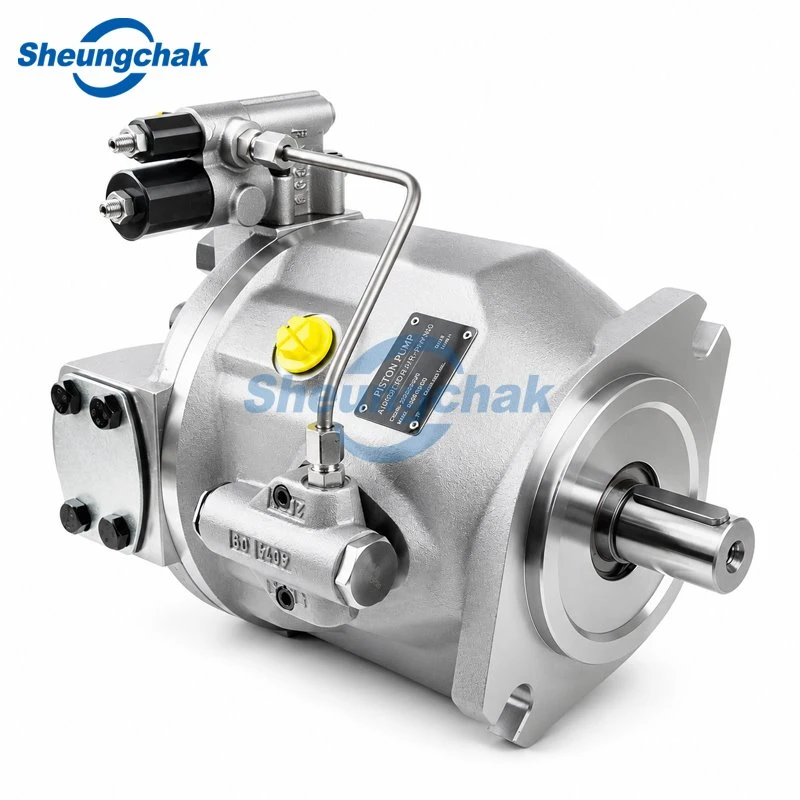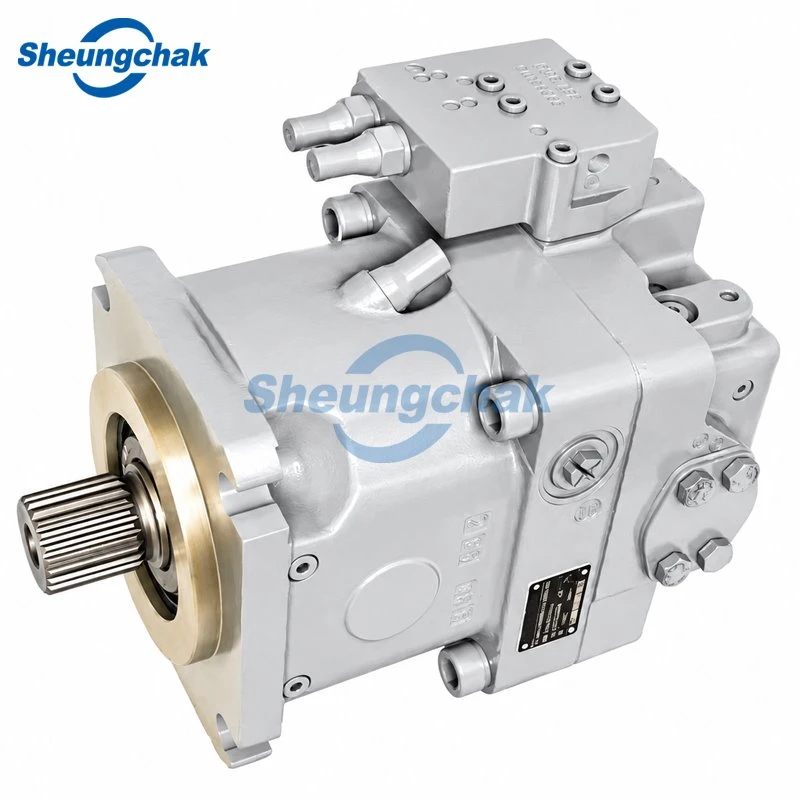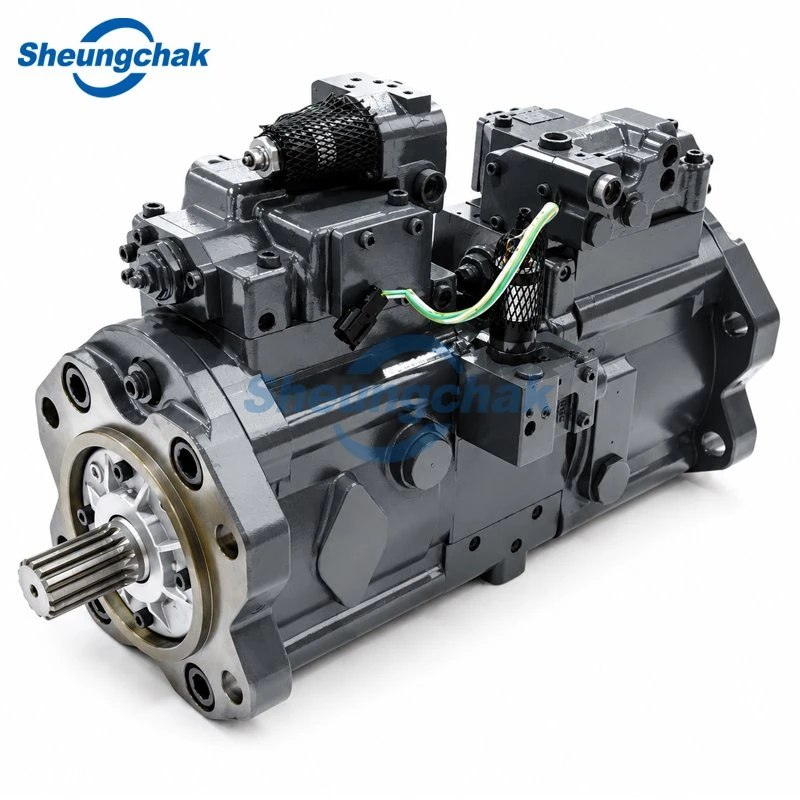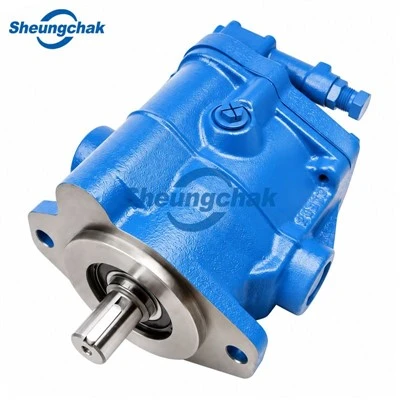


Guangdong Sheungchak Hydraulic Technology Co., Ltd. is one of the leading manufacturers and suppliers of pvh131 in China. With abundant experience, we warmly welcome you to buy high-grade pvh131 for sale here from our factory. All customized products are with high quality and competitive price. Contact us for quotation.
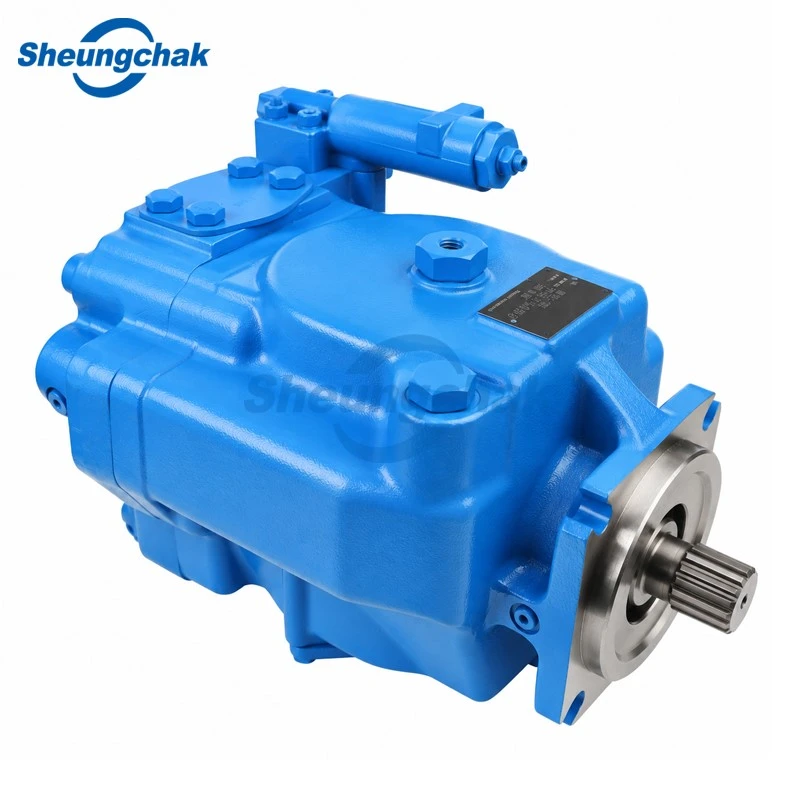
Big pump, big inlet question. That is the first thing to remember about PVH131. Each full-stroke revolution asks the suction line for 131.1 cc of oil. The correct pump can still rattle badly if that oil has to fight through a small hose and two tight elbows.
We normally scribble one calculation on the enquiry sheet: 131.1 × 1500 ÷ 1000 = 196.65 L/min. That is displacement only. The catalog's effective test result is about 186 L/min at rated pressure. Nothing is missing; running clearances account for the difference. A site reading should be compared with the second figure after pressure and oil temperature are noted.
And the 1800 rpm figure? Read the small print with it. The listed 223 L/min result uses 0.48 bar of positive inlet pressure. Take away that boost and the industrial speed row finishes at 1500 rpm. We won't quote the faster duty until the customer explains how the inlet is fed.
PVH131R16AF30B252000001AM1AB010A shows why the nameplate matters. It is one possible build, not a long way of saying "PVH131." The remaining characters settle rotation, the front end, port arrangement, controller and more. Two pumps can share 131.1 cc and still be wrong for each other's machine.
What should the photos show? First, the plate square to the camera. Then the bare shaft, pilot and bolt face; both large ports; the controller; the drain; and the rear cover. Add actual rpm, suction-hose bore and the tank oil level relative to the shaft. A note about cold-start noise is useful too.
Features
- 131.1 cc at full stroke. Useful where a smaller frame simply cannot make the cycle time.
- Closed valve? The yoke comes back instead of pushing the whole delivery over a relief.
- A means pressure compensation. B adds the load-sense flow function.
- Torque sensing gives up flow as pressure climbs, helping the motor or engine stay within its limit.
- Stops and electronic commands exist, although they do not appear on every order code.
- A rear drive is a complete mechanical check: adapter, spline, torque, alignment and length.
[Talk to Our Engineers About Your Application →]
Technical Data
|
Item |
PVH131 Catalog Data |
|
Pump construction |
Open-circuit, in-line variable displacement axial piston pump |
|
Maximum geometric displacement |
131.1 cm³/rev (8.00 in³/rev) |
|
Industrial rated pressure, petroleum oil |
250 bar (3625 psi) |
|
Load-sensing pressure setting note |
Up to 280 bar (4060 psi) is listed for applicable load-sensing systems; confirm control, duty and circuit protection |
|
Industrial rated speed at 127 mm Hg inlet vacuum |
1200 rpm |
|
Industrial rated speed at zero gauge inlet pressure |
1500 rpm |
|
Industrial rated speed with 0.48 bar inlet boost |
1800 rpm |
|
Mobile rated speed at zero gauge inlet pressure |
2000 rpm |
|
Theoretical flow at 1500 rpm |
Approx. 196.7 L/min (52.0 US gpm), before volumetric loss |
|
Typical industrial effective flow at 1500 rpm |
Approx. 186 L/min (49 US gpm) at rated pressure under catalog conditions |
|
Typical boosted industrial flow at 1800 rpm |
Approx. 223 L/min (59 US gpm) at rated pressure with 0.48 bar inlet boost |
|
Typical mobile effective flow |
Approx. 249 L/min (66 US gpm) at 2000 rpm, 250 bar and zero gauge inlet pressure |
|
Approximate dry mass |
60–66 kg (132–146 lb) basic; 62–68 kg (137–150 lb) with thru-drive |
|
Optimum oil viscosity |
16–40 cSt (80–180 SUS) |
|
Common front mounting |
SAE J744 four-bolt D; exact pilot, shaft and projection depend on the code |
|
Shaft rotation |
R clockwise or L counter-clockwise, viewed from the shaft end |
|
Main-port arrangement |
SAE flange combinations and locations vary by the two-letter port code |
|
Petroleum-oil inlet-temperature reference |
Up to 93 °C (200 °F), subject to viscosity and system limits |
|
Alternate-fluid pressure guidance |
Polyol ester 230 bar; water glycol 172 bar; high-water-base fluid 155 bar |
On our worksheet, "223 L/min" and "0.48 bar inlet boost" stay on the same line. That prevents the test point from turning into an unconditional promise. The drain gets its own check: short route, adequate bore, little back pressure. Do not tee it casually into a busy return line.
[Request Quote for Your Displacement & Control Type →]
How It Works
The drive shaft spins the cylinder barrel. Its pistons go around too, with their slippers sliding on a tilted swashplate. One piston is being pulled out and filled while another, on the opposite side, is sending oil to the outlet. Many strokes overlap. The result is a continuous delivery rather than one shot for every revolution.
That plate can tilt. More angle gives the pistons a longer trip and moves the pump toward 131.1 cc per turn; less angle cuts the volume. When a directional valve closes, a pressure compensated piston pump can hold pressure near minimum stroke. For this size, that avoids throwing nearly 200 litres a minute over the relief just to wait for the next command.
Pilot oil, springs and the selected controller move the yoke. Load sensing brings in the small signal line from the valve bank. Torque sensing adds a limit based on the available input. All of that happens after oil reaches the rotating group-none of it fixes air at the inlet, a restricted drain or a crooked coupling.
Model Range
|
PVH131 Version / Code |
Control or Configuration |
Main Selection Point |
|
PVH131-A |
Pressure compensator |
Confirm cut-off setting and operating speed |
|
PVH131-B |
Pressure and flow compensator |
Match load-sense margin, signal line and valve bank |
|
PVH131-D |
Pressure compensator with torque sensing |
Set the torque limit for the available prime-mover power |
|
PVH131-E |
Pressure and flow compensator with torque sensing |
Verify load-sense response and torque schedule together |
|
PVH131-G |
IC pressure compensator |
Check external IC valve and circuit connections |
|
PVH131-H |
IC pressure and flow compensator |
Confirm IC configuration and remote load signal |
|
PVH131-J |
IC pressure and flow with torque sensing |
Requires a complete hydraulic and power-setting match |
|
PVH131-K / L |
Electronic displacement control, with or without shuttle valve |
Match electrical input, shuttle requirement and failsafe behavior |
|
PVH131-N |
Pressure and flow control with unloading valve |
Verify unload and reset settings |
|
PVH131 thru-drive |
Auxiliary-drive version |
Review rear spline, mounting, transmitted torque and overall length |
This is a controller guide, not an ordering shortcut. After choosing the control family, the Vickers PVH131 string still has to answer the shaft, flange, valve plate, ports, drain, seals, stops and design questions. Miss one character and the replacement may never reach commissioning.
Applications & Industries
The 131 belongs on equipment that really needs its flow. It also needs enough reservoir, pipe and shaft power. These five groups are sensible examples; an equipment photograph alone is never our selection method.

Heavy Construction
Mining & Quarrying

Crawler Cranes
Deep Foundation Equipment
Large Concrete Pumps
|
Industry |
Equipment Examples |
What the Pump Does |
|
Heavy Construction |
Large excavators, heavy wheel loaders, road-building machines |
Moves large cylinders quickly, then destrokes between dig, lift and steering commands. |
|
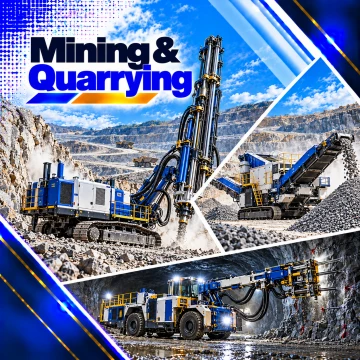
Mining & Quarrying |
Face drills, scalers, crushers, large underground service equipment |
Covers the change from rapid positioning to slow work against a heavy rock load. |
|
Crawler Cranes |
Lattice-boom cranes, duty-cycle cranes, dragline support equipment |
Provides open-circuit oil for winches, boom functions and auxiliary movements. |
|
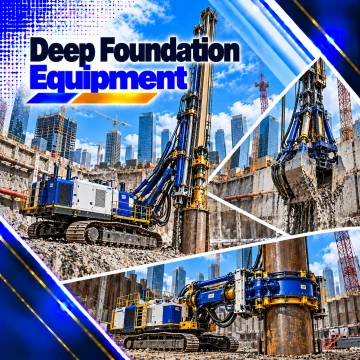
Deep Foundation Equipment |
Rotary drilling rigs, diaphragm-wall grabs, casing oscillators |
Feeds rotary, crowd and clamping circuits as resistance changes below ground. |
|
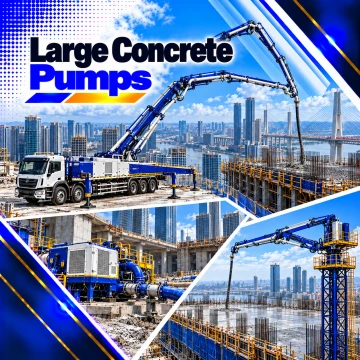
Large Concrete Pumps |
High-output truck pumps, stationary pumping units, placing booms |
Handles the quick switch between boom movement, outrigger work and pressure hold. |
About Us
SheungChak builds hydraulic piston pumps, motors and replacement parts under our own OEM production program. The PVH131 hydraulic pump supplied from us is produced as a SheungChak product.
Small pumps can actually be annoying replacement jobs. There is less room to hide a mistake. Wrong rotation and A/B swap. Wrong shaft. Wrong compensator. A 0.75-inch shaft can still be wrong if the key or projection does not match.
Our usual check is quick: nameplate, shaft photo, rear ports, controller side. For an old unit with no readable code, send the pilot diameter too. Around 82.5 mm immediately tells us a lot.
Factory experience: 20+ years
Main products: Piston pumps, piston motors and hydraulic replacement components
Main markets: Europe / South America / Middle East / Southeast Asia / Africa
MOQ: 1 PC
Sample orders: 1 PC
Normal lead time: 1-2 days
OEM support: Drawing check, code matching, dimensional verification and batch production.

Certifications
Certificate name
Certificate name
Certificate name
Certificate name
Certificate name
Our Factory & Quipment


cooperative partner
We are looking for a cooperative partner to expand our business.










FAQ Display Content
Q: Is 131.1 cc the flow I will always get?
A: No. It is displacement at full stroke: 131.1 cm³/rev, or 8.00 in³/rev. The controller shortens the stroke whenever the circuit needs less oil. Actual flow also loses a little through normal running clearance.
Q: What should a new pump show at 1500 rpm?
A: Theoretical flow is 196.7 L/min. The catalog working point is nearer 186 L/min at rated pressure. Write down oil temperature and test pressure with the meter reading; a number without those notes is hard to judge.
Q: May I run it at 1800 rpm from an ordinary tank?
A: Not from the data on this page. The 1800 rpm test uses 0.48 bar inlet boost. At zero gauge pressure, the industrial limit shown is 1500 rpm. Check pressure at the pump while it is running.
Q: Is 250 bar a continuous figure?
A: It is the industrial petroleum-oil rating quoted in the catalog: 250 bar, or 3625 psi. Other fluid groups have lower limits. Keep the controller and main relief within the rating of the complete circuit.
Q: Why ask for the motor size?
A: Because 186 L/min at high pressure represents a serious shaft load. We calculate the hardest part of the cycle, allow for efficiency, and then look at motor overload and coupling capacity. Frame size alone tells too little.
Q: What is torque control doing?
A: It watches the relationship between load and stroke. As pressure rises, the control can reduce displacement before the engine stalls or the motor is overloaded. The setting has to match the available prime-mover power.
Q: Is PVH141 just another name for this pump?
A: No. PVH141 is the over-bore relative; PVH131 is the 131.1 cc standard-bore size. Their published pressure data are not identical, even though the castings can look familiar.
Q: Could a PVH98 be fitted instead?
A: It is smaller in displacement and frame. If the machine still needs the original cycle time, the answer is no. A planned conversion starts with a new flow and power calculation, then moves on to mounting and ports.
Q: Can any auxiliary pump go on the rear drive?
A: No. The flange and spline must mate, the coupling must be the right length, and combined torque must stay within the drive allowance. The finished tandem also needs support and room around its ports.
Q: Is the pump sold here an original Vickers unit?
A: No. SheungChak manufactures the compatible replacement described here. Vickers, Eaton and Danfoss are used to identify the series being matched.
Q: What should I send for a firm match?
A: Send the full plate, not only "PVH131." Add the old part number, quantity, delivery country and photos of every side. Actual rpm, suction-hose bore and the inlet arrangement are especially useful on this size.
Vickers, Eaton and Danfoss are trademarks of their respective owners. The names are used only for product identification and replacement reference. SheungChak is not affiliated with or endorsed by those trademark owners unless a quotation states otherwise.
[Send your PVH131 nameplate for a replacement check (/contact-us)]
Hot Tags: pvh131, China pvh131 manufacturers, suppliers, factory, A10VSO140, A2FO, A4VG, A4VG125, K3V112, K3V112DT