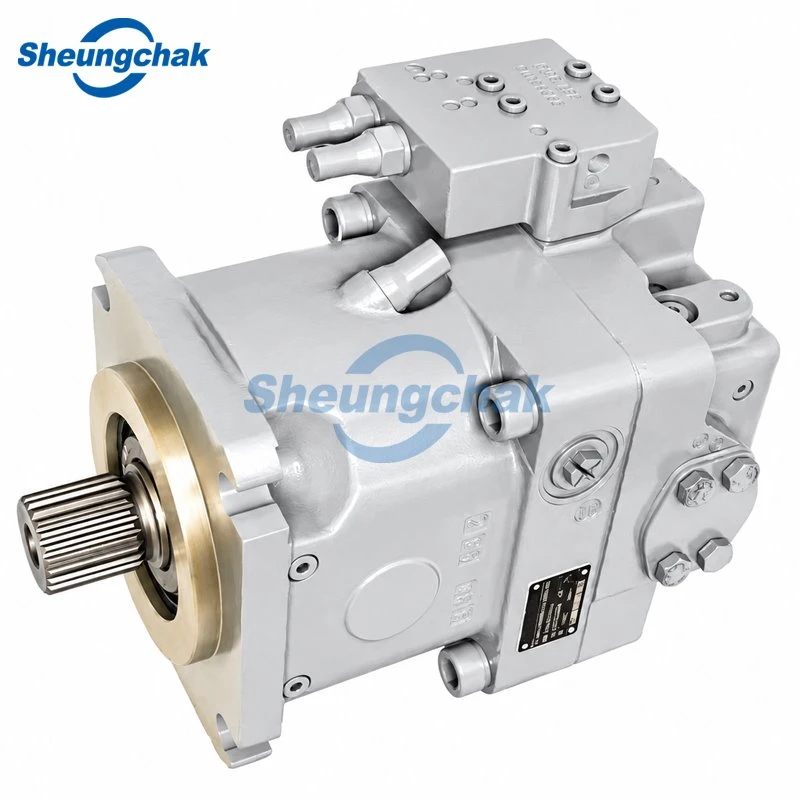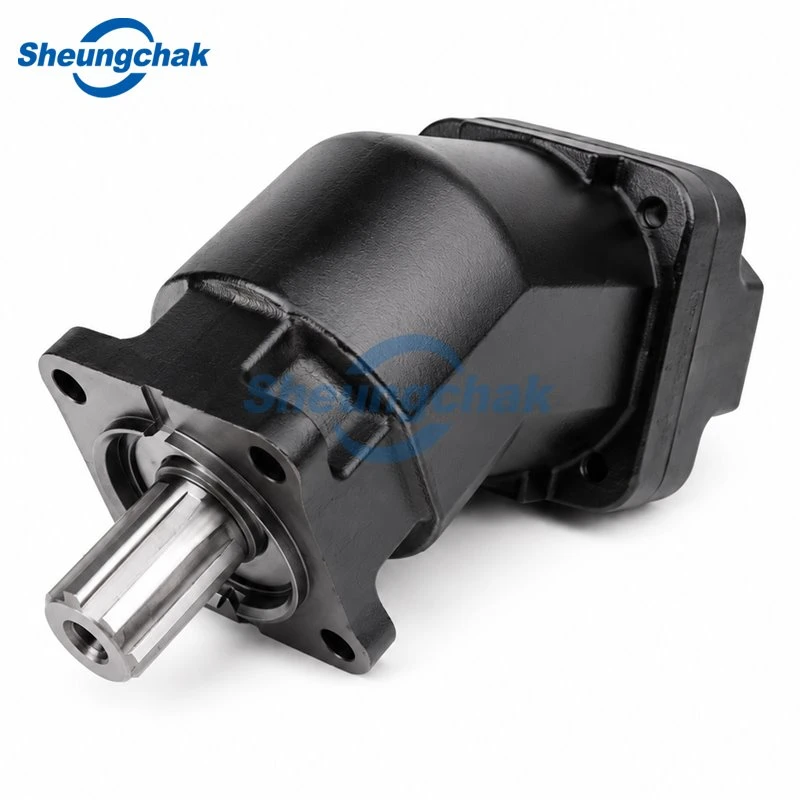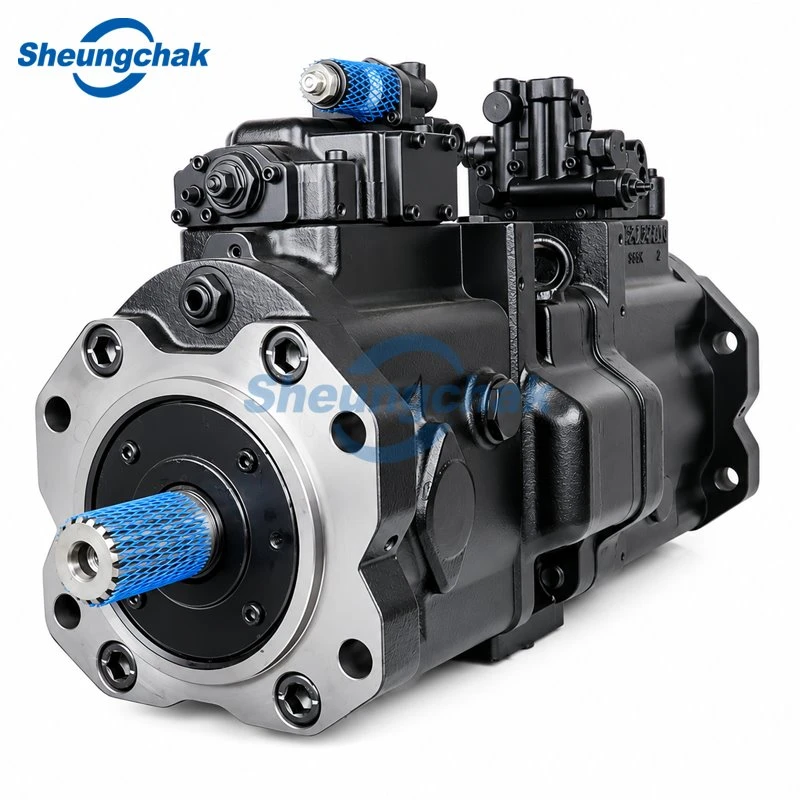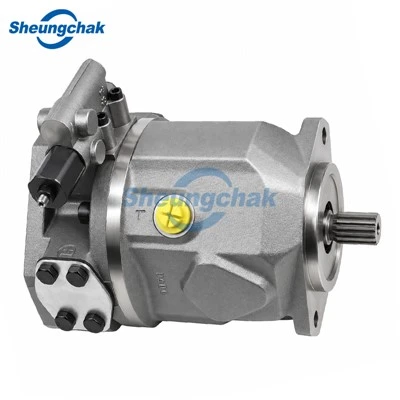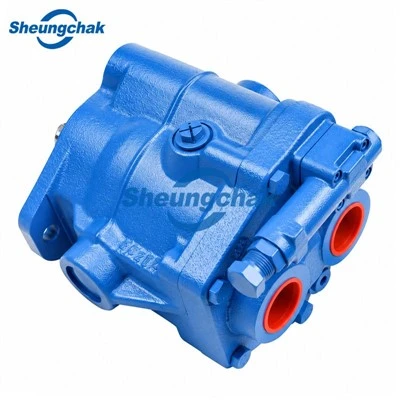

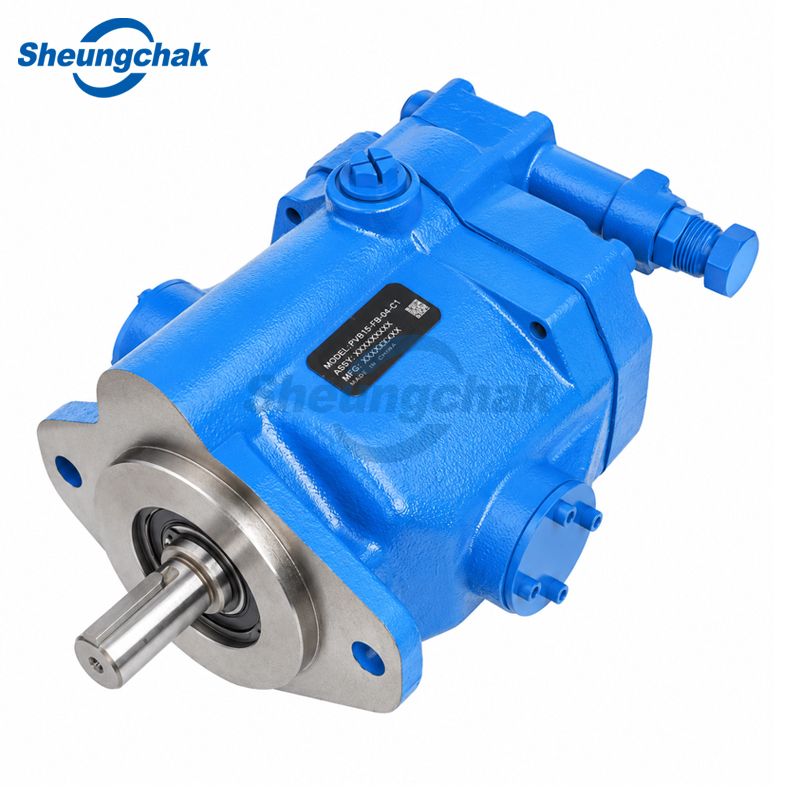
Guangdong Sheungchak Hydraulic Technology Co., Ltd. is one of the leading manufacturers and suppliers of pvb15 in China. With abundant experience, we warmly welcome you to buy high-grade pvb15 for sale here from our factory. All customized products are with high quality and competitive price. Contact us for quotation.
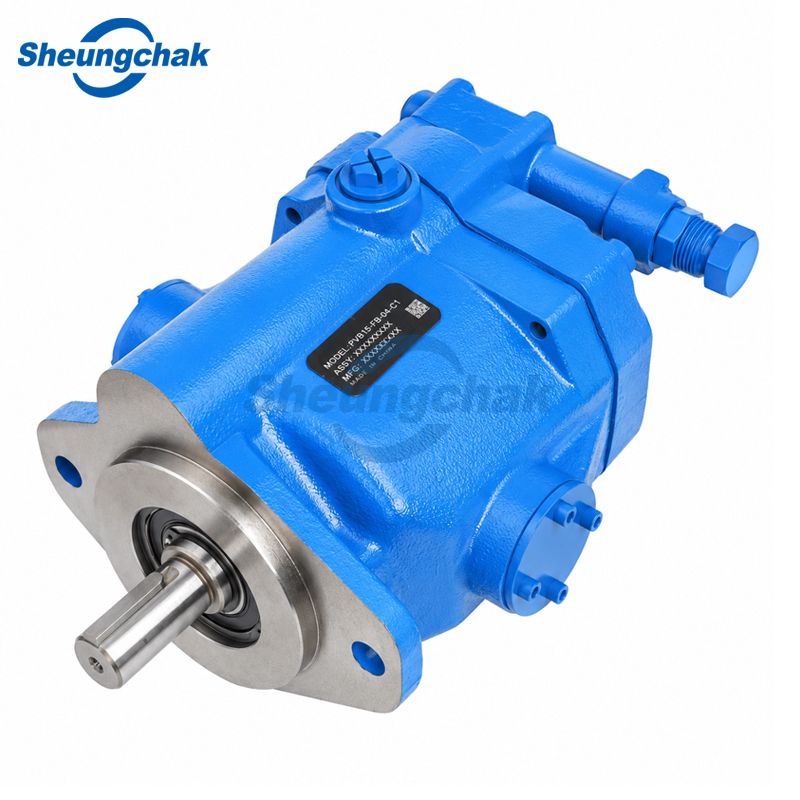
In brief, PVB15 means a 33 cc/rev PVB-frame pump; it does not tell you the rotation, shaft or controller.
It is a fairly small pump, but it is easy to order the wrong one. The name on the tag does not tell the whole story. Rotation, shaft, mounting and the control code all matter. We ask for a front photo and a rear photo before we quote a PVB15 hydraulic pump.
There are two pressure figures that often get mixed together. The C control is adjustable up to 210 bar. The pump is not. Danfoss lists the PVB15 at 140 bar with anti-wear oil. That is the figure we use for a Vickers PVB15 hydraulic pump replacement. Water-based fluids bring the limit down again, to 100 bar.
Displacement is 33 cc per revolution. At 1800 rpm, the catalog gives 59.4 litres per minute. A used machine will not always show that exact number. Speed may be lower. Oil may be hot. Internal wear also takes some flow away.
If the old tag can still be read, send the full code. The series name on its own is not enough. If the tag is blank, measure the pilot, shaft and bolt spacing. Add photos of the rear ports and controller side. That usually gives us enough to start.
Features
- PVB15 changes flow by moving the swash plate.
- C and CM are pressure controls. Their setting ranges are different.
- Remote-pressure and load-sensing controls are also listed.
- Both shaft rotations exist. Direction is viewed from the shaft end.
- The common SAE build has a two-bolt flange and 22.22 mm keyed shaft.
- Two drain positions are provided. The working drain line must stay open.
- Some codes have a stop for limiting maximum displacement.
[Talk to Our Engineers About Your Application →]
Technical Data
|
Item |
PVB15 Catalog Data |
|
Pump type |
Open-circuit variable displacement axial piston swash plate pump |
|
Geometric displacement |
33.00 cm³/rev (2.01 in³/rev) |
|
Maximum shaft speed |
1800 rpm |
|
Approximate delivery at 1800 rpm |
59.4 L/min (15.7 US gpm), before allowance for leakage |
|
Maximum outlet pressure with anti-wear oil |
140 bar (2000 psi) |
|
Maximum outlet pressure with water glycol or water-in-oil emulsion |
100 bar (1500 psi) |
|
C compensator adjustment range |
17-210 bar (250-3000 psi); PVB15 pump limit still applies |
|
CM compensator adjustment range |
17-100 bar (250-1500 psi) |
|
Common SAE shaft |
22.22 mm (0.875 in) keyed shaft |
|
Common mounting pilot |
101.60 mm (4.000 in), SAE two-bolt flange |
|
Main port threads |
1.625-12 UN-2B rear ports, commonly described as SAE-20 |
|
Case-drain threads |
0.750-16 UNF-2B; two drain positions |
|
Maximum case pressure |
0.35 bar (5 psi) |
|
Recommended running viscosity |
13-54 cSt |
|
Permitted viscosity range |
13-220 cSt |
|
Catalog cleanliness guidance |
ISO 4406 20/18/14; older catalog notation also shows ISO 18/14 |
|
Ambient temperature |
-20 to +70 °C (-4 to +158 °F) |
|
Maximum fluid temperature |
80 °C (176 °F) for mineral oil; 54 °C (130 °F) for water-containing fluid |
|
Approximate mass |
15 kg (33 lb) |
|
Typical sound level at 1800 rpm and 140 bar |
69 dB(A) at full flow; 64 dB(A) at cut-off |
The 59.4 L/min figure was taken at 1800 rpm. It is a catalog number. It does not allow for normal leakage. A slower shaft gives less oil. Hot oil and a worn rotating group also change the reading.
[Request Quote for Your Displacement & Control Type →]
How It Works
The drive shaft turns the cylinder barrel. Several pistons are fitted around that barrel. The swash plate makes each piston move in and out. Oil enters on the return stroke. It leaves through the pressure port on the working stroke.
The plate angle decides how far the pistons travel. A large angle gives more oil per turn. A small angle gives less. The drive speed can stay the same while this variable displacement axial piston pump changes its output.
Outlet pressure acts on the compensator. At the set pressure, the control moves the plate back and reduces flow. When the machine asks for oil again, the pump strokes out. The control is not a relief valve. The circuit still needs one, and the catalog limit remains 140 bar.
Model Range
|
Version |
Control Arrangement |
Main Replacement Check |
|
PVB15-C |
Standard pressure compensator |
Check the old pressure setting and pump limit |
|
PVB15-CM |
Lower-range pressure compensator |
Listed for settings from 17 to 100 bar |
|
PVB15-CC / CMC |
Compensator with maximum-displacement stop |
Check pressure control and maximum flow |
|
PVB15-CG / CCG |
Remote pressure setting |
Check the remote pilot line and pressure range |
|
PVB15-CVP |
Load sensing with pressure limiting |
Match the signal line and limiter setting |
|
PVB15-H |
Handwheel displacement control |
Match handwheel side and adjustment range |
|
PVB15-M |
Lever displacement control |
Match lever side, travel and rotation |
|
PVB15-V |
No external displacement-control handle |
Check the old machine layout |
PVB15-RSY-41-C-12 is one clockwise SAE example. It is not a universal code. Left-hand pumps were made too. The same displacement can come with another shaft, port layout or control. Read the whole plate.
Applications & Industries
This pump fits a machine that moves, holds pressure and moves again. A hydraulic press does this all day. It supplies the moving stroke and can back off during the hold.

Metalworking

Plastics Processing

Material Handling
Mining and Process Equipment
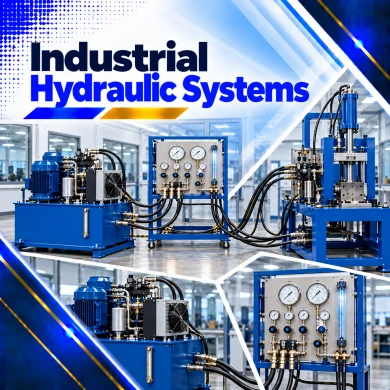
Industrial Hydraulic Systems
|
Industry |
Equipment Examples |
What the Pump Does |
|
Metalworking |
Hydraulic presses, bending machines, punching equipment |
Feeds a working stroke, then reduces flow during the hold. |
|
Plastics Processing |
Injection-molding machines, clamp and ejector circuits |
Runs the clamp and ejector through a repeating cycle. |
|
Material Handling |
Conveyor drives, lift tables, positioning rigs |
Sends oil for movement and backs off after the stop. |
|
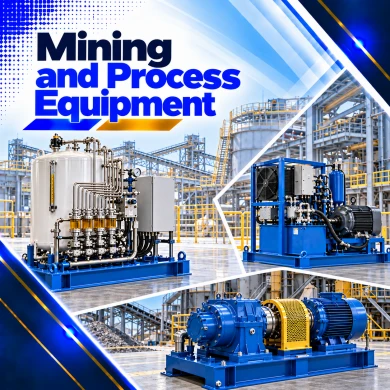
Mining and Process Equipment |
Lubrication skids, service power units, auxiliary drives |
Supplies medium-pressure oil to support equipment. |
|
Industrial Hydraulic Systems |
Custom power packs, test stands, multi-function stations |
Works as the main axial piston hydraulic pump when demand changes. |
About Us
SheungChak builds hydraulic piston pumps, motors and replacement parts under our own OEM production program. The PVB15 hydraulic pump supplied from us is produced as a SheungChak product.
Small pumps can actually be annoying replacement jobs. There is less room to hide a mistake. Wrong rotation and A/B swap. Wrong shaft. Wrong compensator. A 0.75-inch shaft can still be wrong if the key or projection does not match.
Our usual check is quick: nameplate, shaft photo, rear ports, controller side. For an old unit with no readable code, send the pilot diameter too. Around 82.5 mm immediately tells us a lot.
Factory experience: 20+ years
Main products: Piston pumps, piston motors and hydraulic replacement components
Main markets: Europe / South America / Middle East / Southeast Asia / Africa
MOQ: 1 PC
Sample orders: 1 PC
Normal lead time: 1-2 days
OEM support: Drawing check, code matching, dimensional verification and batch production.

Certifications
Certificate name
Certificate name
Certificate name
Certificate name
Certificate name
Our Factory & Quipment


cooperative partner
We are looking for a cooperative partner to expand our business.










FAQ Display Content
Q: What is the displacement of a PVB15 hydraulic pump?
A: The catalog displacement is 33.00 cm³/rev. The inch figure is 2.01 in³/rev.
Q: How much flow does a PVB15 produce?
A: The catalog gives 59.4 L/min, or 15.7 US gpm, at 1800 rpm. A slower motor gives less flow. Leakage and hot oil reduce the measured figure too.
Q: Is the PVB15 rated for 210 bar?
A: No. The 210 bar number belongs to the adjustment range of the C control. It is not the pump rating. The unit is listed at 140 bar on anti-wear oil. The listed water-based fluids have a 100 bar limit.
Q: What is the difference between PVB10 and PVB15?
A: PVB15 is 33.00 cm³/rev. PVB10 is 21.10 cm³/rev. The PVB15 moves more oil at the same speed, but its listed pressure limit is lower. Check the circuit as well as the flange.
Q: What is the difference between C and CM controls?
A: Both are pressure compensators. C is listed from 17 to 210 bar. CM is listed from 17 to 100 bar. The pump and fluid limits still apply.
Q: Which direction does a PVB15 rotate?
A: Either direction is possible. Clockwise and counter-clockwise pumps were both made. Read rotation while looking at the shaft end. Do not guess it from a rear photo.
Q: Can a design 41 PVB15 replace a design 31 unit?
A: Sometimes. Design 41 is only one part of the code. Compare the shaft, flange, pilot, ports, control and rotation. Check the space around the pump as well.
Q: Are SheungChak PVB15 pumps genuine Vickers products?
A: No. This is a SheungChak-made compatible replacement. Vickers and Danfoss identify the old series and application. They are not the manufacturer of our pump.
Q: What should be checked before start-up?
A: Fill the housing through the upper drain port. Run an unrestricted drain line straight to tank. Keep the housing full. Check alignment, rotation, inlet oil and the relief setting before loading the pump. Do not start it dry.
Q: What information is needed for a PVB15 replacement quote?
A: Send the full code, part number, nameplate photo, quantity and destination. If the plate is blank, measure the shaft, pilot and bolt spacing. Add port and controller photos. We also need drive speed, normal pressure and fluid type.
Vickers and Danfoss belong to their respective trademark owners. The names identify the old product and its replacement use. SheungChak is not affiliated with either owner unless a quotation states otherwise.
[Send your PVB15 nameplate for checking (/contact-us)]
Hot Tags: pvb15, China pvb15 manufacturers, suppliers, factory, A10VSO140, A17FO, A4VG71, A4VG90, A4VSO250, AP2D36