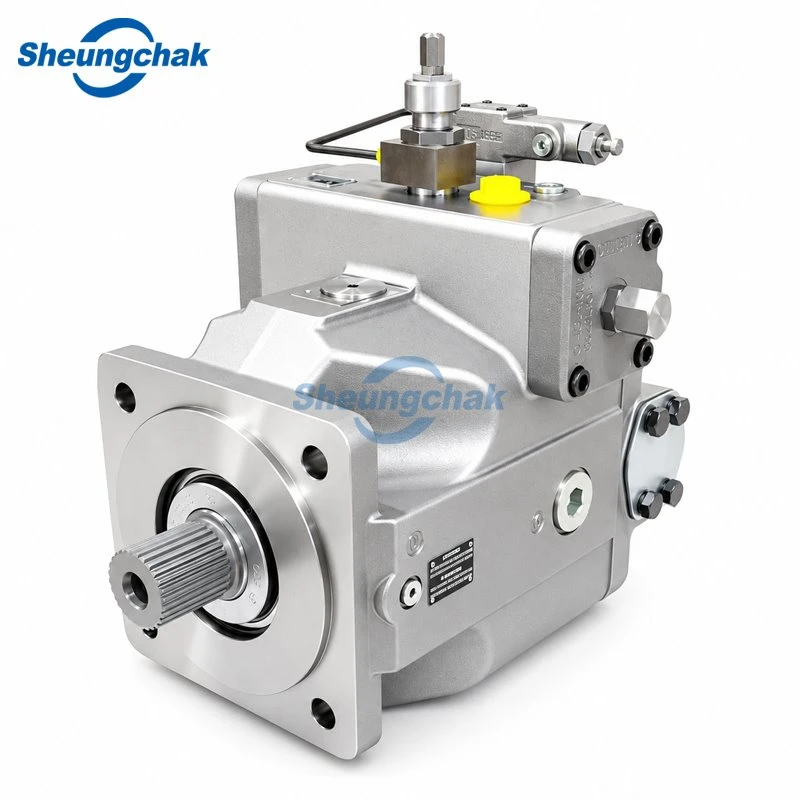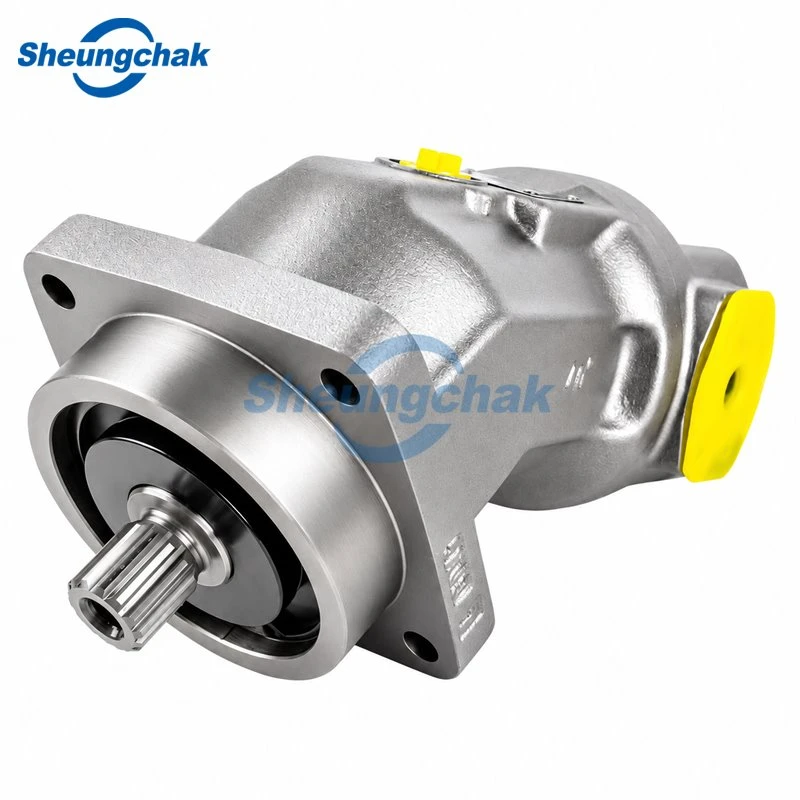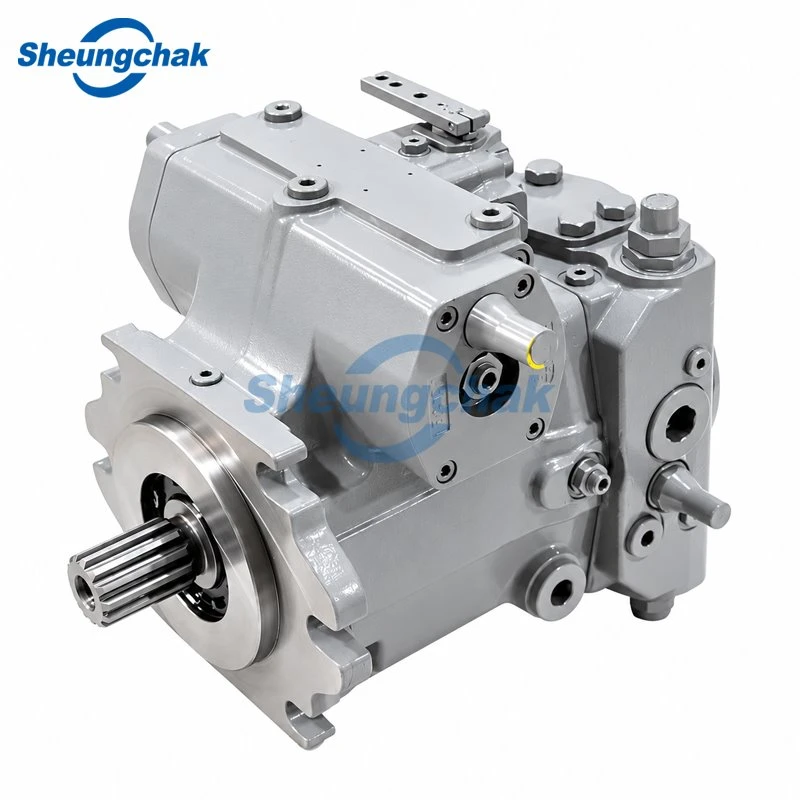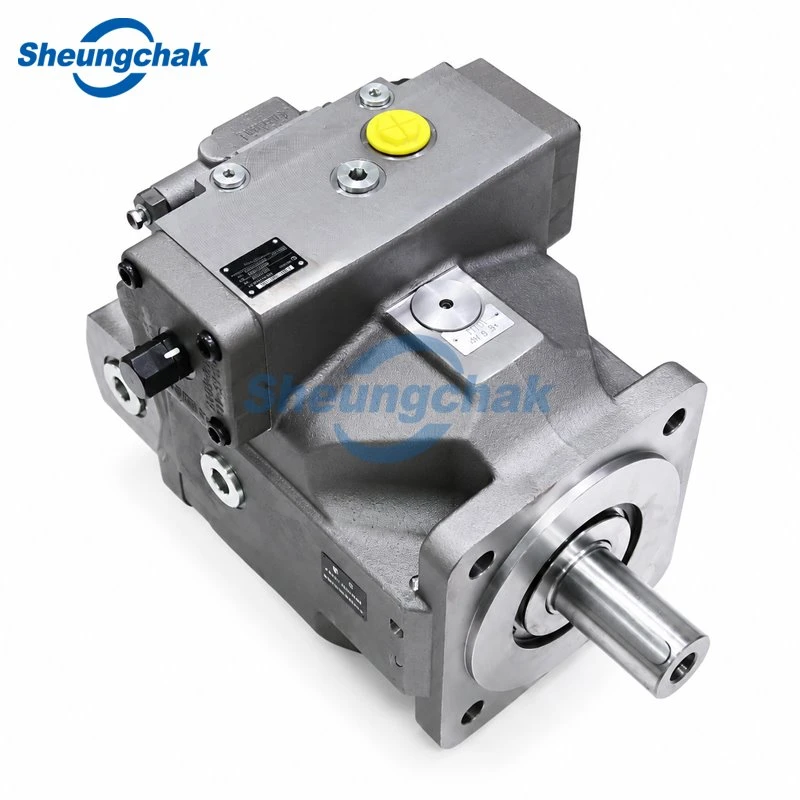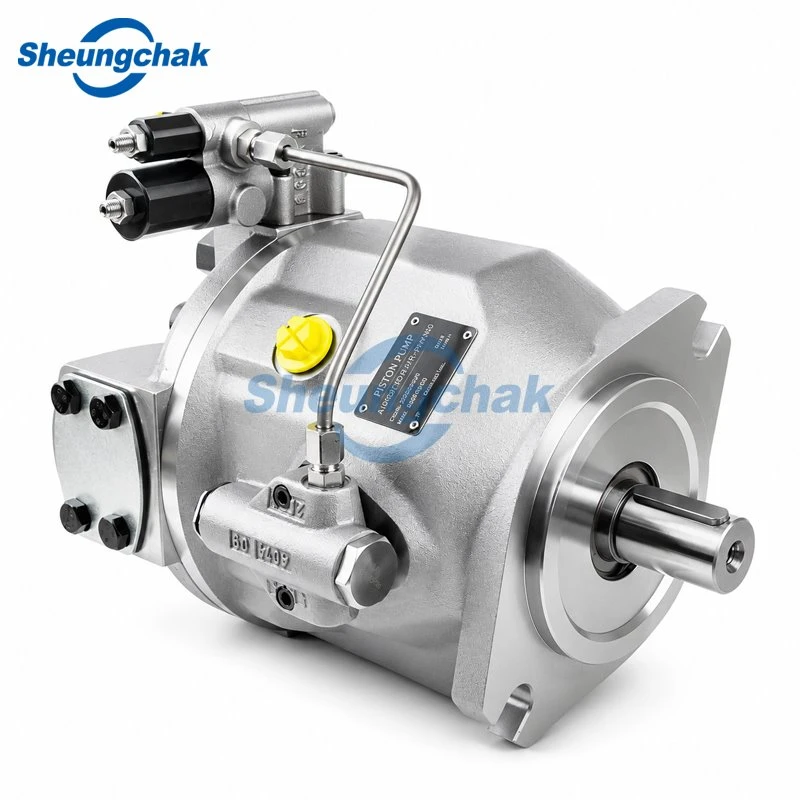

If you already know an A4VSO pump needs work, the harder question is usually what to order. The same model name covers two design series, sizes from NG40 to NG1000, standard and high-speed rotary groups, and several port plate options, and part names on aftermarket quotes rarely match the names in Rexroth documentation. This guide helps you identify which A4VSO pump parts apply to your unit, read a parts quote correctly and decide between a seal kit, individual parts, a rotary group or a complete pump.
It does not give wear limits. The Bosch Rexroth data sheet and operating manual cited here do not publish limits for individual A4VSO components, and figures from other pump types do not transfer. It also does not replace the manufacturer's service instructions for disassembly, inspection and assembly.
The Rexroth figures and procedures cited below describe the documented Rexroth versions. For an aftermarket pump or parts kit, ask the supplier for its own confirmed specifications, compatibility statement and commissioning instructions.
Disclosure: Sheungchak (Guangdong Sheungchak Hydraulic Technology Co., Ltd.) builds new non-OEM A4VSO-type pumps and is not affiliated with Bosch Rexroth. "Rexroth" and "A4VSO" are used only to identify the equipment our products are intended to replace.
Which A4VSO Do You Have? Variants That Change the Parts List
"A4VSO" is a family, not a single pump. Pin down the details below before comparing any parts quotes. The values come from Bosch Rexroth data sheet RE 92050, edition 2023-06-15 (copy hosted by Hyquip). Code tables change between editions. Choose the edition that fits your pump's complete type code and order documents; the manufacturing date (FD) on the nameplate helps narrow the search but does not settle it on its own.
| Detail to confirm | What RE 92050 (2023-06-15) says | Why it matters for parts |
|---|---|---|
| Series | NG40 and NG71 are Series 1x (code 10; code 11 only with HD and EP controls). NG125 to NG1000 are Series 30. | Do not assume parts from one series fit the other. |
| Size (NG) | NG is the nominal size, equal to the maximum geometric displacement in cm³/rev. Sizes run from NG40 to NG1000. With the standard rotary group, nominal speed falls from 2,600 rpm at NG40 to 1,000 rpm at NG1000. These speeds apply at full displacement, 1 bar absolute at suction port S, with mineral oil at 16–36 mm²/s. | Rotary group components are size-specific. |
| Rotary group version | A high-speed version is tabulated for NG71, 250, 355, 370 and 500 (NG180 on request). Under the same conditions, NG250 is rated 1,500 rpm standard and 1,900 rpm high-speed. | Public documentation does not say whether components interchange between versions. Treat them as different until confirmed against the type code. |
| Port plate | Port plates 13 and 25 are rated 350 bar nominal and 400 bar maximum. Port plate 36 is rated 380/420 bar and is listed only for the NG370 high-speed version with selected controls. Port plate 13 is not offered from NG500 upward. | A different port plate is a different part, and its rating limits the duty. |
| Rotation, shaft, seals and through drive | Rotation is coded R (clockwise) or L (counter-clockwise), viewed on the drive shaft. The drive shaft is coded P (parallel keyed) or Z (splined), sealing material V (FKM) or F (special version for HFC fluids), and the rear end N00 (no through drive), K.., U.. or 99. | Each is fixed when the pump is ordered. Ask the supplier which parts in a kit depend on these fields, rotation in particular. |
| Special versions | A special version for HFC fluids (water-containing, fire-resistant) is covered by data sheet RE 92053. The operating manual treats use in explosive atmospheres as improper unless the unit or machine is certified to the ATEX Directive (section 2.3). | Seals and some components may differ from the standard pump. Work from the documentation for that version, and confirm certification status before fitting non-original parts or a replacement pump. |
Nominal and maximum pressure are not interchangeable ratings. RE 92050 defines nominal pressure as the maximum design pressure. Maximum pressure is allowed only in single operating periods of up to 1 second, totalling no more than 300 hours. The whole working pressure range assumes a mineral-oil-based fluid.
Two physical checks help when the nameplate is damaged. Sizes NG40 to NG370 use a 4-hole mounting flange based on ISO 3019-2 (code B), while NG500 to NG1000 use an 8-hole flange (code H). Port sizes also change with size, so measure the ports instead of relying on a generic list.
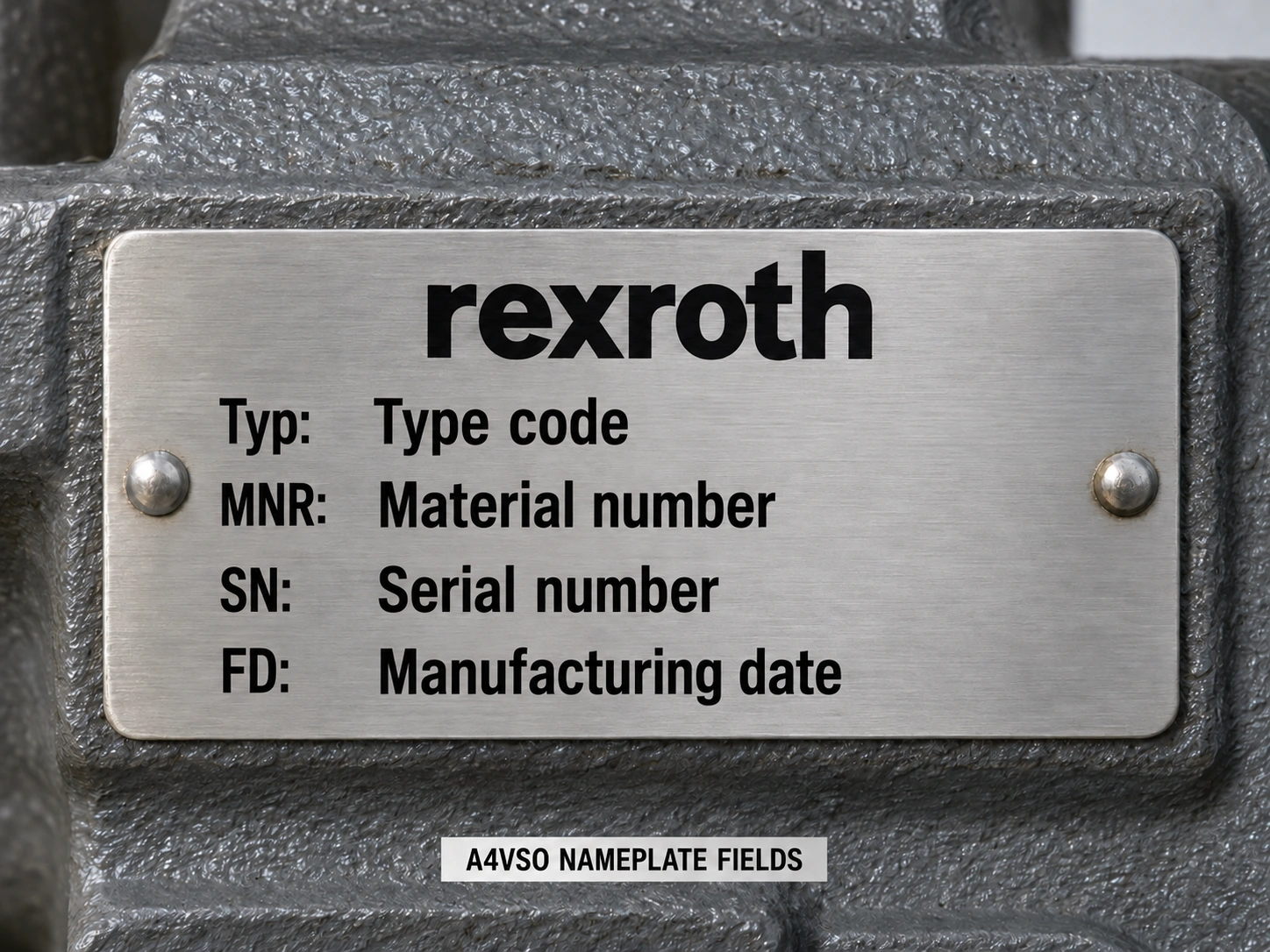
The most reliable identifiers are the complete type code (Typ), material number (MNR) and serial number (SN) on the nameplate. Rexroth's operating manual states that spare parts lists for its axial piston units are order-specific. Genuine parts are ordered with the unit's material and serial numbers plus the material numbers of the parts (section 10.5).
For help decoding the type code, see our guide on how to read an A4VSO model code. If the plate is worn or missing, identifying a pump from its nameplate covers the fallback measurements.
What Is in an A4VSO Rotary Group: Rexroth vs Aftermarket Names
The rotary group is the set of parts that actually displaces fluid. The layout figure in Rexroth's operating manual (RE 92050-01-B/2023-09-28, Fig. 2, copy hosted by Rexton Hydraulic) shows how the parts work together. The numbers in brackets are the figure's item numbers:
- The drive shaft (1) turns the cylinder (10).
- The pistons (11) ride on slipper pads (12), which the retaining plate (2) holds against the swashplate, or cradle (13).
- Fluid enters and leaves the cylinder through the distributor plate (6).
These running surfaces work against each other under high load. The same figure shows the port plate (7), stroking piston (3) and control unit (4) as separate items.
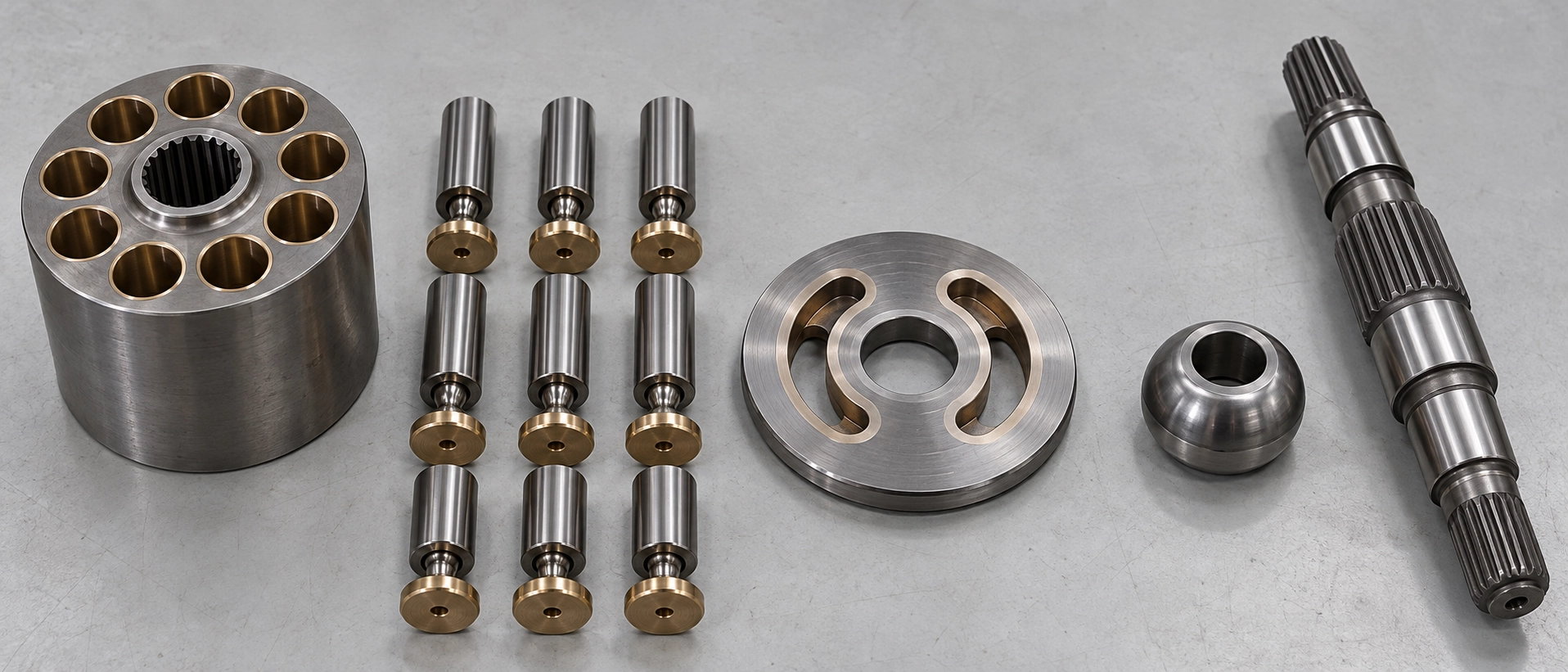
What a "rotary group" or "repair kit" includes is a supplier's packaging decision, not a fixed definition. Two seller listings show how far it varies:
- FridayParts' A4VSO71 overhaul kit lists nine piston shoes, a cylinder block, valve plate, retainer plate, ball guide, shoe plate, drive shaft, bearings and a shaft seal. The drive shaft appears on several lines, which a buyer would need to clarify. The valve plate is listed as "Valve Plate R", so ask whether any part in a kit is specific to one direction of rotation.
- SEIMT's A4VSO355 listing has 12 line items, including nine piston shoes, a cylinder block, valve plate, thrust plate, retainer plate, ball guide, drive shaft and disc springs. It includes no bearings or shaft seal.
Always ask for an itemised list with quantities. Also ask whether the running parts are supplied as a matched set.
The names are where most ordering mistakes start:
| Term in the Rexroth manual (Fig. 2 item) | Names you may see on quotes | What to watch |
|---|---|---|
| Cylinder (10) | Cylinder block, barrel, rotor | Usually unambiguous |
| Piston (11) with slipper pad (12) | Piston shoe, piston assembly, slipper | Confirm the quantity (nine in both listings above) and whether pistons and slippers come assembled |
| Retaining plate (2) | Retainer plate, set plate, return plate | Usually unambiguous |
| Distributor plate (6) | Valve plate, port plate | High risk. SEIMT's listing gives "port plate" as an alternative name for its valve plate. In Rexroth documentation, the port plate is a different component |
| Port plate (7) | Connection plate, end cover | A separate component in Rexroth documentation, selected in the type code (13, 25 or 36) |
| Swashplate, or cradle (13) | Swash plate, thrust plate, shoe plate | "Thrust plate" and "shoe plate" can mean a plate on the slipper running surface rather than the whole cradle. FridayParts lists a shoe plate and a retainer plate as separate items. Confirm with a photo |
| Not labelled separately in the manual's layout figure | Ball guide, ball joint, spherical guide | Ask for a drawing or photo showing where the part sits before comparing prices |
If a quote says "port plate" or "shoe plate", ask which part it means before you approve it. The safest way to order is to send photos of the removed parts together with the manual's item numbers, not just names. The item numbers only locate a part in the figure; they are not order numbers. Genuine parts are still ordered by material number, as described above.
Parts Outside the Rotary Group
Several parts that wear or fail sit outside the rotary group. A rotary group price may or may not include them:
- Shaft seal, O-rings and other seals, usually supplied as a seal kit.
- Bearings and the drive shaft. Some suppliers include these in a rotary group and others do not. Rexroth's manual notes that, within permissible operating parameters, the pump's service life is limited by bearing life, and it leaves the bearing replacement interval to the system manufacturer (section 10.3).
- The port plate, which is chosen by type code.
- The control unit (for example DR, DFR, LR or HS controls) and its stroking piston.
- The housing.
If the fault is in pressure or flow control rather than in the pumping parts, the rotary group may not be the problem at all. Each control is identified by its own code in the type code and documented in a separate Rexroth data sheet, for example 92060 for DR and DFR, 92064 for LR power controllers and 92076 for HS and EO controls.
Symptoms That Do Not Prove a Worn Rotary Group
Noise, heat and loss of performance are often blamed on the rotary group, but many of the causes Rexroth lists sit outside the pump. The malfunction table in the operating manual (section 14.2, Table 11) lists these causes of unusual noise:
- insufficient bleeding;
- poor suction conditions;
- drive speed that is too high;
- the wrong direction of rotation;
- improper mounting or coupling installation;
- resonance from an unsuitable coupling;
- vibrating valves or controllers.
A new rotary group installed into the same conditions can fail the same way.
Measurements on a running system should be made by qualified personnel. Any connection work must follow the machine builder's shutdown, isolation and depressurisation procedures. Before condemning the rotary group, check:
Case pressure. RE 92050 limits static case pressure to 4 bar absolute. It must also be no more than 1.2 bar above the inlet pressure at port S, and the permissible value falls as speed rises. Pressure peaks up to 6 bar absolute are acceptable only momentarily (t < 0.1 s).
- The manual's commissioning check measures case pressure at port K1 or K2 at maximum working pressure (section 8.1.2).
- A restricted, undersized or shared drain line can push case pressure past these limits. The data sheet links higher case pressure to shorter shaft seal life.
Inlet pressure. At port S, pressure must be at least 0.8 bar absolute without a charge pump, or 0.7 bar absolute with one, both in operation and at cold start.
- On a standard gauge reading relative to atmosphere, 0.8 bar absolute shows as about −0.2 bar, as the manual's Fig. 6 illustrates. That reading assumes atmospheric pressure of about 1 bar. Where local atmospheric pressure is lower, for example at altitude, subtract the local value from the absolute limit instead.
- The required value rises with speed and displacement, so measure at nominal speed and maximum swivel angle.
Speed. Compare actual drive speed with the rating for your size and rotary group version, under the conditions given in the first section.
Direction of rotation, pump mounting and coupling alignment.
Filling and bleeding. Confirm the housing was full of fluid at start-up.
Fluid cleanliness. The data sheet calls for at least ISO 4406 20/18/15. Contamination damages new parts as fast as old ones.
Rising case drain flow is often cited as a sign of internal wear, but the Rexroth documents cited here give no A4VSO threshold for it. A trend only means something if readings are comparable:
- the same fluid temperature and viscosity;
- the same drive speed, working pressure, displacement and control state;
- the same measuring point in the drain line.
Treat a rising trend as a reason to inspect, not as a verdict on its own. Without a comparable baseline, it cannot condemn a rotary group.
Seal Kit, Parts Set, Rotary Group or Complete Pump?
Once the pump is open and system causes have been ruled out, choosing the repair scope is a trade-off. You are weighing parts cost, the condition of what you keep and how much uncertainty you accept. The table sets out the factors. It does not replace inspection of your parts.
| Scope | Typically addresses | What you are still relying on | Key questions |
|---|---|---|---|
| Seal kit | External leakage at seals | All running surfaces, bearings and housing | Have the cylinder, distributor plate and slippers been inspected and found serviceable? Has excessive case pressure been ruled out as the cause of the leak? |
| Individual parts | Specific damaged components | Old parts that run against the new ones | Can a qualified repairer confirm, against applicable service data, that old and new mating surfaces can run together? |
| Rotary group | The main running surfaces as a set | Housing, bearings, control and port plate (unless included) | Does the group match your series, size and standard or high-speed version? Is its itemised scope clear? |
| Complete pump | All of the above | Installation and commissioning | Is the full type code, including control and port plate, confirmed? |
Two factors often outweigh parts price:
- Warranty. Rexroth's operating manual states that repairs should only be performed by service centres certified by Bosch Rexroth. It also says that using non-original spare parts means functional reliability cannot be guaranteed and the warranty is voided (sections 10.4–10.5). If the pump is still under Rexroth warranty, factor that in before choosing any aftermarket option, including ours.
- Downtime. Lead times for each scope differ by supplier and by size. Ask for a confirmed lead time for your exact configuration rather than comparing parts prices alone.
Verifying an Aftermarket A4VSO Parts Supplier
Aftermarket listings often say "100% interchangeable" or "100% compatible" without explaining how that was checked. Aftermarket parts can be a sound choice; the issue is evidence.
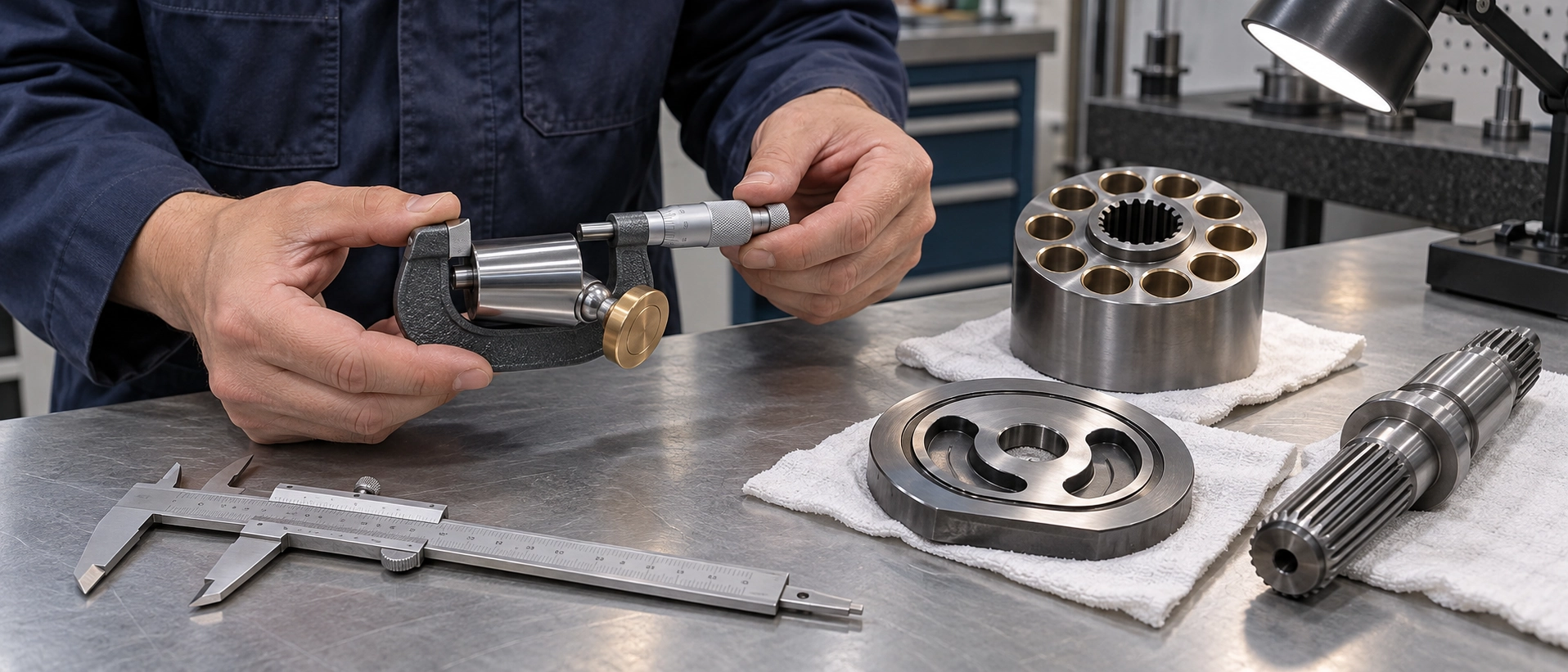
Matching evidence (ask before ordering):
- Confirmation against your complete type code, material number and serial number, not just the size. The confirmation should cover rotation, shaft, seal material, port plate and through drive, not only displacement.
- The exact series, size and rotary group version (standard or high-speed) the parts are made for.
- An itemised scope with quantities, including whether the running parts are supplied as a matched set.
- A drawing or photo that identifies each part, so names cannot be misread.
Supporting evidence of quality:
- A dimensional inspection report for the critical mating features.
- A description of materials and heat treatment for the cylinder, slippers and distributor plate.
- For an assembled pump, a unit test report tied to its serial number. It should state the test conditions (speed, pressure, fluid temperature or viscosity) and the results, including case leakage.
- Written warranty terms, including exclusions.
A supplier that cannot confirm the matching evidence is asking you to take fit on trust. How much supporting evidence you need depends on the duty and on what a failure would cost you. For a wider comparison, see original vs aftermarket hydraulic pumps.
For the complete A4VSO-type pumps Sheungchak builds, our A4VSO product page states two things. Each unit ships with a serial-matched test report, a certificate of conformity and dimensional drawings. Seal and repair kits are supplied against the pump's serial number. These are our own statements, not third-party verification. Ask us for a sample of those documents before ordering, as you should with any supplier.
Stocking Spare Rotary Groups and Pumps
A spare on the shelf has a limited preservation period. Rexroth's operating manual (section 6.2, Table 7) gives maximum storage times for a complete unit under these conditions:
- in its undamaged, closed factory corrosion-protection film;
- in a closed, dry room at a uniform +5 °C to +20 °C;
- the manual also recommends relative humidity of 60% or less.
Under those conditions, the limit is 12 months with standard corrosion protection and 24 months with optional long-term protection. Once the storage time has elapsed, the manual calls for these steps before installation:
- Check the whole unit for damage and corrosion.
- Do a test run to check function and leak-tightness.
- If storage exceeded 24 months, replace the shaft seal.
Rexroth also recommends having the unit checked by its service partner. These are preservation periods, not part life, and they are stated for Rexroth units in factory packaging. A bare rotary group has no housing or shaft seal around it. Ask the supplier how it was preserved and how long that protection is valid.
In practice:
- Record the receipt date, protection type and packaging condition on each spare, and check stored units monthly as the manual recommends.
- Use the oldest stock first.
- For any spare past its preservation period, budget for inspection and a test run as well as a seal kit.
After Installation: Filling, Bleeding and Running-In
New running parts are most vulnerable in their first hours. For a Rexroth unit, the key precautions in the manual's initial commissioning chapter are summarised below; this is not the full procedure. For a repaired or aftermarket unit, also follow the commissioning instructions supplied with it.
- Flush the system lines before first commissioning, but keep the pump out of the flushing circuit (section 7.5).
- Fill and bleed the housing and lines before start-up.
- Check the direction of rotation by inching the drive.
- Run at low speed until the fluid leaving the drain port is free of bubbles.
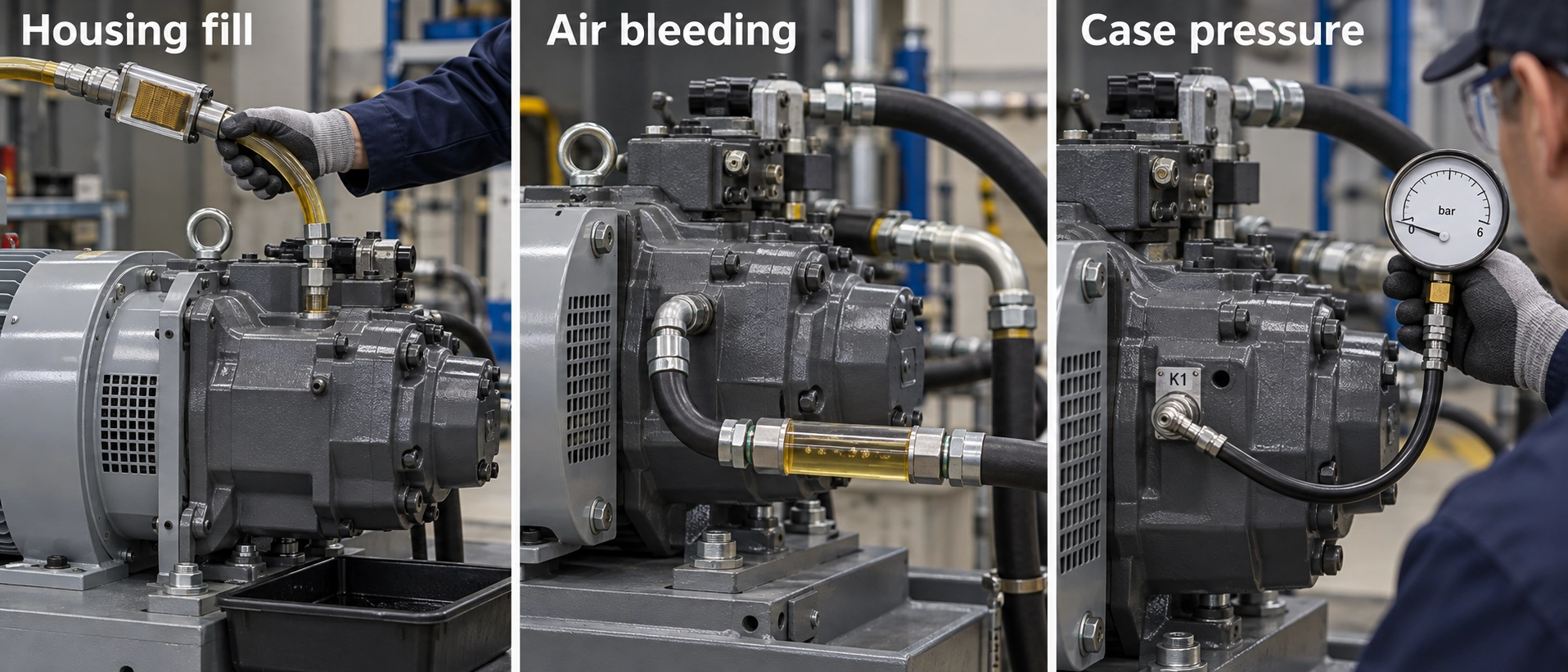
The running-in phase lasts about 10 operating hours (section 8.2). During it, monitor operating temperature and reduce pressure or speed if temperature or viscosity becomes unacceptable. Afterwards, Rexroth recommends having a fluid sample analysed for cleanliness, then changing the fluid if the required level is not reached. If no laboratory test is done, the manual recommends changing the fluid.
Cleanliness should be at least ISO 4406 20/18/15. If fluid viscosity at the drain port falls below 10 mm²/s, the requirement tightens to 19/17/14 (RE 92050). Cleaner fluid does not widen the viscosity limits: the data sheet treats 10 mm²/s as the minimum for short-term operation only (up to 3 minutes at no more than 0.3 × nominal pressure, measured at port T).
After that, the manual's inspection schedule (Table 10) applies:
- daily leak and noise checks;
- a filter check yearly or every 1,000 operating hours, whichever comes first, with the replacement interval depending on fluid cleanliness;
- fluid analysis yearly or every 2,000 operating hours, whichever comes first.
Before You Ask for a Quote
Whether you buy from Rexroth or an aftermarket supplier, a quote is only as accurate as the information behind it. Prepare:
- The complete type code, material number and serial number from the nameplate, with a photo of the nameplate.
- Photos of the damaged parts, with item numbers from the manual's layout drawing if possible.
- Operating conditions: fluid type (especially HFC fluids), working pressure, drive speed and control type.
- Which parts you intend to reuse: housing, control, port plate and bearings.
If you are buying genuine Rexroth parts, request the order-specific spare parts list using the pump's material and serial numbers.
If you are considering a complete replacement pump, send the same details through our request-a-quote form. Our A4VSO product page states that we check the flange and shaft against your nameplate or drawing before quoting; whichever supplier you use, ask for that check in writing before you approve the order. The product page covers complete pumps; say in your inquiry if you are looking for parts instead.