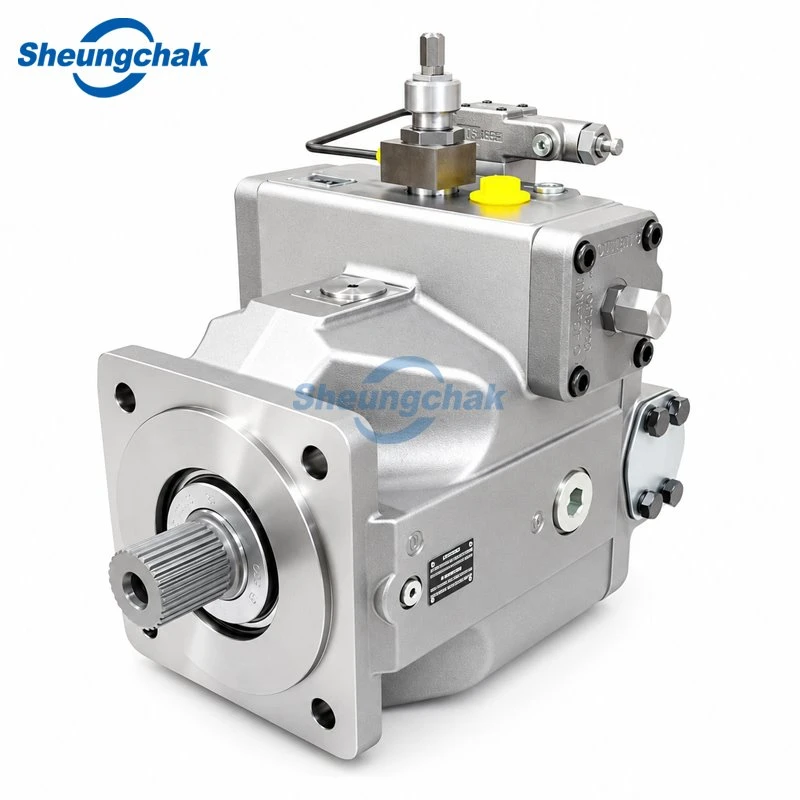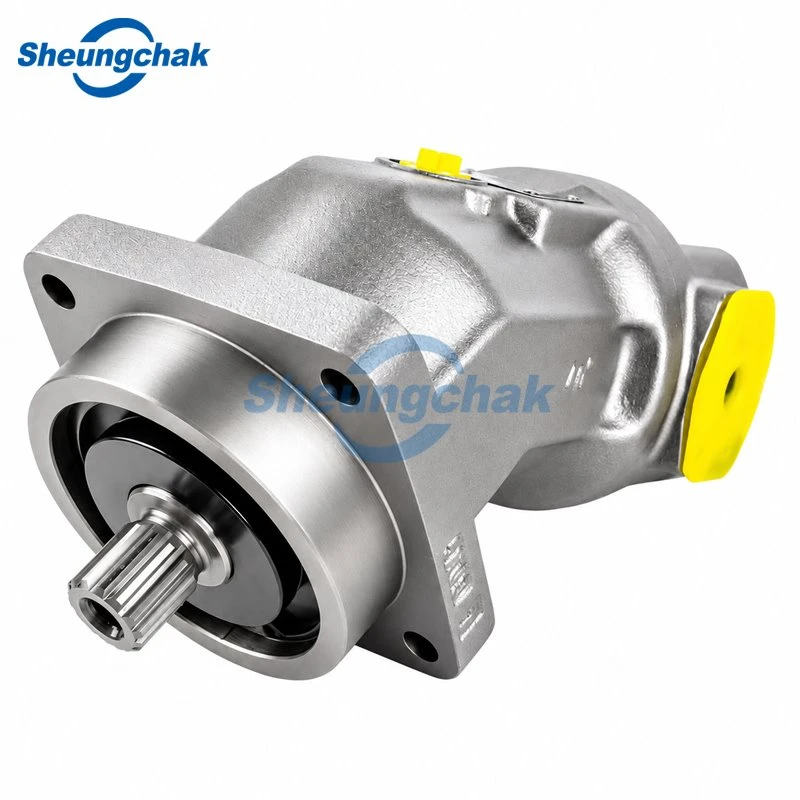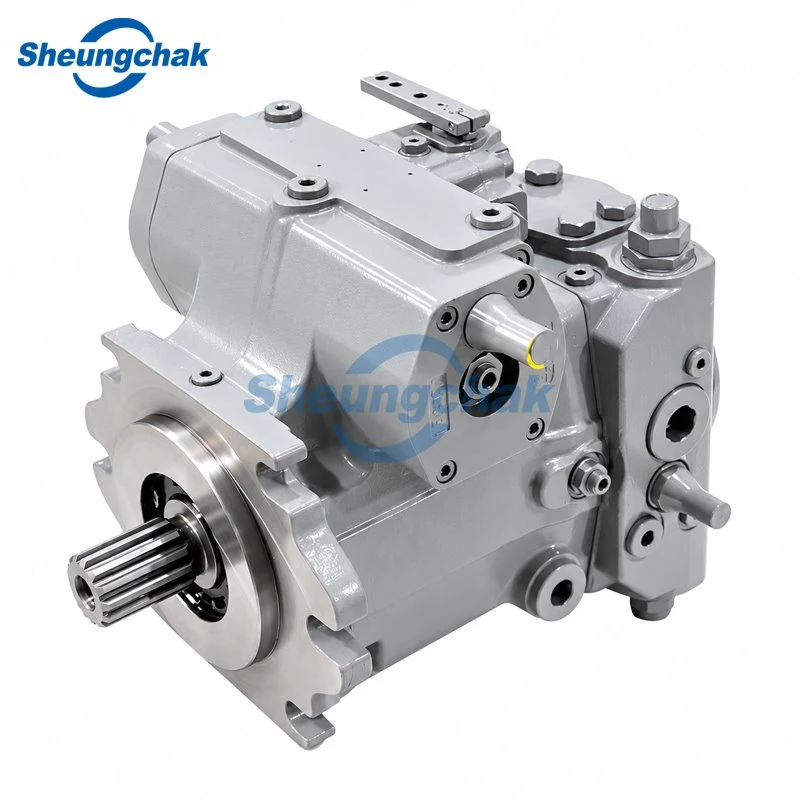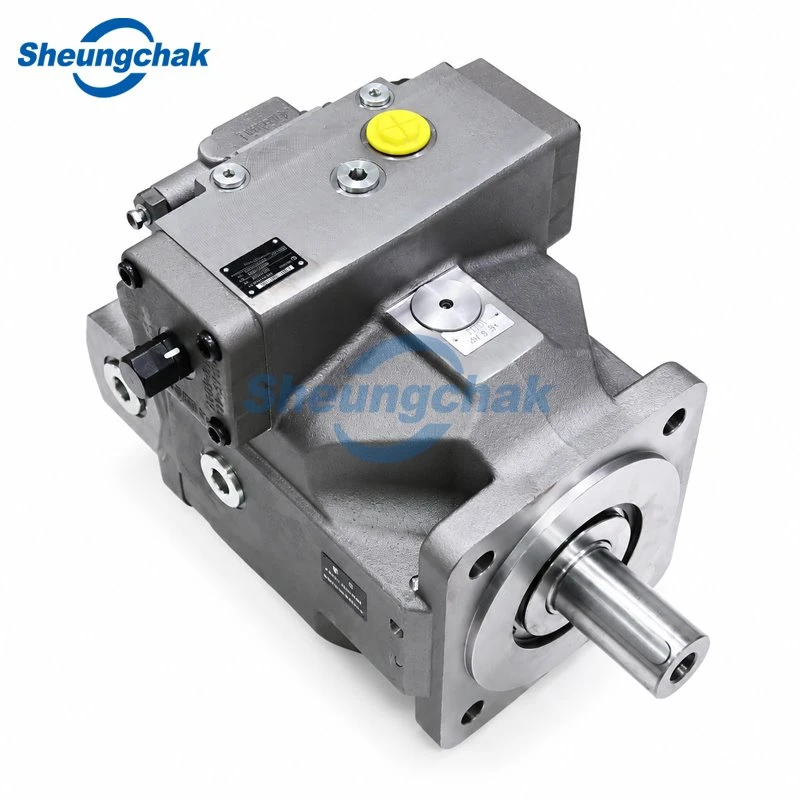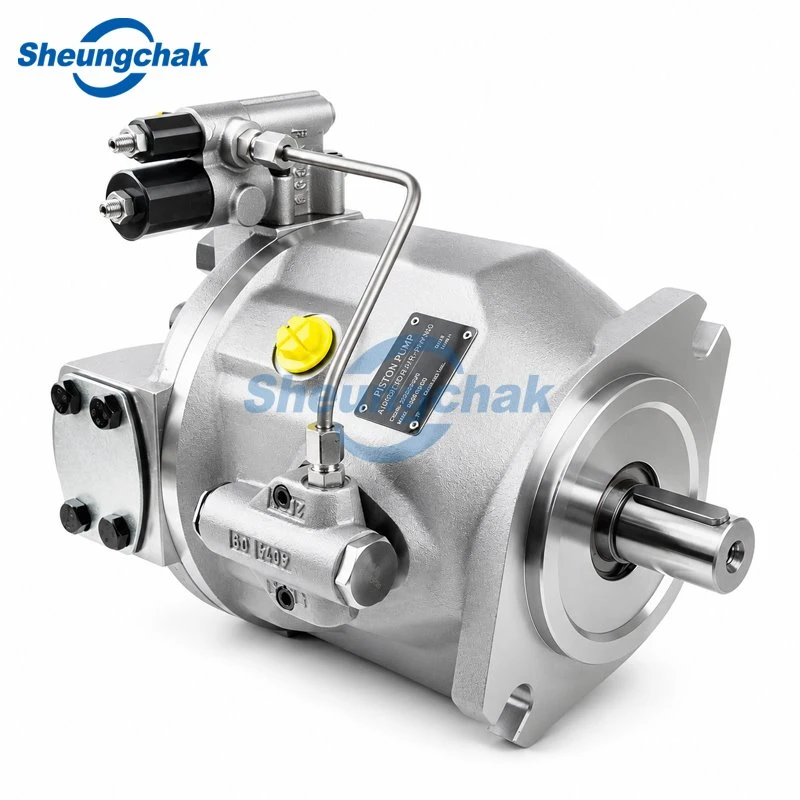

The correct hydraulic oil viscosity for a piston pump is the viscosity that meets the pump manufacturer's requirements at the temperatures the oil actually reaches. ISO VG 32, 46 and 68 describe oil viscosity at 40°C; they do not establish whether a fluid will remain within a particular pump's operating limits when the system is cold or fully loaded.
For a reliable selection, identify the exact pump model, read its normal and short-term viscosity limits, obtain the candidate oil's technical data, and check both hot operation and cold starting. This applies whether the machine uses an existing axial piston pump or a replacement unit being specified for the same circuit.

What Hydraulic Oil Viscosity Should a Piston Pump Use?
An axial piston pump relies on hydraulic fluid to lubricate loaded interfaces, including the slippers and swashplate, piston-to-bore surfaces, bearings and the cylinder block against the valve plate. Viscosity affects the lubricating film, leakage through working clearances and resistance to flow during inlet filling. Too little viscosity can reduce film protection and increase leakage. Excessive viscosity can increase flow resistance, especially during cold starts.
There is no single optimum viscosity range for every piston pump. The normal range stated in a manufacturer's manual is the starting point, not a general number taken from an oil selection chart. In particular, the minimum permissible viscosity is not a desirable target for continuous operation, and a maximum cold-start allowance does not mean full-speed, full-load operation is permitted at that viscosity.
Before selecting the oil grade, record the following:
- The complete pump model code, design series and relevant OEM manual revision.
- The specified fluid family and any required approvals or performance standards.
- Normal operating viscosity, minimum allowed viscosity and maximum allowed viscosity, including any duration or operating restrictions.
- Normal and highest oil temperatures at the measurement point specified by the manufacturer.
- The lowest expected oil temperature before starting, which may differ from daytime ambient temperature.
ISO VG 32, 46 and 68: What the Numbers Actually Mean
The ISO 3448 viscosity classification identifies grades of industrial liquid lubricants by their kinematic viscosity at 40°C. A grade number is a nominal value, with a permitted band around it. Kinematic viscosity is commonly reported in mm²/s, equivalent to centistokes (cSt).
| ISO viscosity grade | Nominal viscosity | Grade band at 40°C | What the grade does not tell you |
|---|---|---|---|
| ISO VG 32 | 32 cSt | 28.8–35.2 cSt | Its viscosity at the pump's actual operating or startup temperature |
| ISO VG 46 | 46 cSt | 41.4–50.6 cSt | Whether a particular piston pump approves the fluid |
| ISO VG 68 | 68 cSt | 61.2–74.8 cSt | Whether the oil remains suitable through cold starts and hot operation |
ISO VG 68 is more viscous than ISO VG 46 at the 40°C reference temperature, and ISO VG 46 is more viscous than ISO VG 32. That comparison alone is not a recommendation. The same grade can have different viscosity-temperature behavior across different products. A colder site does not automatically require VG 32, and a hotter site does not automatically justify VG 68.
Use the grade to make a shortlist. Use the pump manual and the actual oil properties to decide whether a candidate belongs on the approved list.
How to Read a Piston Pump's Viscosity Requirements
Pump specifications often separate a preferred or normal operating band from exceptional conditions. Those categories need to remain separate during selection. Two official examples show why a universal piston pump viscosity range is misleading.
| Pump series | Normal or recommended viscosity | Other published viscosity limits | Reference |
|---|---|---|---|
| Parker P2/P3 | 15–40 cSt, normal operation | 10 cSt minimum and 1,000 cSt maximum, both for short periods | Parker P2/P3 catalogue, page 46 |
| Danfoss H1P 045/053 | 12–80 cSt, recommended range | 7 cSt minimum, 5 cSt intermittent and 1,600 cSt maximum; the intermittent 5 cSt condition has explicit time limits | Danfoss H1P 045/053 technical information, page 8 |
The values above are documented in the Parker P2/P3 catalogue and the Danfoss H1P 045/053 technical information. These are limits for the named series, not industry-wide limits. The wider Danfoss recommended band also does not prove that thicker oil has no efficiency penalty; it establishes only the stated operating envelope for that design.
Do not confuse the normal range with a short-term limit
A fluid close to a published minimum may be permitted only under certain conditions or for a limited time. Look for footnotes on speed, pressure, temperature, duration and duty cycle. A fluid that merely stays above a minimum number has not necessarily passed the continuous-duty check.
Use the correct series and revision
A shared family name is not enough to identify the relevant specification. Before checking fluid limits for an A10VSO pump, confirm the complete model code and series documentation. The same applies to other displacement sizes, control versions and replacement designs. Do not assume that a limit found in another series, or even a different manual revision, applies without verification.
How Temperature Changes Hydraulic Oil Viscosity
As hydraulic oil warms, its kinematic viscosity generally falls. The relationship is nonlinear, which is why the grade printed on the container is not the viscosity experienced at a hot pump. The relevant operating temperature is the one specified by the pump manufacturer, not simply the day's air temperature.

Ambient, reservoir and case-drain temperatures
Ambient temperature helps establish the cold-start conditions, especially after a machine has stood overnight. Reservoir temperature indicates the bulk oil condition. Case-drain temperature can reveal hotter oil within a piston pump, but the difference from reservoir temperature depends on the installation and operating state.
For example, Parker notes in its P2/P3 catalogue that average case-drain temperature can be up to 20°C above reservoir temperature under the stated conditions. Danfoss specifies its H1P temperature limits at the hottest point, normally the case-drain port. Neither statement means that every pump always has a hotter case drain, or that reservoir temperature should be ignored.
On a closed-circuit unit such as an A4VG hydrostatic pump, charge supply, loop conditions and housing temperature must be checked under the applicable technical instructions. An open-circuit pump's temperature or inlet assumptions cannot simply be carried over to a closed-loop drive.
Check cold starting separately
Oil that has acceptable viscosity when hot may become too viscous for the permitted starting conditions after a cold night. Confirm the fluid's low-temperature data and the pump manufacturer's startup restrictions. Where the manual specifies a reduced speed, unloaded operation or a preheating procedure, follow that procedure rather than assuming a stated maximum viscosity allows immediate full-load operation.
High-viscosity oil can increase inlet-line pressure loss. If a machine already shows inlet-related symptoms, the separate guide to hydraulic pump cavitation and its causes covers that diagnosis. Oil selection should not be used as a substitute for investigating a damaged or restricted supply path.
Why Two ISO VG 46 Oils May Perform Differently
Viscosity index (VI) describes how strongly an oil's viscosity changes with temperature. A higher VI generally indicates a smaller relative change over a temperature range, but VI alone does not establish the correct fluid for a piston pump. Viscosity at specified temperatures is more useful for the actual model check.
Consider two commercial products with the same ISO VG 46 designation:
| Oil | At 40°C | At 100°C | Published source |
|---|---|---|---|
| Mobil DTE 10 Excel 46 | 45.7 cSt | 8.4 cSt | Mobil product specifications |
| Shell Tellus S2 MX 46 | 46.0 cSt | 6.9 cSt | Shell safety data sheet, revised May 2026 |
Both are VG 46 oils at 40°C, but their published viscosities at 100°C differ. This is a reason to examine the individual product's viscosity-temperature data rather than assuming that all VG 46 oils behave identically at the pump's working temperature.
It is not evidence that one of these oils is approved for a specific Parker, Danfoss or Rexroth pump. Approval also depends on the manufacturer's fluid requirements, the formulation, seal compatibility, application conditions and any specified qualification standards.
How to Select Piston Pump Oil Viscosity Step by Step
- Identify the exact pump. Record the manufacturer, full model code, design series and the applicable manual. If a replacement pump is being considered, check the proposed unit rather than relying on the old pump's limits.
- Extract the fluid requirements. Note the permitted fluid types, normal viscosity band, minimum and maximum viscosity, and the conditions attached to any intermittent or cold-start values.
- Establish the temperature envelope. Record the lowest likely starting oil temperature and the normal and highest oil temperatures at the OEM-specified measurement location. If these values have not been measured, label them as unknown rather than inventing a field reading.
- Collect candidate oil data. Obtain the current technical data sheet for each product. Read viscosity at 40°C and 100°C, viscosity index and any relevant lower-temperature data. A pour point is not a substitute for a cold-start viscosity check.
- Estimate viscosity at the relevant operating temperatures. Use the oil supplier's viscosity-temperature chart or a documented calculation method. The ASTM D341 viscosity-temperature practice provides a basis for estimating viscosity from measurements at two known temperatures within an appropriate range. Record that the result is calculated, not directly measured.
- Compare each result with the right OEM category. Check the normal operating band first, then examine the separate high-temperature, cold-start and short-term restrictions. A result inside one permitted limit does not establish compliance with the complete duty cycle.
- Verify the fluid specification and system conditions. Check fluid type, additive and performance requirements, seal compatibility, inlet conditions and the manufacturer's cleanliness target. The separate article on how filtration affects piston pump life addresses contamination control without turning the oil-selection process into a filter-sizing exercise.
- Document the selection. Keep the pump manual revision, oil product data sheet, measured temperature range and reason for acceptance or rejection together. Obtain the necessary equipment or pump manufacturer confirmation before a change of oil grade or fluid type.
| Field | What to enter | Reason |
|---|---|---|
| Pump identification | Complete model code and manual revision | Determines which limits apply |
| Fluid requirement | Required type, approval and viscosity bands | Separates grade from compatibility |
| Temperature evidence | Startup, normal and maximum temperatures with measurement points | Defines the conditions to check |
| Candidate oil | Full product name, 40°C and 100°C viscosity, low-temperature data | Identifies the actual fluid rather than the grade alone |
| Viscosity assessment | Measured or calculated viscosity at each relevant temperature | Shows whether the OEM band is met |
| Outstanding checks | Approvals, compatibility and any missing measurements | Prevents a conditional result from being treated as final approval |
Practical Example: Checking an ISO VG 46 Oil at 70°C
Consider a piston pump whose applicable documentation is the Parker P2/P3 catalogue cited above. That catalogue states a normal operating viscosity of 15–40 cSt. For this example only, assume the relevant oil temperature at the required measurement location has been verified at 70°C during normal operation. The following comparison checks one part of the fluid-selection decision; it does not certify either oil for the pump.

Compare the published oil values
Using the Mobil and Shell 40°C and 100°C values shown earlier, a two-point Walther-type viscosity-temperature calculation gives the following estimates:
| Candidate | 40°C published | 100°C published | Estimated at 70°C | Comparison with 15–40 cSt normal band |
|---|---|---|---|---|
| Mobil DTE 10 Excel 46 | 45.7 cSt | 8.4 cSt | About 17.0 cSt | Within the band on this estimate |
| Shell Tellus S2 MX 46 | 46.0 cSt | 6.9 cSt | About 15.0 cSt | At the lower edge on this estimate |
The 70°C figures are calculations from rounded published values, using a common two-point Walther relation with a viscosity offset of 0.7 cSt and absolute temperature in kelvin. They are not direct measurements, batch guarantees or equipment approvals. Rounded inputs and the calculation method affect a result near a limit.
Interpret the result without overclaiming
At the assumed 70°C operating point, the Mobil estimate lies inside the example pump's stated normal range. The Shell estimate is close enough to the lower boundary that further verification is particularly important. Neither finding checks the lowest startup temperature, the highest temperature reached across the duty cycle, or the manufacturer's fluid qualification requirements.
If the oil falls below the recommended band at another operating point, the next action is to review the temperature conditions and approved fluid options with the equipment manufacturer. It is not automatically correct to move from VG 46 to VG 68: the thicker grade may create an unacceptable cold-start or inlet condition. Likewise, satisfying a short-term minimum does not establish suitability for continuous service.
A complete assessment repeats the viscosity check across the expected temperature range and records the applicable OEM limits and fluid approval status before any change is made.
Common Mistakes When Selecting Piston Pump Oil
Choosing a grade from climate alone
Ambient temperature matters most when establishing startup conditions. A site that experiences warm afternoons may still have cold overnight starts, while the oil in a loaded pump can operate much hotter than ambient air. Check the oil's actual temperature range rather than using a climate-to-VG shortcut.
Using a minimum viscosity as the continuous-duty target
A short-term low limit can describe an exceptional permitted condition. It is not an alternative to the stated normal operating range. Read the footnotes for duration and operating restrictions before using the number.
Assuming all VG 46 oils are interchangeable
Even oils in the same grade may differ in viscosity index, additives, approvals and low-temperature properties. Match the complete product and its current data sheet, not just the grade on the label.
Increasing viscosity to compensate for wear
Thicker oil may reduce leakage in some circumstances, but it does not repair worn surfaces and can create additional inlet or starting difficulties. If leakage has changed, determine whether it reflects wear or another operating condition using a model-specific assessment of piston pump case-drain flow before changing the oil specification.
Changing fluid type without checking compatibility
HLP, HVLP, biodegradable, fire-resistant and other hydraulic fluids are not interchangeable merely because they share an ISO VG grade. Confirm the fluid category, manufacturer-approved specifications, seal compatibility and the equipment's changeover procedure. Do not substitute engine oil for the specified hydraulic fluid unless the equipment manufacturer expressly permits it.
Confirm Fluid Requirements Before Ordering a Replacement Pump
A replacement pump must work with the machine's actual hydraulic fluid and duty conditions. Before requesting a quote, collect the complete existing pump code, current oil product name and grade, fluid specification, startup temperature and highest relevant operating oil temperature. Also record the circuit type, pressure and speed requirements so the proposed configuration can be checked against the correct documentation.
For example, buyers comparing A4VSO pump configurations should confirm the applicable series and fluid limits rather than relying on a generic ISO VG recommendation. Provide this information with your inquiry to Sheungchak so the requested replacement configuration and any unresolved fluid-compatibility questions can be reviewed before quotation. Final fluid suitability remains subject to the applicable pump and equipment manufacturer's requirements.
Frequently Asked Questions
Is ISO VG 46 suitable for all piston pumps?
No. ISO VG 46 indicates a nominal viscosity of 46 cSt at 40°C. Whether a particular VG 46 fluid is suitable depends on its viscosity across the operating temperature range, the exact pump's viscosity limits and the required fluid specification.
Can ISO VG 68 replace ISO VG 46 in a piston pump?
Not automatically. VG 68 is more viscous at the 40°C reference point and may affect cold starting and inlet conditions. Check the replacement oil's viscosity-temperature data against the complete OEM operating envelope before changing grade.
What viscosity range should an axial piston pump operate in?
Use the normal or recommended range in the manual for the exact pump series. As examples, Parker P2/P3 specifies 15–40 cSt for normal operation, while Danfoss H1P 045/053 specifies a recommended range of 12–80 cSt. Neither range should be applied to every piston pump.
How can I estimate hydraulic oil viscosity at operating temperature?
Use the oil supplier's viscosity-temperature chart or a suitable method such as ASTM D341 with published viscosities at two known temperatures. Record the calculation assumptions and check the result against the pump's normal operating range and other restrictions. A calculated value near a limit calls for additional verification.
Is a higher viscosity index always better for piston pumps?
No. A higher viscosity index can help retain viscosity across a wider temperature range, but it does not override fluid approval, additive compatibility, cold-start requirements or the pump manufacturer's operating limits. Evaluate the complete oil specification.