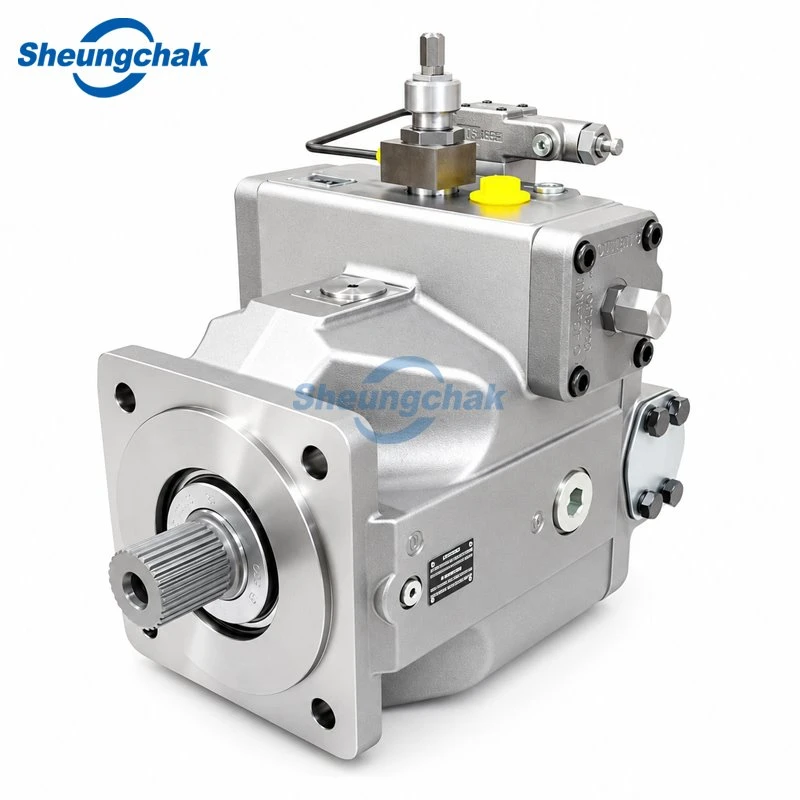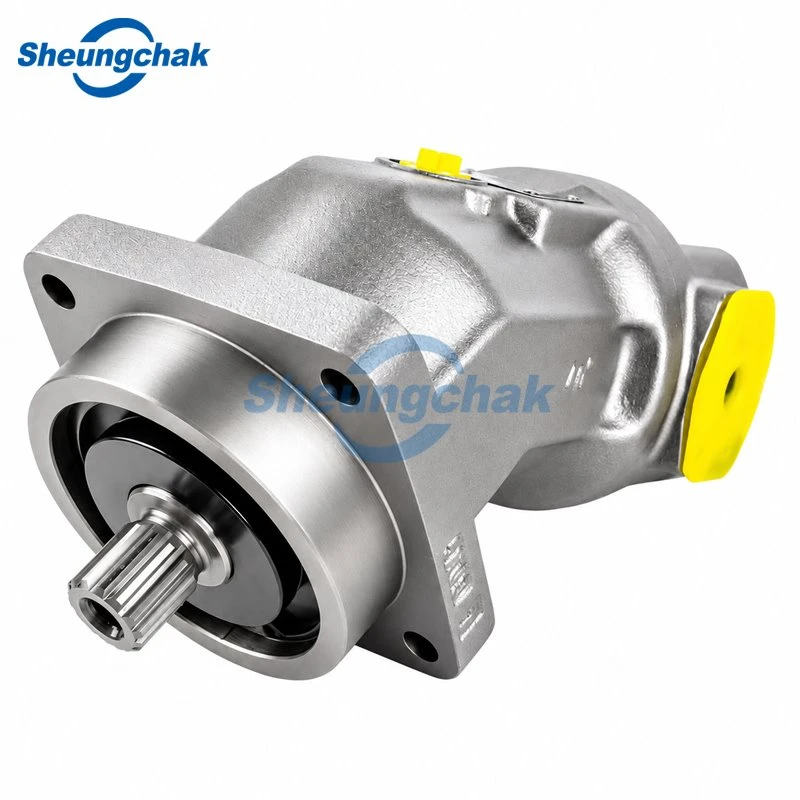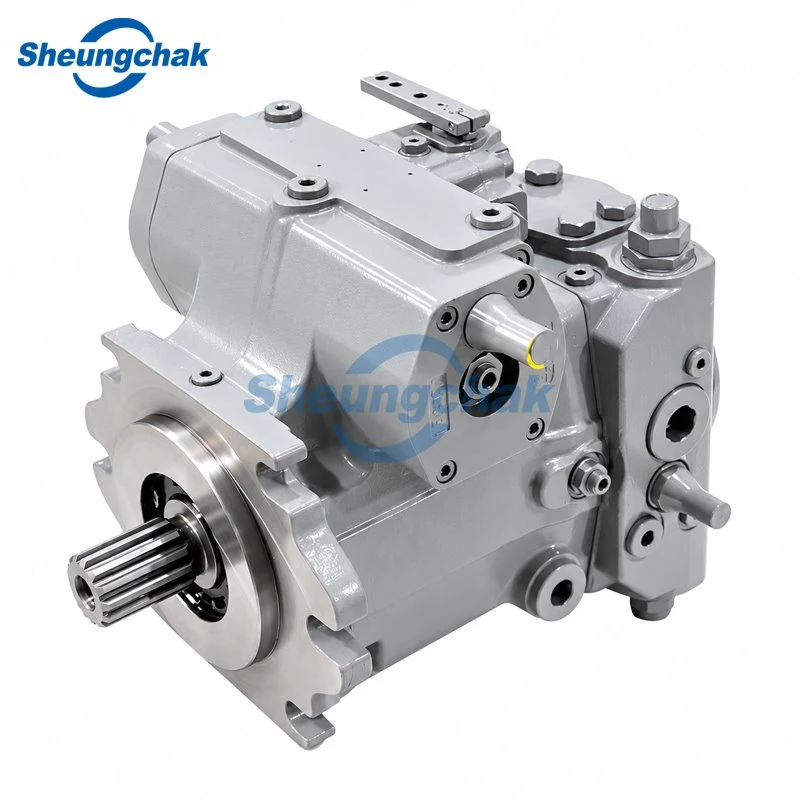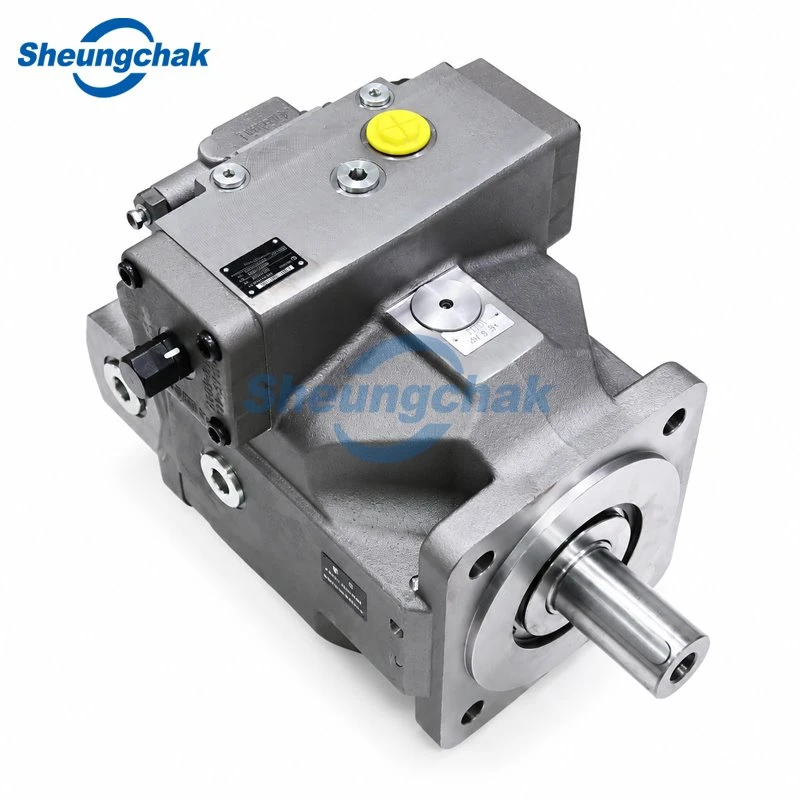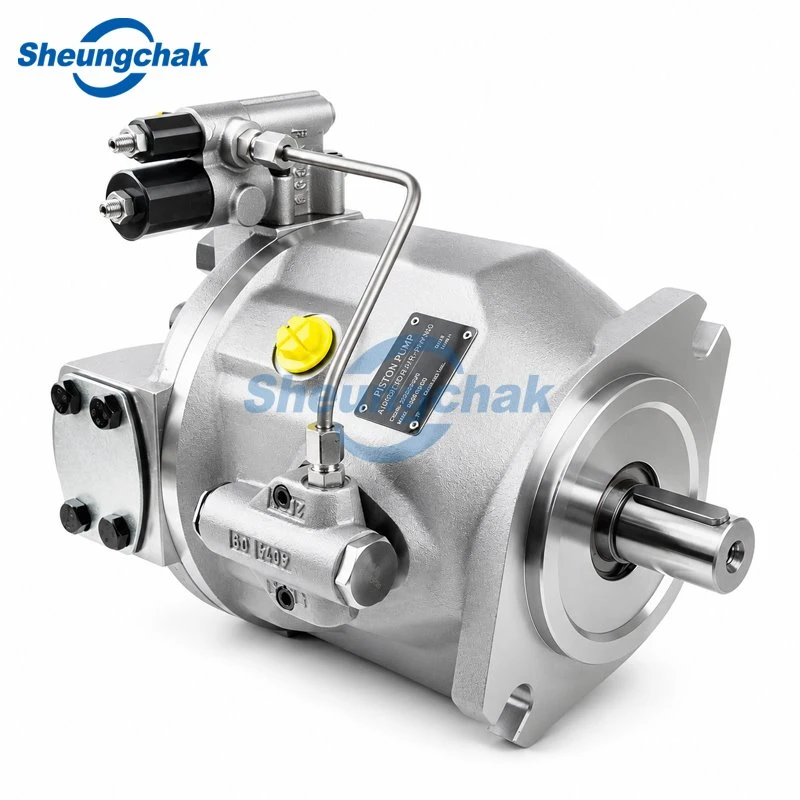

A hydraulic pump test bench is useful to a pump buyer when its demonstrated capabilities cover the configuration and operating conditions being purchased. Ask for evidence connecting your required test points, the installed bench configuration and the measurements behind the result.
This guide helps OEM buyers and supplier quality engineers review a pump manufacturer's testing capability before ordering. It addresses supplier qualification rather than purchasing test-bench equipment. It does not establish the capability of any particular supplier or replace the agreed pump specification.
Define What the Bench Must Prove
Separate three questions: Can the supplier perform the required test? Will that test be included in your order? What evidence will support acceptance of the delivered unit? A capable installation does not automatically answer the other two.
Start with the decision the test must support. Checking output at an agreed operating point, evaluating a variable pump's control function and assessing long-term durability require different evidence. Record the required outcome before comparing equipment descriptions.
ISO 4409:2019 covers performance and efficiency methods for positive-displacement pumps, motors and integral transmissions with continuously rotating shafts. Its published scope concerns steady-state test procedures and presentation of results. A reference to ISO 4409 alone does not establish that separate endurance or transient-response tests have been performed. (ISO)
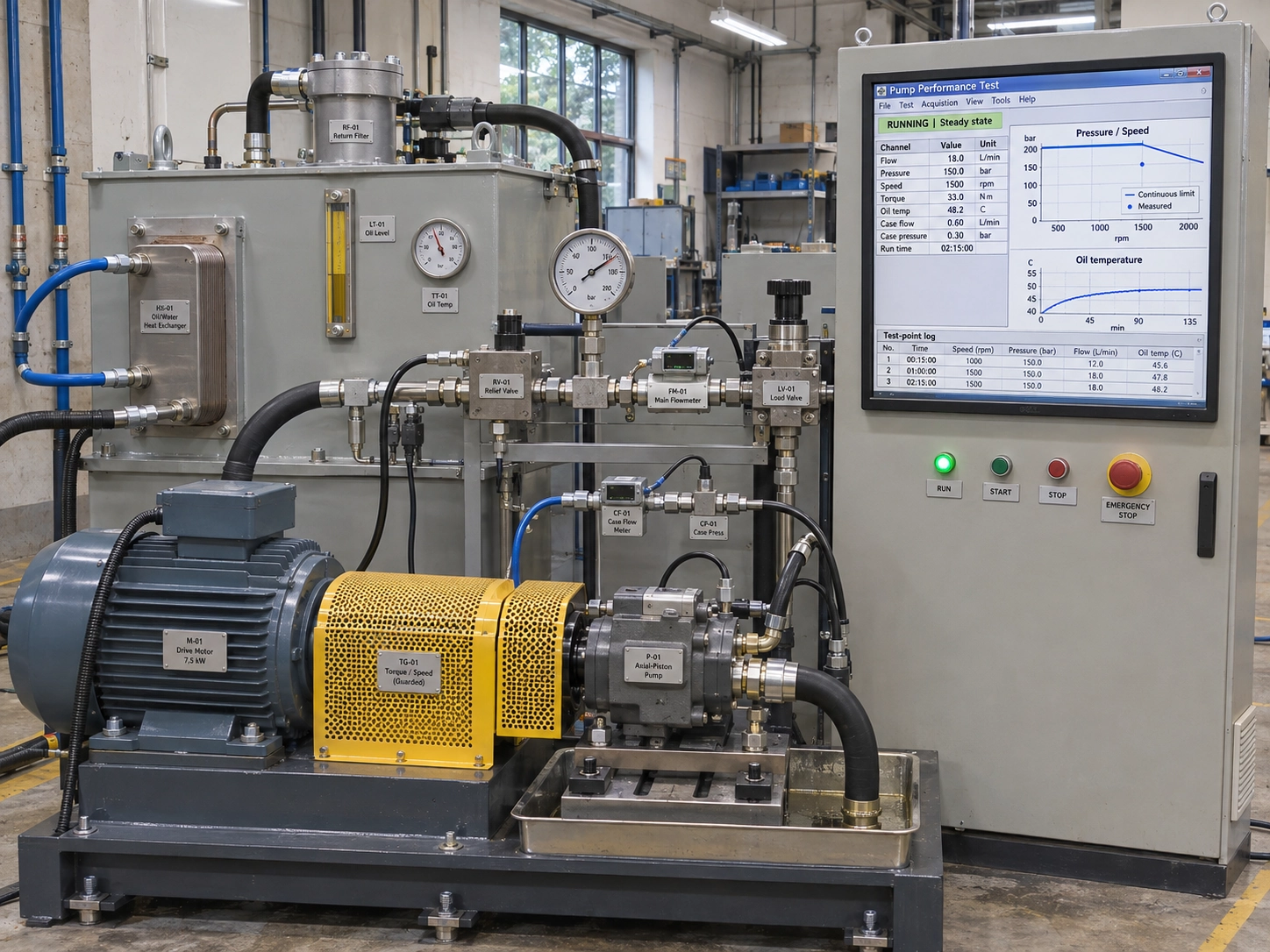
For procurement, ask which procedure and revision will apply, which tests are included and which acceptance limits come from the approved specification. Resolve undefined requirements before treating a supplier's answer as a pass.
Keep the component, configuration and purpose of testing together in the scope statement so technical and purchasing teams review the same requirement.
Ask for the Operating Envelope, Not Separate Maximums
A maximum pressure and a maximum flow listed separately do not establish that both are available together at your required shaft speed. Request coverage of complete operating points, with control state, fluid conditions and permitted duration attached.
Confirm Pressure, Flow, Speed and Torque Together
Use a calculation to make the question concrete. For an illustrative steady-state pump point, assume a pressure difference of 250 bar and an actual delivered flow of 100 L/min:
Hydraulic output power (kW) = pressure difference (bar) × flow (L/min) ÷ 600
The result is 41.7 kW. If, solely for illustration, overall pump efficiency is 0.90, required shaft input is approximately 46.3 kW. At an assumed 1,500 rpm, calculate shaft torque using:
Torque (N·m) = 9,550 × shaft input power (kW) ÷ shaft speed (rpm)
Using the unrounded shaft power gives approximately 295 N·m.
These are hypothetical inputs, not test results or recommended acceptance values. The pressure–flow power relationship and distinction between pump input power and efficiency are consistent with the formulas published by commercial distributor Applied Industrial Technologies. (Applied)
This is a preliminary power check, not a complete bench specification. It assumes the simple hydraulic output boundary stated above. Ancillary flows, auxiliary power and other circuit arrangements require separate accounting. The supplier must still confirm available torque at the required speed, loading capacity and thermal limits.
Ask whether the point can be held for the agreed measurement period. Distinguish the pump's permissible duty from the bench's available duty. A short demonstration does not establish continuous coverage.
Before requesting this assessment, identify the complete unit among the hydraulic pump configurations for OEM sourcing. Family names alone leave displacement, series, rotation and control details unresolved.
Check Circuit and Control Compatibility
Mechanical fit is only part of compatibility. The supplier's configuration-specific answer should cover mounting, shaft coupling, rotation, port arrangement and circuit architecture; a statement that the bench accepts piston pumps is insufficient.
For a fixed-displacement open-circuit pump, the review may focus on driving the unit and measuring output under agreed loading and inlet conditions. A variable-displacement pump adds questions about how its control is commanded and evaluated. A closed-circuit pump needs confirmation of appropriate loop, charge and control arrangements. These are distinct review paths.
For tandem or multi-section pumps, ask whether the required sections can be evaluated under the specified combination of loads. Testing sections separately may answer a different question from checking the agreed combined duty. The supplier should identify which arrangement the proposed evidence represents.
Identify the Signals Behind the Test
Ask how the supplier supports the fitted pressure, load-sensing, power or electronic control, as applicable. Establish which pilot supplies, hydraulic signals, electrical interfaces and feedback channels are available for that version.
Manufacturer documentation illustrates why options matter. Dorninger Hytronics describes control-characteristic measurements while distinguishing certain electronic interfaces and optional extensions. Power Test's Model 700 brochure separately identifies optional control and closed-loop equipment. These commercial documents describe their respective products; they do not verify another supplier's installation. (Dorninger Hytronics; Power Test)
A useful response identifies the installed interface, the function to be checked and the resulting evidence. Do not substitute a generic wiring arrangement or universal signal value for pump-specific documentation.
Check Measurement Capability at Your Test Points
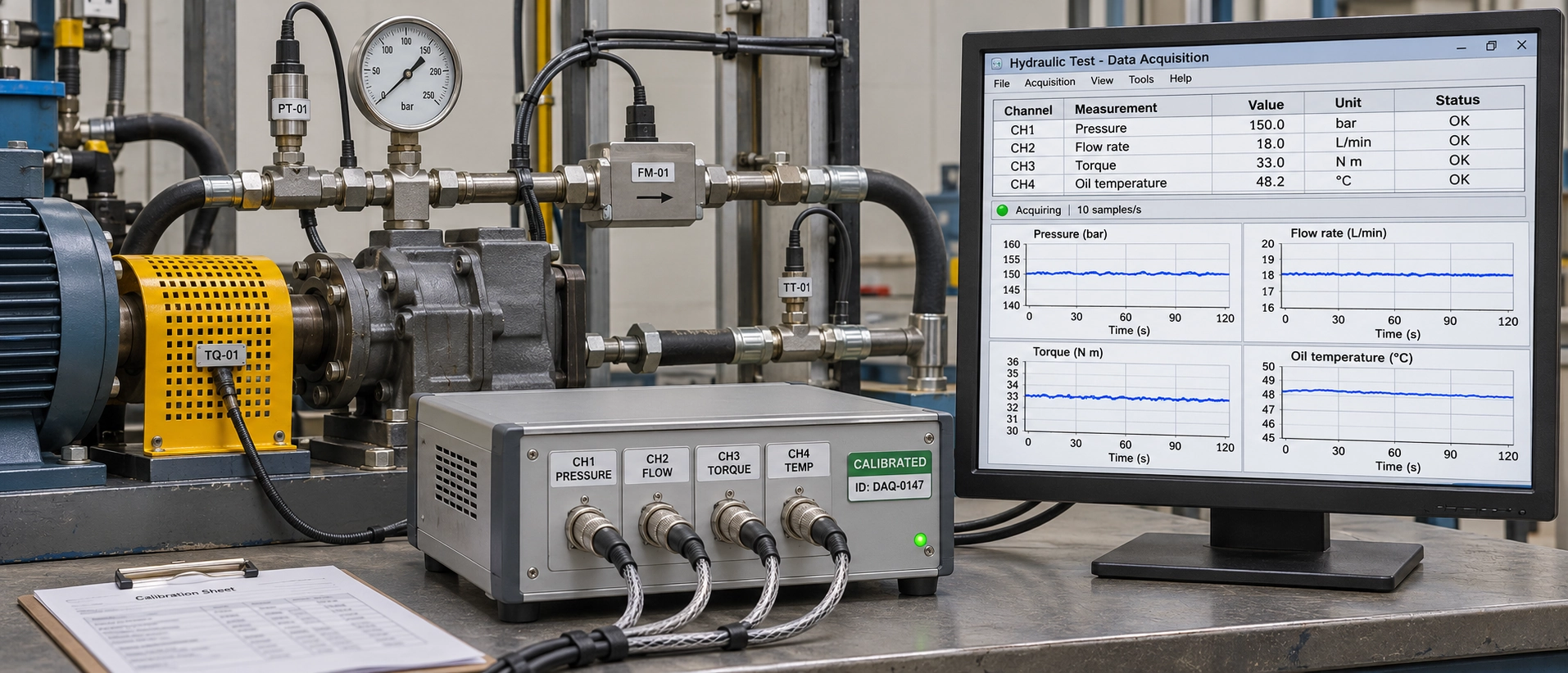
An instrument display can show a number without establishing that the complete measurement is suitable for acceptance. Review the channels used at the requested points: pressure, flow, speed and temperature, plus shaft torque where the efficiency assessment requires it.
Separate Calibration from Fitness for Acceptance
NIST explains that metrological traceability concerns a measurement result and that traceability alone does not guarantee fitness for purpose. Associated uncertainty must suit the measurement need. A calibration label therefore cannot, by itself, establish whether a result supports your acceptance tolerance. (NIST)
Use these procurement questions to request relevant evidence. They are not a universal calibration specification.
| Supplier statement | Evidence to request | Decision supported |
|---|---|---|
| Sensors are calibrated | Instrument IDs, applicable certificates, ranges and calibration status | Whether records match the channels used |
| Flow measurement is suitable | Performance at the requested flow range and fluid conditions | Whether the measurement suits the required point |
| The pump passes the tolerance | Applicable uncertainty and the agreed acceptance decision rule | How results near the limit will be treated |
| Pump efficiency is measured | Efficiency definition, calculation boundary and input/output measurements | Which efficiency claim the data support |
For overall pump efficiency, establish how shaft input power is determined. An electrical reading upstream of the drive includes a different measurement boundary. If an estimate or correction is used, ask for its method and limitations. Do not treat unexplained electrical input as measured pump shaft power.
The supplier may have adequate equipment but insufficient documentation for your decision. Record an evidence gap until it is resolved, rather than immediately assuming either conformity or nonconformity.
Confirm Fluid, Temperature and Case-Drain Conditions
Comparable results require defined conditions. Ask the supplier to state the fluid, temperature measurement location, inlet conditions and control state associated with each point. Confirm which limits come from documentation for the proposed pump.
| Condition | What to confirm |
|---|---|
| Fluid and viscosity | Fluid identity and suitability at the specified test temperature |
| Temperature and duty | Measurement location, recording conditions and ability to maintain them |
| Inlet or charge conditions | Conditions appropriate to the circuit and version |
| Case drain | Flow path, pressure measurement and applicable housing-pressure limits |
| Contamination control | Fluid handling, filtration and agreed cleanliness evidence |
The grade on an oil container does not fully describe viscosity during a hot test. For that distinction, review hydraulic oil viscosity at the test temperature. This capability review does not prescribe one oil grade or temperature for every pump.
Case-drain measurement deserves separate attention. Webtec's technical discussion explains that drain-line components can introduce restriction and raise case pressure, while drain flow may include contributions beyond wear leakage. It is commercial technical guidance, not a universal leakage limit. (Webtec)
Ask how the measurement arrangement respects pump-specific limits and whether records include the conditions needed to interpret the result. For tandem units, establish whether the reading represents one section or combined flow. The separate guide to interpreting piston pump case-drain measurements develops that diagnostic context.
Match Each Capability Claim to Evidence
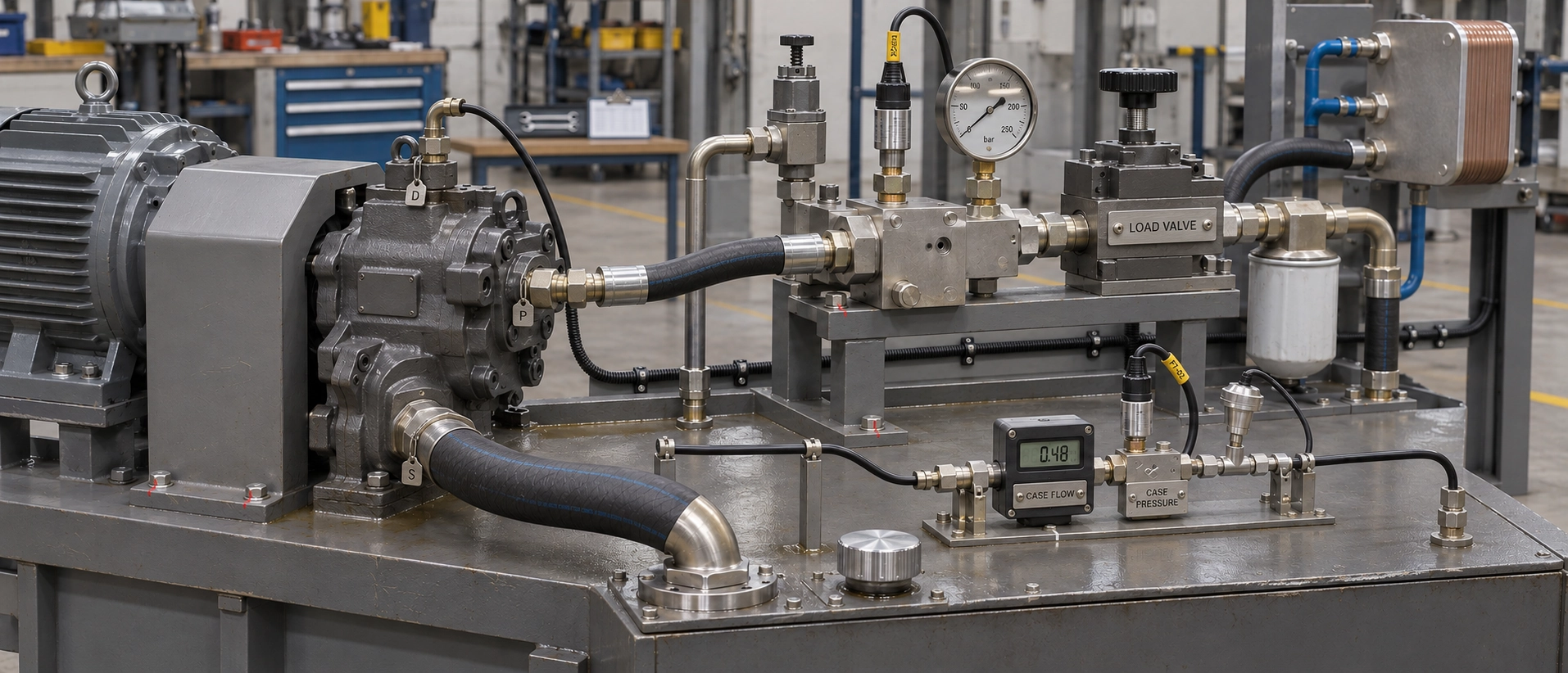
At supplier qualification, use evidence to decide whether the installed bench and proposed method cover your requirements. A photograph may help identify installed equipment, but it cannot establish a calibrated measurement range or prove that your requested operating points were completed.
A representative test record can support this capability review when its configuration and conditions are relevant. It is not a release record for a future delivery.
| Capability claim | Useful supporting material | Remaining limitation |
|---|---|---|
| Required load points are covered | Configuration-specific capability information and relevant point records | Coverage remains conditional on setup and duty |
| The control can be evaluated | Interface description, test method and corresponding characteristic records | Another control version may differ |
| Results support the tolerance | Measurement documentation and an acceptance decision rule | Calibration alone does not settle every result |
| The proposed scope can be included in the order | Written scope, exclusions and proposed documentation | Capability approval does not prove that a future delivery has been tested |
Ask What Remains Untested
Request explicit exclusions. If the supplier demonstrates steady-state performance, record separately whether transient response, endurance, cold starting or operation in the complete machine is included. Avoid interpreting silence as coverage.
A reduced-load result can be useful if both parties agree what it establishes. Retain its actual conditions rather than relabeling it as verification at an untested point.
When evidence comes from a representative unit, ask what connects that unit to the configuration under review. Differences in displacement, controls, interfaces or test conditions should be identified before the record is used to support a broader claim.
Once capability and order scope are agreed, move to reviewing pre-shipment pump test records for delivery identification, measured results, deviations and release approval. Keep those delivery checks separate from this pre-order capability decision.
Send a Test-Capability Review Package
Prepare the complete pump code, applicable specification, required operating points, circuit and control details, fluid conditions, acceptance criteria and requested documentation. Mark unknown inputs as unresolved so the supplier can identify what needs clarification.
Use this blank procurement worksheet during supplier qualification. It is a request template, not an existing test report. Attach the following identifying information to the worksheet:
- Complete pump model code, configuration and configuration revision, where applicable.
- Applicable specification title and revision.
- Proposed test procedure title and revision, subject to agreement with the supplier.
Complete one row for each required point or function and add rows as necessary. Unknown requirements should remain identified as unresolved during the review.
| Required test condition | Evidence requested | Supplier response | Coverage gap |
|---|---|---|---|
| Enter pressure difference (bar), flow (L/min), shaft speed (rpm), shaft torque (N·m) or shaft input power (kW) where required, control state and duration | Installed capability, measurement method and relevant point evidence | To be completed | To be assessed |
| Enter required control function | Compatible interface and function-specific record | To be completed | To be assessed |
| Enter required measured quantities, units, acceptance limits and specification references | Applicable measurement evidence and proposed decision rule | To be completed | To be assessed |
| Enter fluid, inlet and case-drain conditions | Method and condition records | To be completed | To be assessed |
Shaft torque or shaft input power belongs in the request where the agreed assessment requires it, such as overall or hydromechanical efficiency. This worksheet does not impose the same efficiency test on every pump.
Separate routine testing from additional validation when requesting a quotation. Ask which setup work, fixtures, documentation or outside testing require separate agreement. Compare these confirmed items instead of relying on an unsupported claim that more testing is always cheaper or faster.
For a Sheungchak OEM/ODM project, contact the team to confirm OEM pump configuration and test requirements with this review package. Request written confirmation of available test scope, supporting documents and exclusions before finalizing the order requirements. The published OEM/ODM process provides the project-review context; specific bench coverage remains subject to confirmation.