
For OEM procurement engineers and supplier quality teams, hydraulic pump testing before shipment is useful when the results identify the pump, describe the operating conditions and show how the agreed acceptance criteria were met. A pressure photograph or an unsigned "tested OK" statement leaves buyers without enough information to review the delivery.
For procurement and supplier quality teams, the practical task is to connect four things: the ordered configuration, the agreed test scope, the measured results and the release decision. This guide explains what to request and how to assess those connections before approving dispatch.
It covers positive-displacement hydraulic pumps and provides a purchasing framework; the actual test procedure and limits must come from the applicable product documentation and approved order requirements.
What Pre-Shipment Testing Can Establish
A test establishes performance only within its recorded scope. Before reviewing individual readings, ask whether the evidence concerns the delivered unit, a production sample, a prototype or a repaired pump. These records answer different questions.

| Evidence presented | What the buyer can assess | What still needs separate evidence |
|---|---|---|
| Identity and configuration checks | Whether the inspected item matches the specified configuration | Hydraulic performance under load |
| Recorded steady-state operating points | Performance at the stated pressure, speed, fluid conditions and control state | Unmeasured points and transient behavior |
| Defined control-function checks | Whether the specified function met its agreed criteria | Compatibility with every machine circuit |
| Prototype or endurance results | Behavior of the tested design or specimen under the documented program | Whether the delivered unit received the required production checks |
ISO 4409:2019 addresses steady-state performance measurement for rotating positive-displacement hydraulic components. Its public description covers test arrangements, procedures and reporting. Naming the standard alone does not establish that a supplier followed it or that an order passed its acceptance requirements. (ISO)
Ask the supplier to identify the procedure used and the supporting records. If the report states that a standard was followed, clarify the edition and scope claimed. Keep the test method, the product's operating limits and the order's acceptance criteria distinct.
To organize the acceptance review, follow this sequence:
- 1Confirm the configuration and acceptance basis;
- 2Agree on the test scope and conditions;
- 3Obtain the applicable inspection and measurement records;
- 4Compare results with the approved criteria;
- 5Document any disposition and authorized release.
This is a purchasing framework, not a description of a particular factory's test procedure.
Sheungchak's published inspection and testing information describes inspection resources and pre-shipment checks. That company description provides background; the test scope and records available for a particular order still need confirmation.
Agree on the Pump Configuration and Acceptance Criteria
The complete configuration should be agreed before testing. A family name or displacement does not fully identify the item being accepted. The buyer's technical schedule should cover the full model code, rotation, shaft, mounting, ports and control configuration, together with any approved deviations.
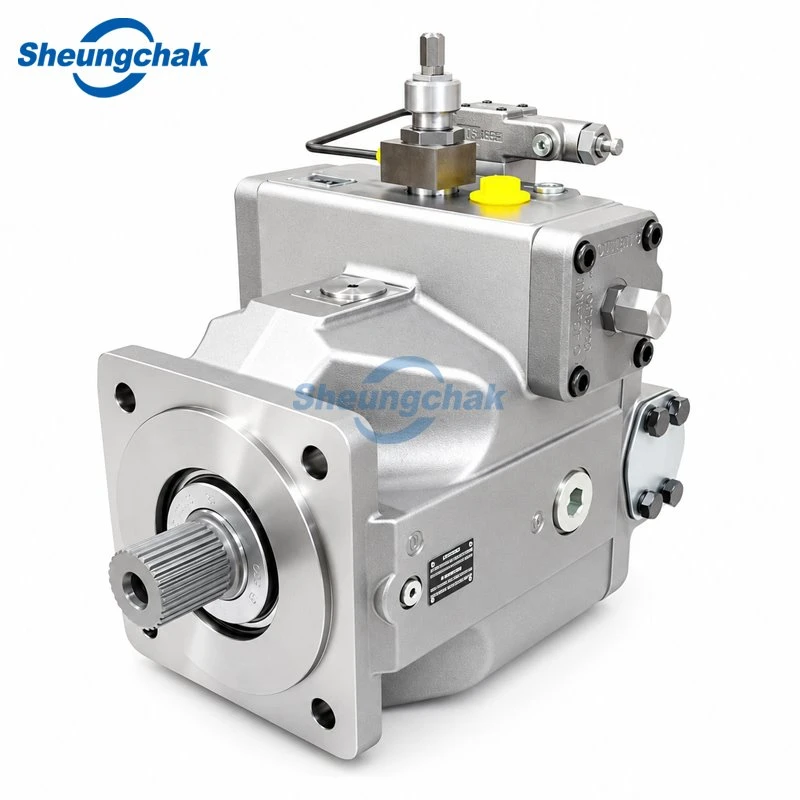
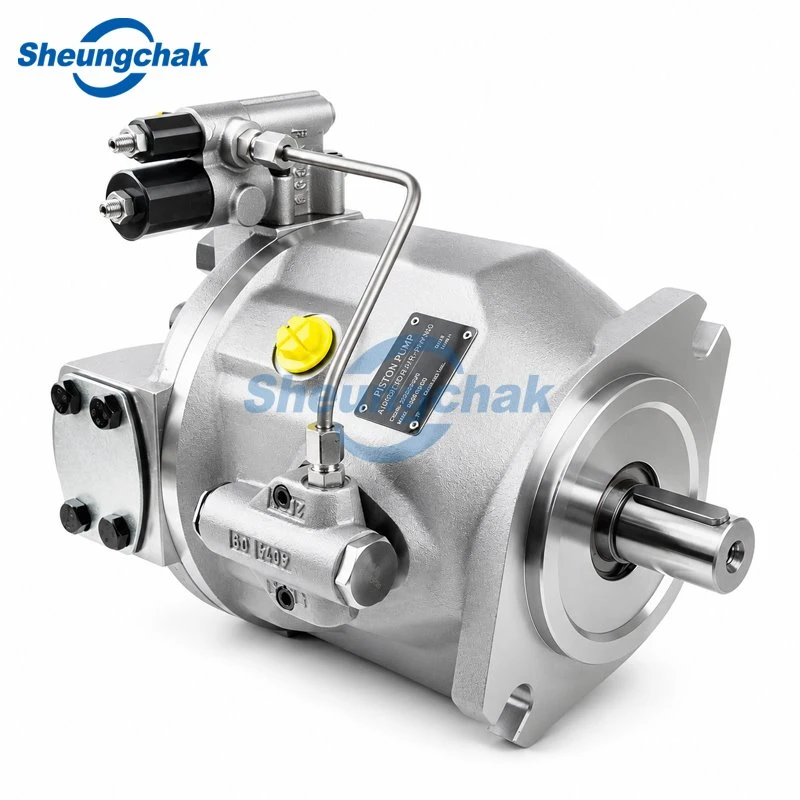
For example, the A10VSO pump configuration and control options provide a product-specific starting point for identification. Catalog information helps define the requested configuration; it is not evidence of the operating points measured on the delivered pump.

Detailed inspection of a variable displacement hydraulic piston pump configuration prior to shipment.
Acceptance criteria should identify the relevant specification and revision, the required test points, the measured quantities and the permitted limits. Where the requirement concerns a setting, state the setting and the conditions under which it is checked. Where it concerns performance, specify the corresponding operating conditions rather than asking for a general "full-pressure test."
If the order does not define these requirements, resolve the gap before dispatch approval. A report cannot establish compliance with a criterion that neither party has defined.
Separate Routine Checks from Order-Specific Tests
Request a scope table that distinguishes checks included in the supplier's routine inspection from additional requirements for the order. Possible subjects include dimensional verification, external leakage observations, selected pressure-flow points, control settings and agreed documentation.
These are subjects to discuss, not a statement that every supplier performs every check. Confirm whether each requirement applies to every unit or a defined sample, and how results will identify the tested items. Additional environmental, endurance or machine-integration tests need their own agreed scope; they should not be inferred from a routine test certificate.
Record the Conditions Behind Every Test Point
A reading becomes useful when its conditions are known. When comparing results with a reference or another report, check that differences in speed, temperature and control state have been addressed. Pico Technology's pump-performance guidance, published by a measurement-equipment supplier, explains why speed and oil temperature matter when comparing pressure-flow measurements. Its field-diagnostic context should not be mistaken for a production acceptance specification. (Pico Technology)
Use the following as a report-review checklist, adapting the fields to the approved procedure.
| Field | What to request | Why it matters |
|---|---|---|
| Pressure | Inlet and outlet pressure, or differential pressure where required; units and measurement locations | Identifies the pressure condition being evaluated |
| Delivered flow | Value, unit, measurement location and corresponding test-point reference | Connects delivery to the stated load condition |
| Shaft speed | Actual measured speed and unit | Makes the flow comparison interpretable |
| Test fluid and temperature | Fluid identity, measured temperature and location | Helps establish comparable fluid conditions |
| Control state | Control configuration, command or setting, and relevant signal conditions | Explains the intended displacement response |
| Case-drain flow and case conditions, where applicable | Measured case-drain flow, unit, measurement point and method, included control or auxiliary flows, and case pressure | Helps distinguish measured leakage-related flow from control flow and identify the conditions affecting the reading |
Match the pressure quantity to the acceptance basis. If a requirement is defined by the pressure difference across the pump, an outlet gauge reading alone does not establish that difference. Confirm the inlet and outlet measurement locations and a consistent pressure reference before comparing results. The approved procedure determines which measurements are required.
A fluid grade by itself does not describe the fluid's condition during measurement. For the relationship between temperature and viscosity, see the guide to hydraulic oil viscosity at the test temperature. The test report should still record the actual conditions required by its procedure.
Pressure and Flow Must Refer to a Defined Operating Point
Treat each pressure-flow point as a related set of measurements. A maximum-pressure reading from one stage and a maximum-flow reading from another do not demonstrate that both occurred together.
Ask which combinations were actually measured and whether any requested conditions were outside the available test scope. If separate checks were used, keep them separately identified. The buyer can then assess whether the documented coverage satisfies the order, without assuming an unrecorded full-power operating point.
Key point: The requirement is not to demand maximum pressure and maximum flow simultaneously for every pump. It is to agree on relevant points and obtain evidence for those points. A clear statement of limited coverage is more useful for acceptance than an undefined claim of complete testing.
Account for Variable-Displacement Controls
A change in flow needs to be read alongside the control state. Pressure compensation, load sensing or another configured control can alter displacement as conditions change. Webtec's guidance explains how variable-pump controls change displacement and output flow. (Webtec)
For a variable-displacement pump, identify the commanded or expected response, applicable settings and the basis for judging the result. Do not compare an intentionally destroked condition with a full-displacement reference and call the difference a failure. Equally, a general explanation about control behavior is not a substitute for evidence that the specified function passed its agreed check.
Interpret Leakage and Functional Checks in Context
Delivered flow, case-drain flow and external leakage describe different observations. Case-drain flow is not a universal measure of all internal leakage: the flow reaching the case depends on the design and may include control-related flow. Webtec, a hydraulic measurement-equipment manufacturer, discusses these limitations in its case-drain guidance. (Webtec)

Hydraulic pump case-drain flow measurement and testing analysis on test bench.
For applicable pumps, review the case-drain reading against the specified pressure, speed, fluid condition and control arrangement. Also ask how the measurement was taken. Webtec explains that measurement resistance and case-pressure effects can influence the arrangement; adding an instrument is not automatically neutral. The applicable pump documentation must govern allowable case conditions. (Webtec)
The separate guide to interpreting piston pump case-drain readings provides diagnostic context. For shipment acceptance, the immediate question is narrower: does the result meet the approved criterion under the recorded conditions?
Functional observations also need a defined scope. "No external leakage observed" should relate to the conditions and period inspected. A control-function result should identify the function checked and the required outcome. Neither statement should be expanded into a lifetime leak-free or machine-performance guarantee.
Avoid Universal Pass-or-Fail Numbers
Do not apply an unsourced leakage percentage, temperature limit, efficiency threshold or test duration across different pump designs. Use the limits approved for the specific configuration and test conditions.
If a report contains a result without its criterion, request the missing basis. If the result conflicts with the criterion, request a documented disposition. These are different situations: incomplete evidence needs clarification, while a recorded nonconformance needs technical review. Buyers should avoid turning either into an unsupported diagnosis based on a generic rule.
What a Useful Factory Test Report Should Include
A useful factory test report allows another reviewer to follow the acceptance decision. The following fields are procurement recommendations, not a claim that ISO 4409 mandates this exact template.
Where overall or hydromechanical efficiency is part of the approved acceptance scope, request the applicable shaft input torque or power measurements, calculation basis and associated operating conditions. Volumetric efficiency instead requires a defined displacement and shaft speed together with measured delivery; do not treat these different efficiency measures as interchangeable. (Applied Industrial Technologies, Fluid Power Formulas)
Each result should connect a test-point identifier, specified conditions, actual conditions, the measured value and unit, the applicable limit, the acceptance decision and any disposition reference. Keep these fields separate: a catalog limit is not a measured result, and a measured result without its acceptance basis is not a complete pass decision.
| Report section | Recommended information |
|---|---|
| Item identification | Complete model/configuration and a serial, job or other agreed traceable identifier |
| Order reference | Purchase order or job reference, quantity represented and approved deviations |
| Acceptance basis | Procedure/specification title, revision and applicable limits |
| Test conditions | Actual operating conditions associated with each point |
| Results | Measured values, units and comparison with the criteria |
| Measurement traceability | Relevant instrument identification and calibration status or supporting reference |
| Coverage | Checks completed, checks omitted and conditions not tested |
| Disposition | Deviations, corrective action and retest references where applicable |
| Responsibility | Test date, responsible personnel and authorized release record |
Traceable records are a practical supplier question. In its repair-service description, Bosch Rexroth Africa discusses recording and retaining test information through its CADASYS system and providing customer documentation. That is a published commercial service example, not evidence that another supplier uses the system or that all new-pump reports follow the same format. (Bosch Rexroth Africa)
A pass statement that omits the required measured flow or shaft speed does not provide enough evidence to confirm compliance. Request the missing evidence. A complete record showing a value outside the approved limit instead identifies a nonconformance requiring formal disposition.
Match Results to the Pump and the Order
Cross-check the report identifier with the delivery documentation and the identification on the supplied item. Where a batch or sample report is used, confirm which units it represents and whether that arrangement meets the order.
Review revisions as well as identifiers. An earlier report may describe a configuration or setting that changed later. If the item was reworked or retested, ask which record supports the final delivered condition and whether the earlier result has been superseded. Keep the approved deviation or retest reference with the release documentation so the reason for acceptance remains clear.
Confirm Test Coverage Before Approving Dispatch
Review the evidence against the agreed requirements before deciding whether the shipment is ready. The following decision aid supports review; it does not replace the buyer's authorized quality process.
| Evidence status | Appropriate next action |
|---|---|
| Required results and traceability are complete, with criteria met | Route the evidence for authorized release |
| Conditions, identification or acceptance basis are missing | Request clarification or corrected records; keep the affected acceptance decision open |
| A required test has not been completed | Arrange completion before release, unless the order permits deferral and the authorized approval records the remaining requirement and responsibility |
| A measured result does not meet its approved criterion | Record the nonconformance and obtain formal technical disposition; any corrective action, retest or acceptance of a deviation must follow the authorized approval process |
Clarify Any Untested Conditions
A steady-state record does not, by itself, establish transient response, endurance or performance in every installed system. List any requirements outside the completed program and confirm who is responsible for the remaining validation. Do not silently broaden the meaning of a pass result.
Before dispatch, also confirm the agreed arrangements for identification, port protection, preservation and packaging where these affect the handover. These are matters to verify with the supplier, rather than procedures established by this guide.
Next step: For a Sheungchak sourcing project, confirm OEM pump testing requirements by submitting the complete model code, application conditions, proposed acceptance criteria and required report fields. Ask the team to confirm the available test scope, supporting documentation and any exclusions before the order's release requirements are finalized.