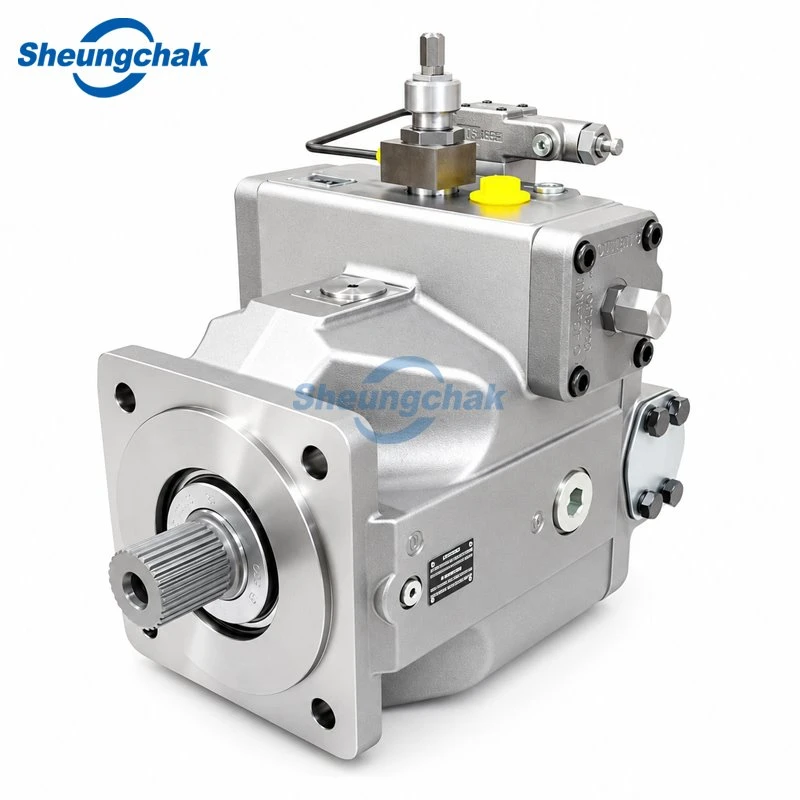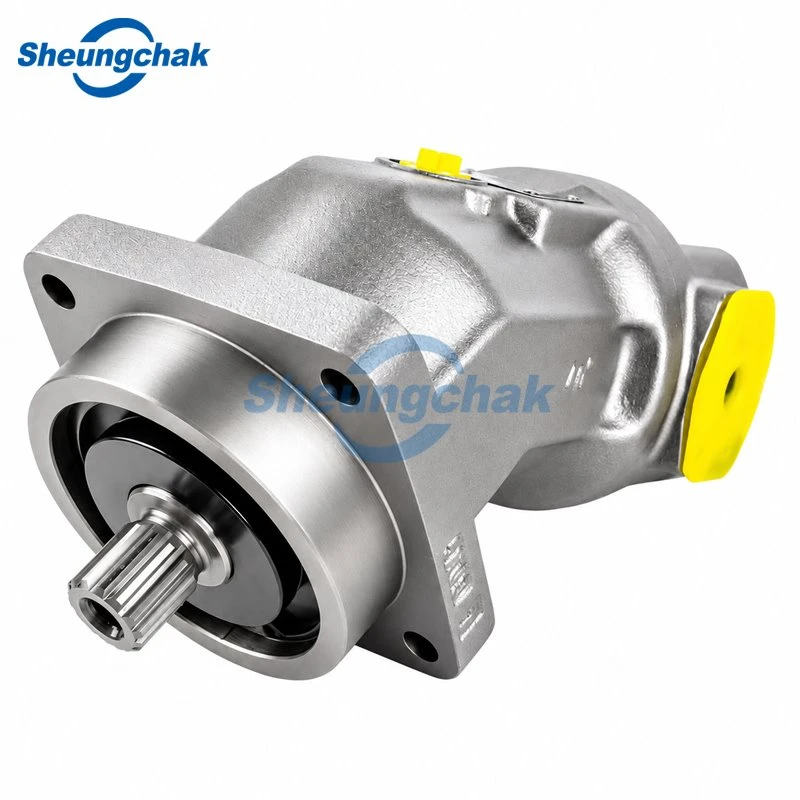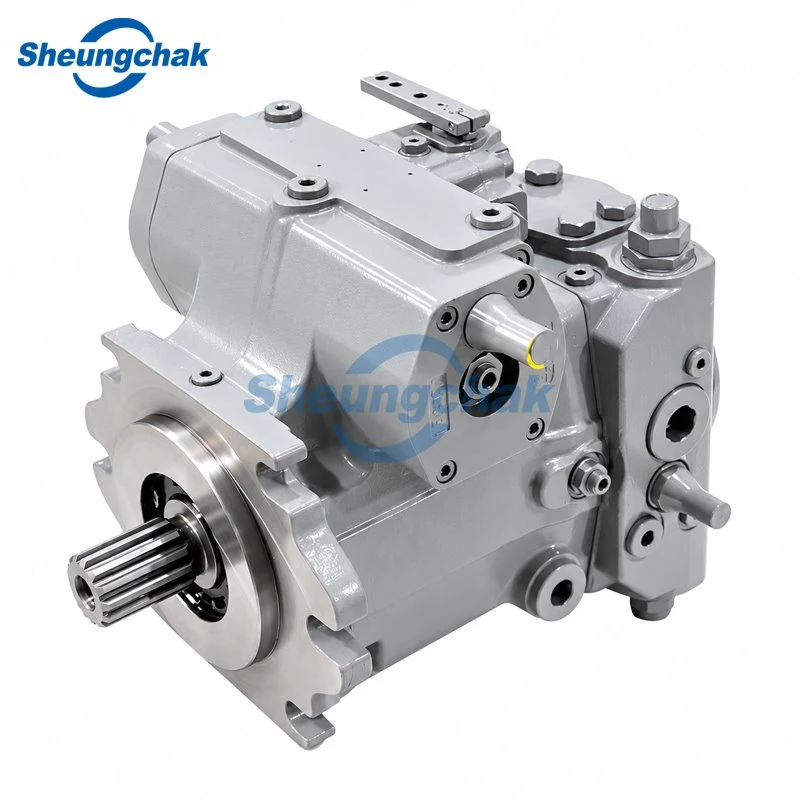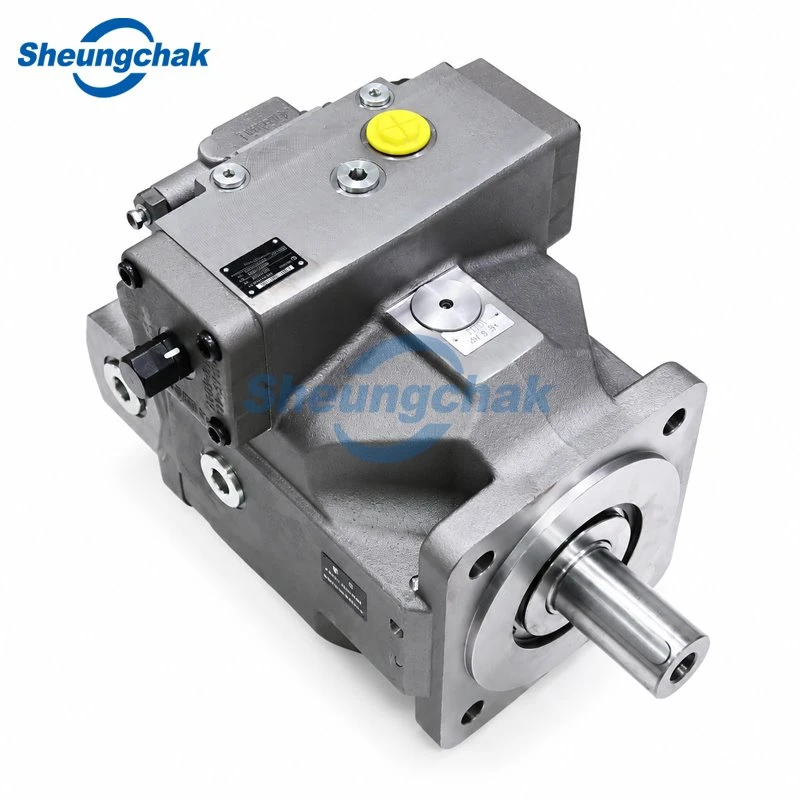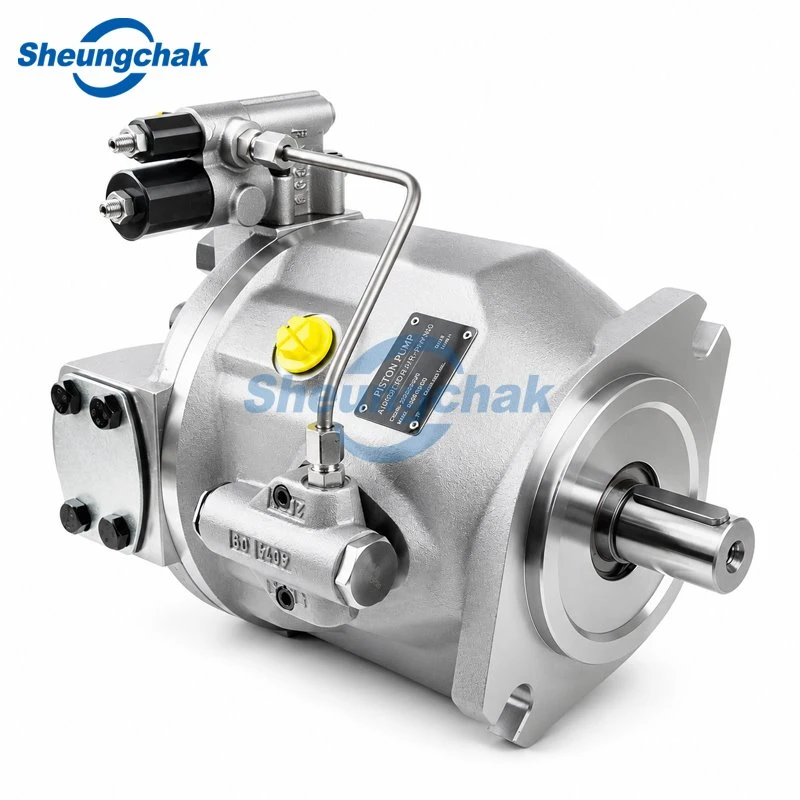

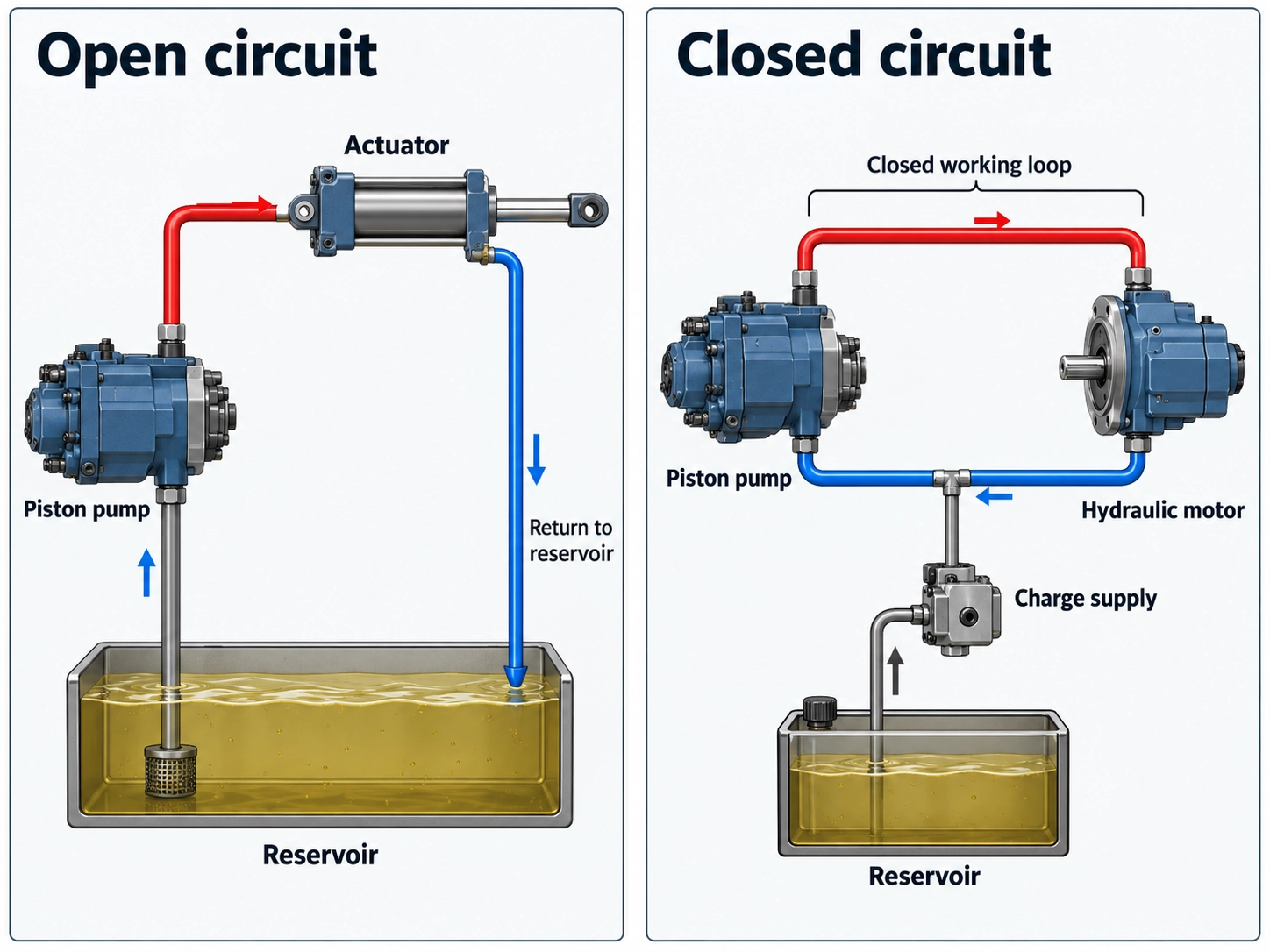
The first question when selecting a piston pump is where the oil goes after it leaves the actuator. In an open circuit, the pump draws oil from a reservoir and the actuator's return oil flows back to that reservoir. In a closed circuit, the pump and hydraulic motor form a working loop: most return oil goes directly back to the pump. A separate charge supply replaces leakage and supports loop conditioning. These different oil paths affect the pump, controls, cooling arrangement and replacement specification. (HAWE Hydraulik; Danfoss)
Neither circuit label establishes the better pump for every machine. Begin with the function the pump serves, then confirm how the complete circuit supplies oil, reverses motion and removes heat.
Trace the oil path before comparing pumps
A simplified open-circuit path is:
Reservoir → piston pump → control valve → actuator → reservoir
The pump takes its inlet supply from the reservoir. Directional valves can route its output to a cylinder or motor, and one pump can supply multiple work functions when the control system is designed for them. In an open circuit, reversing an actuator does not require reversing the pump's delivery direction; a directional valve can change the actuator's flow path. (HAWE Hydraulik; Danfoss)
A simplified closed-circuit drive is:
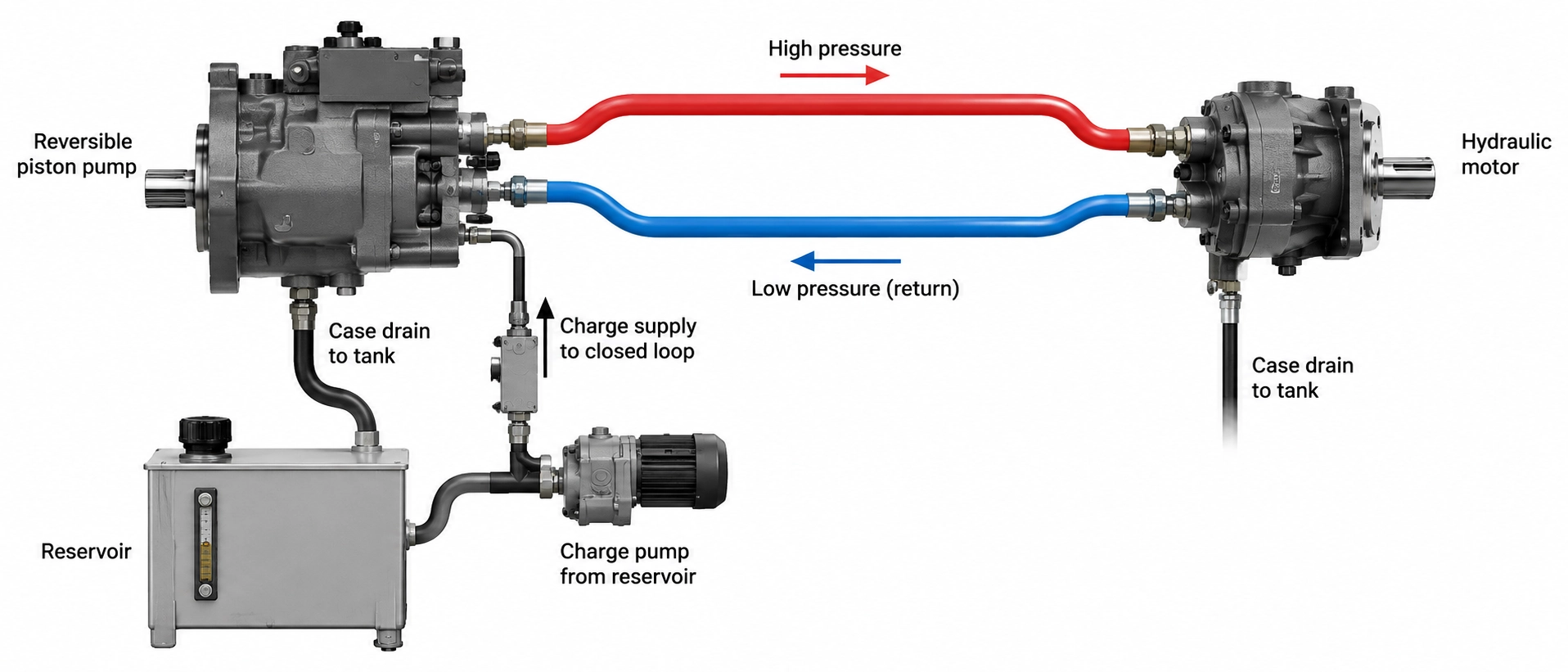
The main pump ports connect to the motor's ports. Changing the swashplate angle across neutral can reverse the main flow and the motor's rotation. The loop still needs a reservoir connection: Danfoss's closed-circuit design uses a charge pump for replenishment, cooling oil and control flow, and shows case drains and a heat exchanger outside the main working loop. The drawing above is a routing aid, not an installation schematic. (Danfoss)
That distinction is the first replacement check. A pump with a reservoir-fed inlet and one system outlet cannot be treated as interchangeable with a reversible pump whose two main ports form a hydrostatic loop. Matching displacement or mounting dimensions alone does not resolve the circuit difference.
Match the circuit to the machine's work
| Machine requirement | Starting point | What still needs checking |
| Several valve-controlled cylinders or motors share a supply | Open circuit | Required flow across simultaneous functions, valve arrangement, pump control and return-oil conditioning |
| A dedicated motor must drive in both directions through a hydrostatic transmission | Closed circuit | Reversible pump control, charge supply, loop protection, flushing and cooling |
| A motor runs mainly in one direction | Decide from the complete duty cycle | Required speed control, stopping or braking behavior, heat rejection and any other functions sharing the pump |
The first two starting points follow the circuit arrangements documented by pump manufacturers: an open-circuit pump can serve multiple work functions, while a reversible closed-circuit piston pump can control a hydrostatic motor's direction by changing pump displacement. The third case needs more information because motor rotation alone does not identify the circuit. (Danfoss, open-circuit controls; Danfoss, closed-circuit pumps)
Consider a machine with lifting and positioning cylinders operated through a valve bank. Its oil path and need to distribute flow among functions point toward an open-circuit supply. The pump's control still matters: Danfoss describes pressure-compensated and load-sensing open-circuit controls that change pump output in response to system requirements. "Open circuit" therefore does not mean "fixed flow at all times." (Danfoss)
For a dedicated bidirectional travel drive, a closed-circuit arrangement may be appropriate because the pump can change motor direction through its displacement control. That decision also brings charge-pressure, leakage, cooling and control requirements into the specification. A replacement inquiry that gives only the main pump displacement leaves those requirements unresolved. (Danfoss)
For a conveyor or fan motor that runs predominantly one way, ask how speed is controlled and what happens during stopping, overrunning or abnormal load conditions. Check the entire operating cycle before drawing an efficiency or cost conclusion. Valve losses, pump and motor losses, charge flow and cooling demand belong to different parts of the system; a circuit name by itself does not quantify any of them.
Keep "closed centre" separate from "closed circuit"
A closed-centre valve describes what a directional valve does in its neutral position. A closed circuit describes where the actuator's return oil goes. An open-circuit piston pump can operate with a closed-centre control valve; Danfoss documents both pressure-compensated and load-sensing examples. Seeing "closed centre" on a valve specification is therefore insufficient evidence that the machine needs a closed-circuit pump. (Danfoss)
When a drawing or parts list uses the word closed, follow the oil lines. If actuator return oil reaches the reservoir before the pump draws it again, classify that working path as open circuit. If a motor returns its main flow directly to a pump port, examine it as a closed-circuit drive and identify its separate charge and case-drain paths. (HAWE Hydraulik; Danfoss)
Check the support circuit, not just the main pump
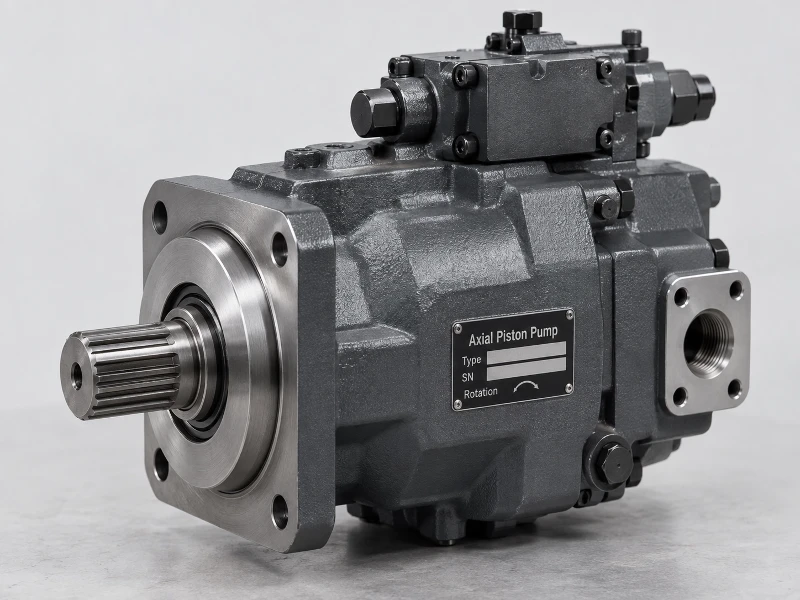
In an open circuit, confirm how the reservoir supplies the pump inlet and how return oil is filtered and cooled. The selected pump control must also match the machine's valves. For example, Danfoss's load-sensing open-circuit control uses a signal from a compatible control valve to adjust flow to demand. Substituting a pump with a different control arrangement can change the behavior of the whole hydraulic system even when the mechanical interface fits. (Danfoss)
In a closed circuit, confirm the charge path and how the working loop exchanges hot oil. Danfoss identifies an integral charge pump in its Series 90 closed-circuit pumps and an optional motor loop-flushing feature. Those are documented features of that product family, not proof that every closed-circuit pump has the same configuration. The applicable pump and motor documents must establish the actual charge, filtration, flushing and cooling arrangement. (Danfoss)
Pressure and efficiency claims also need product-specific evidence. Do not transfer a rating from one pump family or circuit example to a proposed replacement. Confirm the permitted operating conditions in the data sheet for the exact configuration, then assess the machine's load and duty cycle against that document.
Specify a replacement that can be checked
A useful replacement request lets the supplier compare the installed unit with the proposed unit field by field. Collect:
| 1 | Circuit evidence: a hydraulic schematic or clear photographs showing the pump connections, motor or valve bank, reservoir feed and return path. |
| 2 | Pump identification: the complete model code, nameplate photograph, series and any available original documentation. |
| 3 | Working requirements: the machine function, direction of operation, required flow or displacement, operating pressure, input speed and duty cycle. |
| 4 | Controls and auxiliary paths: the control type and signal, charge arrangement where applicable, case-drain connection, filtration and cooling provisions. |
| 5 | Mechanical interfaces: input rotation, shaft, mounting flange, port locations and available installation space. |
| 6 | Unresolved differences: any field or connection the proposed replacement does not match, for written review before ordering. |
The value of the full model code is especially clear with closed-circuit pumps. Sheungchak Hydraulic's A4VG model-code reference explains why a short family-and-size designation cannot establish the complete control and interface configuration. Use the document matching the installed pump's series and region when interpreting that code.
Once the circuit and configuration are known, review the relevant hydraulic piston pump range for an appropriate product family. The range includes products identified for open-circuit applications and products identified for closed-circuit hydrostatic drives. A category match is a starting point; the full specification determines whether a particular unit is suitable.
For a replacement review, send Sheungchak Hydraulic the nameplate, circuit drawing and completed checks above. Ask for a proposed configuration and a written list of any differences so your engineering team can assess compatibility before purchase.