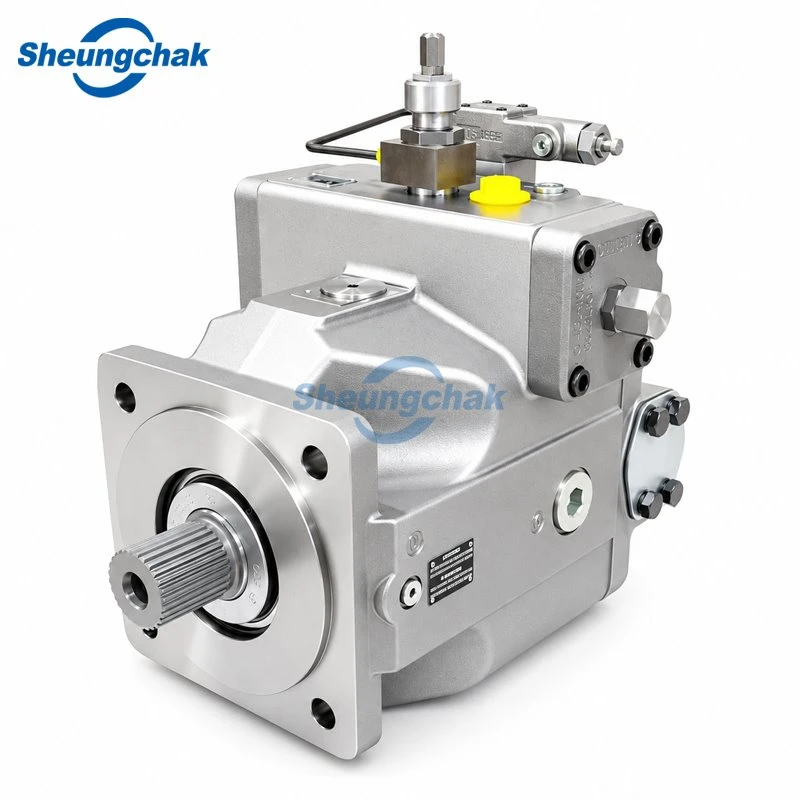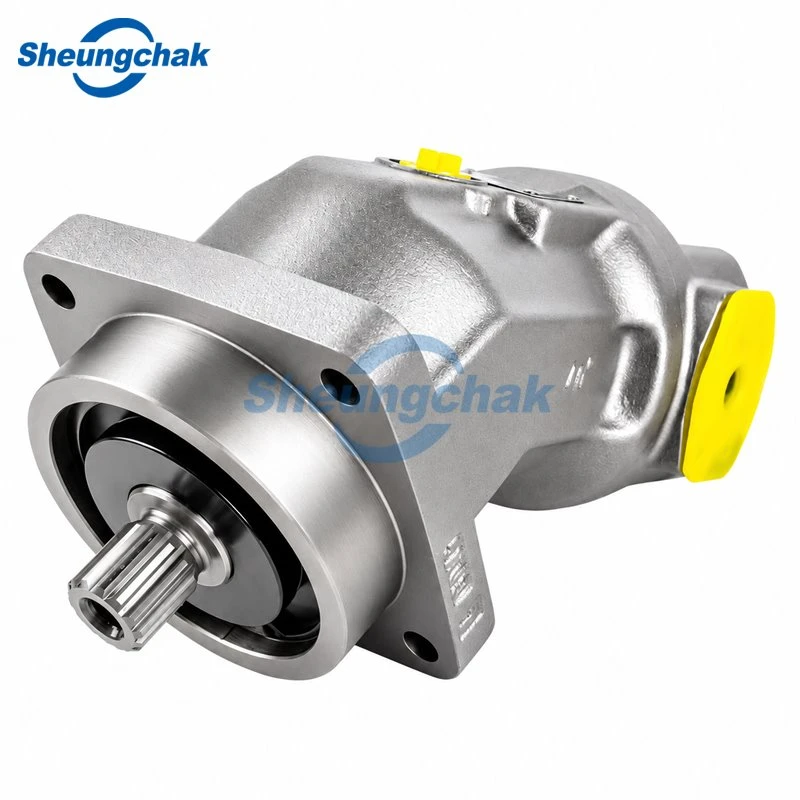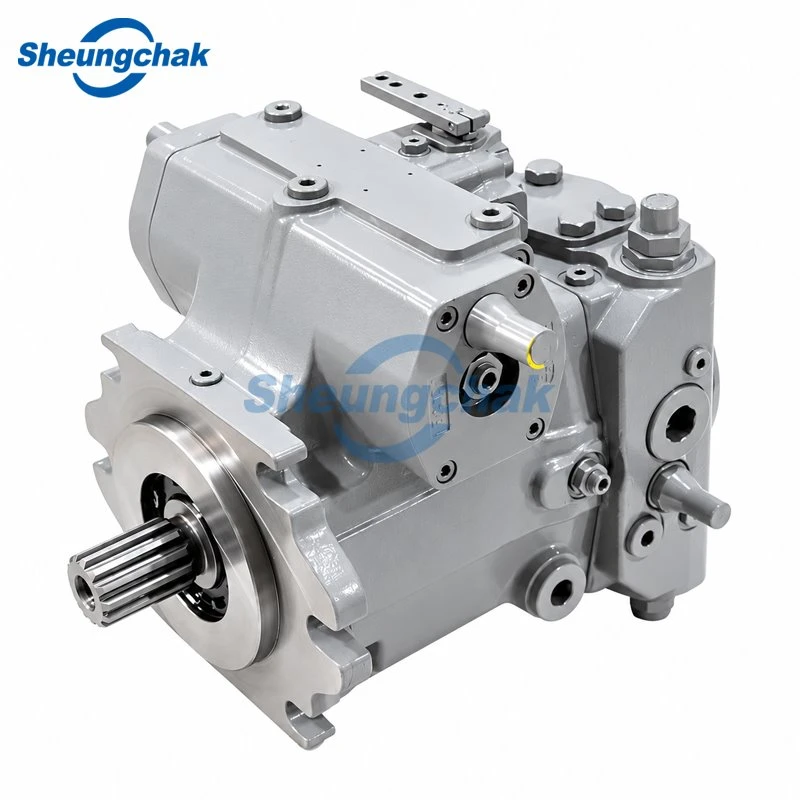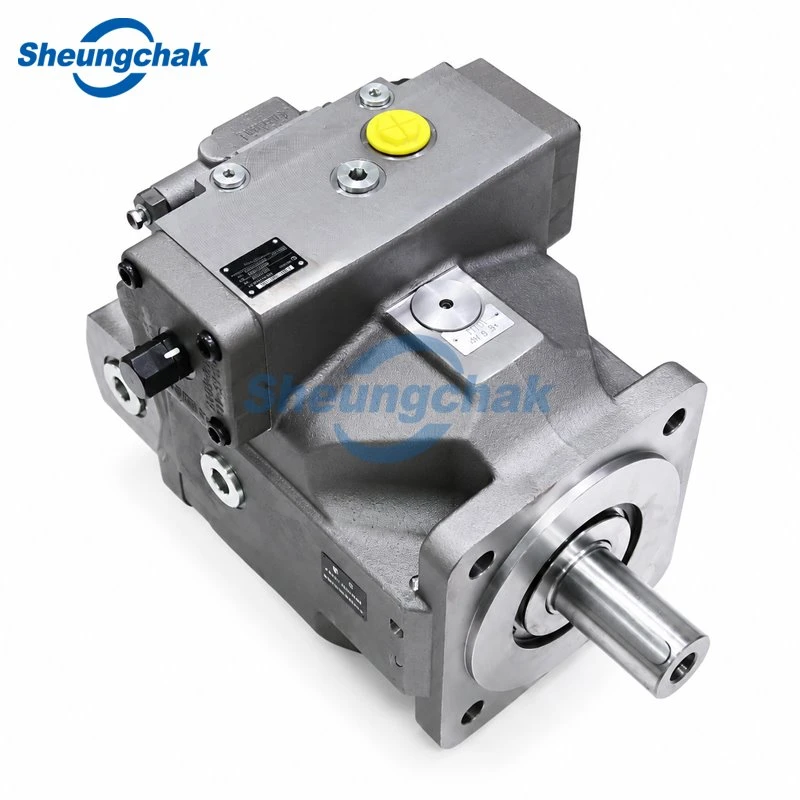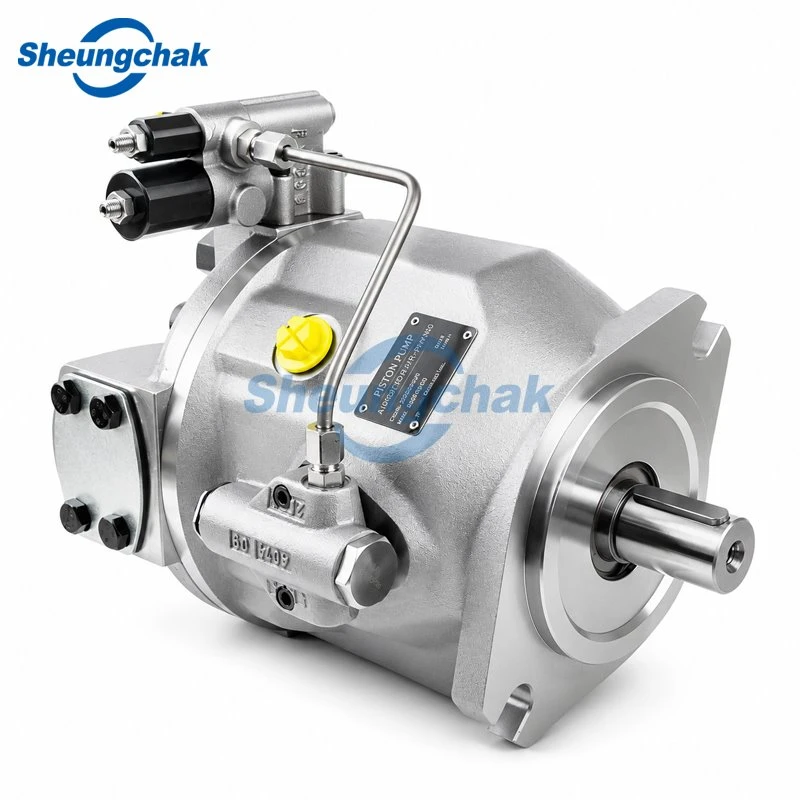

Swashplate and bent-axis units are both axial piston machines. They use the same basic parts: a rotating cylinder barrel, pistons parallel to the barrel axis, and a valve plate that alternates pressure and suction. What differs is where the angle sits and which part carries the load.
That one choice affects maximum speed, starting torque, displacement range, how the shaft handles side loads, cost, and whether one unit can be swapped for another.

Where the angle sits and what drives what
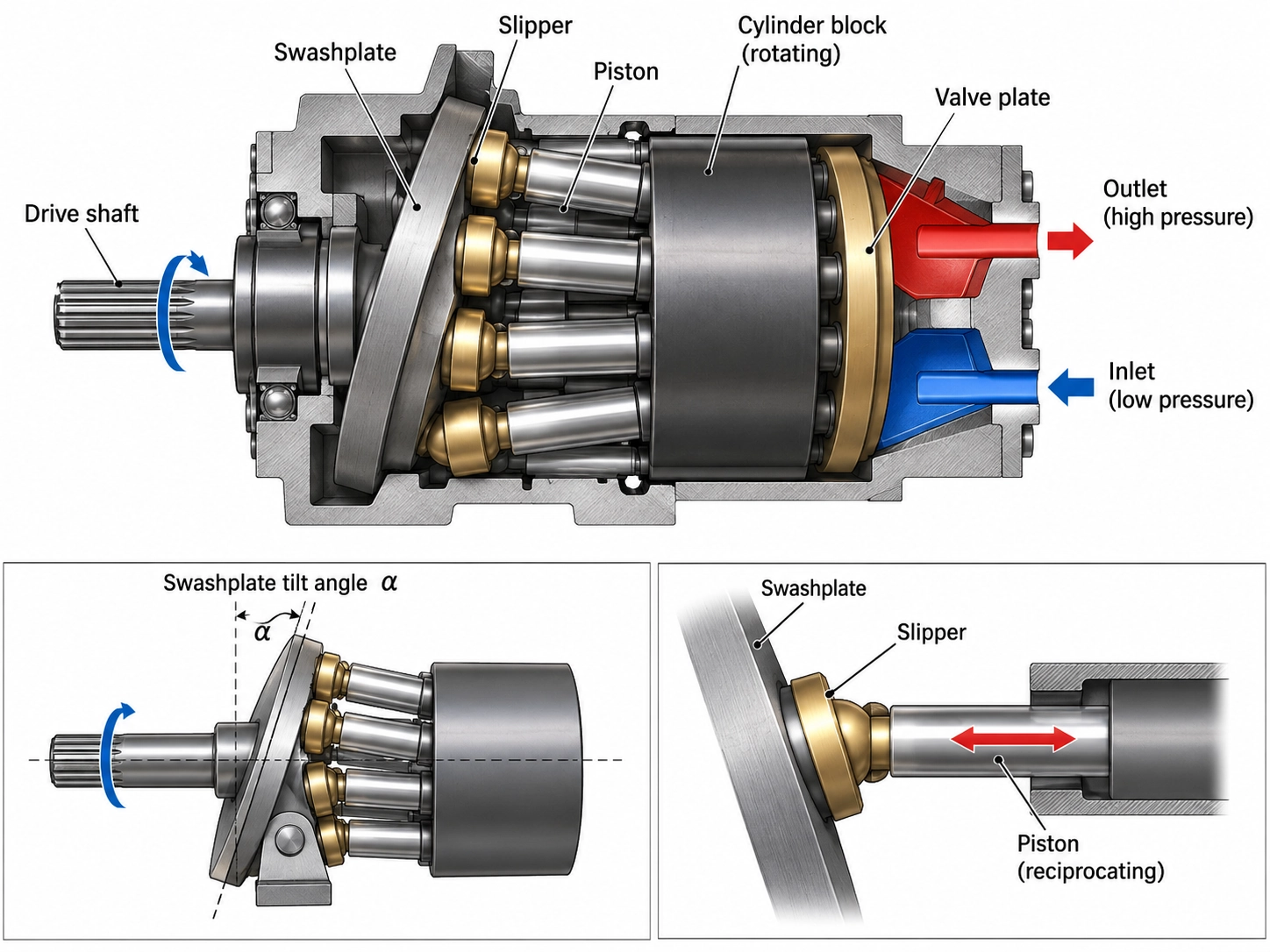
Swashplate (in-line) design
The drive shaft and cylinder barrel share one axis. The pistons ride on slippers against an inclined plate. As the barrel turns, the plate's angle makes each piston stroke in and out. In a motor, pressurized pistons push against the inclined plate, which makes the barrel turn, and the barrel then turns the shaft.
Insane Hydraulics sums up the direction of force like this: in swashplate motors the barrel drives the shaft. (Insane Hydraulics)
Bent-axis design
The cylinder barrel is tilted relative to the shaft. The pistons connect to a drive flange on the shaft, so piston force goes straight into the shaft. A synchronizing element then keeps the barrel turning with the shaft. That element can be a center shaft, the piston rods themselves, or a timing gear. Here the shaft drives the barrel. (Insane Hydraulics)
Parker, for example, uses a timing gear to synchronize the shaft and barrel in its F11/F12 series. (Parker Hannifin, catalogue MSG30-8249/UK)

Why the angle matters
Piston stroke rises with the angle. A swashplate angle is typically limited to under about 20°, while a bent-axis unit can be bent to about 40°. (Hydraulic Supermarket, Brendan Casey) Real products span that range:
<20°
Typical swashplate limit
~40°
Bent-axis upper range
40°
Parker F11/F12
32°
Danfoss H1B
- Parker's F11/F12 fixed units use a 40° angle between shaft and barrel, which the company credits for a compact, lightweight unit. (Parker Hannifin)
- Danfoss's H1B variable bent-axis motor works at up to 32°. (Danfoss)
A longer stroke means more displacement from a smaller barrel and fewer, smaller rotating parts. That is where most bent-axis advantages come from.
What two catalogue units show at the same displacement
General comparisons are easier to judge with real data. The table below puts two Bosch Rexroth fixed-displacement motors of about 45 cc/rev side by side, one of each design. Both figures come from the manufacturer's data sheets. The theoretical rows are calculated as explained under the table.
| Parameter | A10FM 45 (swashplate) | A2FM 45 (bent-axis) |
| Displacement Vg | 44.5 cm³/rev | 45.6 cm³/rev |
| Nominal / maximum pressure | 280 / 350 bar | 400 / 450 bar |
| Maximum speed (data sheet) | 4,000 rpm | 5,600 rpm |
| Theoretical torque at nominal pressure | 198 Nm | 290 Nm |
| Theoretical flow at max speed | 178 L/min | 255 L/min |
| Theoretical hydraulic power (nominal pressure, max speed) | ≈ 83 kW | ≈ 170 kW |
| Source | Bosch Rexroth RE 91172 | Bosch Rexroth RE 91001 |
How the calculated rows were worked out
• Theoretical torque T = Vg × Δp / (20π), in Nm, with Vg in cm³ and Δp in bar
• Flow Q = Vg × n / 1000, in L/min
• Power P = Q × Δp / 600, in kW
These figures leave out volumetric and mechanical losses. They also don't represent a continuous duty rating, because a unit is not meant to run at maximum speed and nominal pressure at the same time for long.
How to read the table:
At almost the same displacement, the bent-axis unit is rated about 40% faster (5,600 vs 4,000 rpm). This matches Casey's general point that a bent-axis motor can run much faster than an in-line design of the same displacement.
The two data sheets place the families in different pressure classes. With both higher pressure and higher speed, the bent-axis unit handles about twice the theoretical hydraulic power in a similar displacement class.
The swashplate data sheet lists a starting torque at 0 rpm and 280 bar of 170 Nm for size 45. Its theoretical torque is 198 Nm, so it delivers about 86% at breakaway. For the smaller size 23, the ratio is lower: 75 of 105 Nm, about 71%. (Bosch Rexroth RE 91172) The A2FM data sheet lists "good starting efficiency" as a feature but, in the edition reviewed, gives no breakaway torque table. Casey puts the bent-axis breakaway advantage at about 5% over an in-line motor of the same displacement.
These are two product families from one manufacturer, not a law of physics. Some swashplate pumps, for example, run at higher pressures than the A10FM. Use the table to see the kind of differences to look for, then check the actual data sheets for your units.
Trade-offs that change the decision
| Factor | Swashplate | Bent-axis |
| Maximum angle | Typically < 20° | Up to about 40° |
| Speed at given displacement | Lower | Higher |
| Breakaway / low-speed torque | Lower; drops further on small sizes (see table above) | Around 5% higher (Casey) |
| Variable displacement range | Narrower | Around twice the stroke ratio (Casey) |
| Going to zero displacement | Common | Some models can, not all |
| External radial shaft load | Check data sheet; often limited | Heavy roller bearings designed for it |
| Through-drive for tandem pumps | Widely offered (e.g. A10VSO) | Confirm per model |
| Purchase cost | Lower | Higher, often significantly (Casey) |
Sources: angle, stroke ratio, breakaway torque and cost are from Hydraulic Supermarket. Zero displacement and bearings are covered in the points below.
A few of these rows need more context:
It is often said that only in-line motors can stroke to zero, which some drives need to freewheel or switch modes. Casey's wording is more careful: not all variable bent-axis motors can go to zero. Danfoss offers a bent-axis variable motor with zero-degree capability. (Danfoss H1B) If your drive needs zero displacement, write it into the spec and confirm it for the exact model. Don't assume it from the design type.
In a bent-axis unit, piston force goes straight into the shaft, so the shaft bearings carry heavy loads. Casey notes these bearings are more prone to early failure than in-line shaft bearings. Mobile Hydraulic Tips says you are more likely to replace bearings on a bent-axis pump. (Mobile Hydraulic Tips)
Those same large tapered roller bearings are why bent-axis units tolerate outside side loads well. Parker says its heavy-duty roller bearings allow substantial external axial and radial shaft loads. Mobile Hydraulic Tips calls bent-axis a strong choice for pumps driven by gears or pulleys. Rexroth adds that setting the direction of the radial force can reduce bearing load and extend service life. (Bosch Rexroth RE 91001)
Because the shaft must turn a heavy barrel, the synchronizing element is under cyclic torsion. Insane Hydraulics links repeated synchronizing-shaft breaks to fatigue from frequent, sharp acceleration and deceleration. (Insane Hydraulics) Treat this as a failure pattern seen in the field, not a quantified failure rate. It is still worth checking on duty cycles with constant reversing.
How the answer changes by application
The better design depends on the job, not on the design itself. Here is how the trade-offs above play out in common cases:
| Application | Starting point | Why, and what to check |
| Closed-circuit travel or propel drives with a wide speed range | Variable bent-axis motor | Makes good use of its large displacement range and high speed. Danfoss positions its H1B mainly for closed-circuit propel. A common layout pairs a swashplate variable pump, such as an A4VG-type closed-circuit pump, with a variable bent-axis motor such as an A6VM. Circuit type matters as much as pump design here; our guide to open circuit vs closed circuit piston pumps covers that separately. |
| Pumps driven by belt, gear or engine PTO with side load on the shaft | Fixed bent-axis pump | Its bearings are built for external radial force. Sheungchak's A2FO and A17FO pumps, for example, are fixed bent-axis designs. |
| Industrial power units, presses and machine tools | Variable swashplate pump | Pressure, flow and power controls fit easily, and through-drive allows tandem pumps. The A10VSO, for example, comes with controls including DR, DFR and DFLR, with through-drive as an option. Displacement is changed simply by tilting the swashplate, so control is simple and cost stays lower. |
| Cost-driven, moderate-speed, moderate-pressure circuits | Swashplate unit | Usually enough performance at a lower price, which fits Casey's cost point. |
| Motors that start under load or creep at low speed | Compare data sheets | Compare breakaway torque, not just displacement. As the A10FM data shows, smaller swashplate sizes can lose a noticeable share of theoretical torque at 0 rpm. |
Replacement: keep to the original design
When a pump or motor fails, the practical question is whether the replacement matches the original, not which design is better in general. Switching from bent-axis to swashplate, or the reverse, is not a like-for-like swap:
The tilted barrel gives a bent-axis unit a different housing shape and length. Mounting flanges, port positions and drain locations may not line up.
A swashplate unit fitted where a bent-axis unit handled belt or gear side loads may not be rated for those forces.
In the table above, the bent-axis unit is rated for both higher speed and a higher pressure class. A swashplate replacement of the same displacement could be overloaded.
Variable units of the two designs use different control mechanisms and displacement ranges. Machine response will change even if the port sizes match.
The model code usually tells you the design. Among the families Sheungchak supplies:
Bent-axis
A2FM and A6VM motors; A2FO and A17FO pumps
Swashplate
A10VSO, A4VSO, A11VO, A4VG and K3V112 pumps
For how to decode those codes, see how to read an A2FM model code.
Before you order a replacement pump or motor, confirm:
| 1 | The full type code and part number from the nameplate. This includes design family, size, series and control. |
| 2 | Direction of rotation, and whether the circuit is open or closed. |
| 3 | Shaft type, flange, port positions, and case drain location. |
| 4 | Working pressure, peak pressure and drive speed at your real duty cycle, not only the nameplate maximum. |
| 5 | Any external shaft load from a belt, gear or coupling misalignment. |
| 6 | For variable motors, whether the drive needs zero or near-zero displacement. |
| 7 | Fluid type, operating temperature, and filtration level. |
If you are weighing an OEM part against an aftermarket unit for the same model, original vs aftermarket hydraulic pump explains what test evidence to ask for.
Choosing between the two
Choose bent-axis when…
You need high speed, high power density, a wide variable range, strong breakaway torque, or tolerance for shaft side loads, and the higher price and bearing maintenance are acceptable.
Choose swashplate when…
You need flexible pressure and flow control, through-drive tandem pumps, or zero-displacement motor capability, or a lower purchase cost matters more than maximum speed.
For a replacement, keep to the design already installed unless an engineer has reviewed the mounting, loads and controls.
Sheungchak Hydraulic supplies bent-axis piston motors in the A2FM (5 to 1000 cc/rev), A6VM and AA6VM families. If you are replacing a bent-axis motor, send the nameplate type code and photos of the shaft, flange and ports through our hydraulic motor product page. Our team can confirm a matching configuration before you place an order.