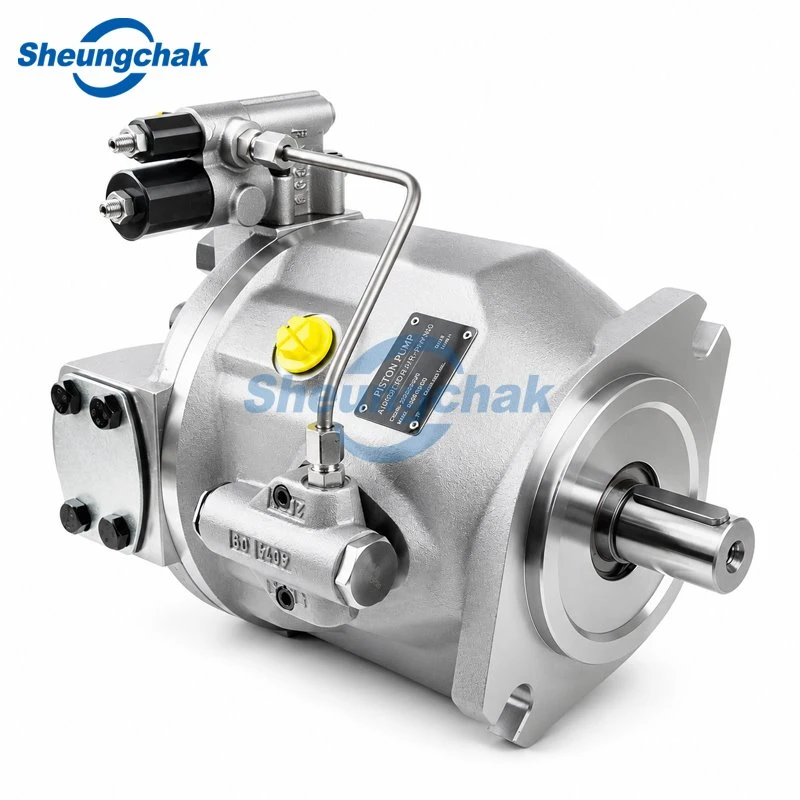

Selecting a hydraulic pump is not simply a choice between a more powerful piston design and a less expensive gear design. The right option depends on the system's continuous pressure, required flow, operating cycle, control strategy, fluid conditions and mechanical interfaces.
A hydraulic piston pump is often the better fit for high-pressure systems that require accurate flow control, variable displacement or sustained operation under demanding loads. An external gear pump is often more practical for fixed-displacement circuits where straightforward operation, compact construction and lower initial equipment cost are priorities.
However, these are general selection tendencies, not absolute limits. High-pressure gear pump designs are available, and piston pumps can also have fixed displacement. The decision should therefore be based on the actual operating requirements and the performance data of the specific pump model.
This comparison focuses on axial piston pumps and external gear pumps. Radial piston pumps and internal gear pumps are outside its detailed scope.

How the Two Pump Designs Deliver Flow
Both piston pumps and external gear pumps are positive-displacement pumps. They draw hydraulic fluid into an expanding chamber and move it toward the outlet through a defined displacement.
The difference lies in how the pumping chambers are formed and how their displacement can be controlled.
External Gear Pump: Simple, Fixed-Displacement Operation
An external gear pump uses two meshing gears rotating inside a close-fitting housing. As the gears separate at the inlet, the increasing chamber volume draws hydraulic oil into the pump. The oil is carried around the housing between the gear teeth and the casing before being displaced through the outlet as the teeth mesh again.
Most conventional external gear pumps have fixed displacement. At a given rotational speed, their theoretical flow is determined by displacement per revolution.
Their relatively simple construction makes them suitable for many mobile hydraulic systems, auxiliary circuits and hydraulic power units where predictable flow is sufficient.
However, fixed displacement does not mean that delivered flow is always constant. Actual flow changes with shaft speed, internal leakage, operating pressure, fluid viscosity and wear.
Axial Piston Pump: Adjustable Displacement and Flow Control
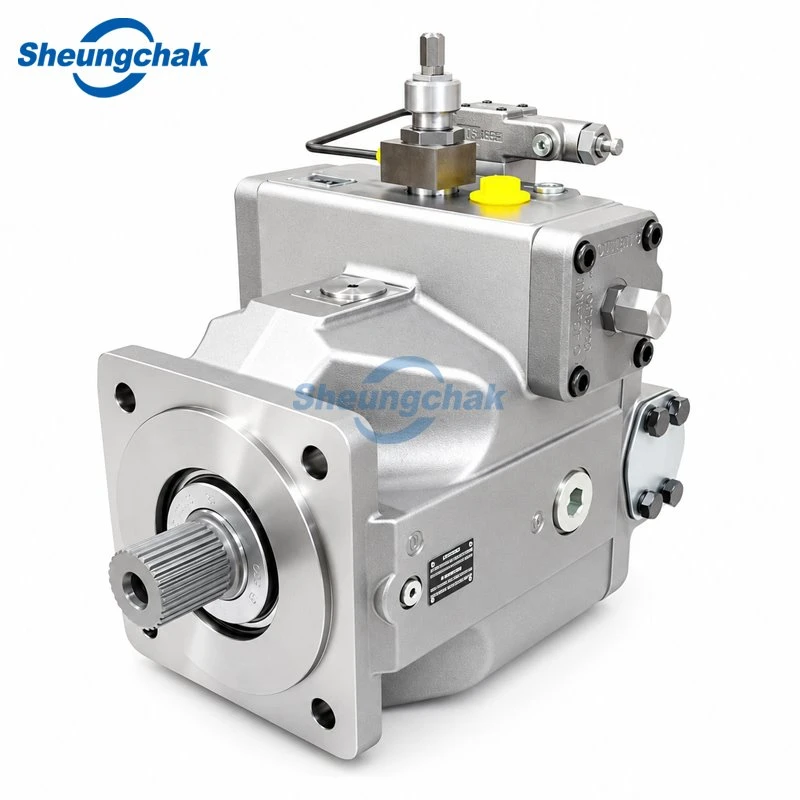
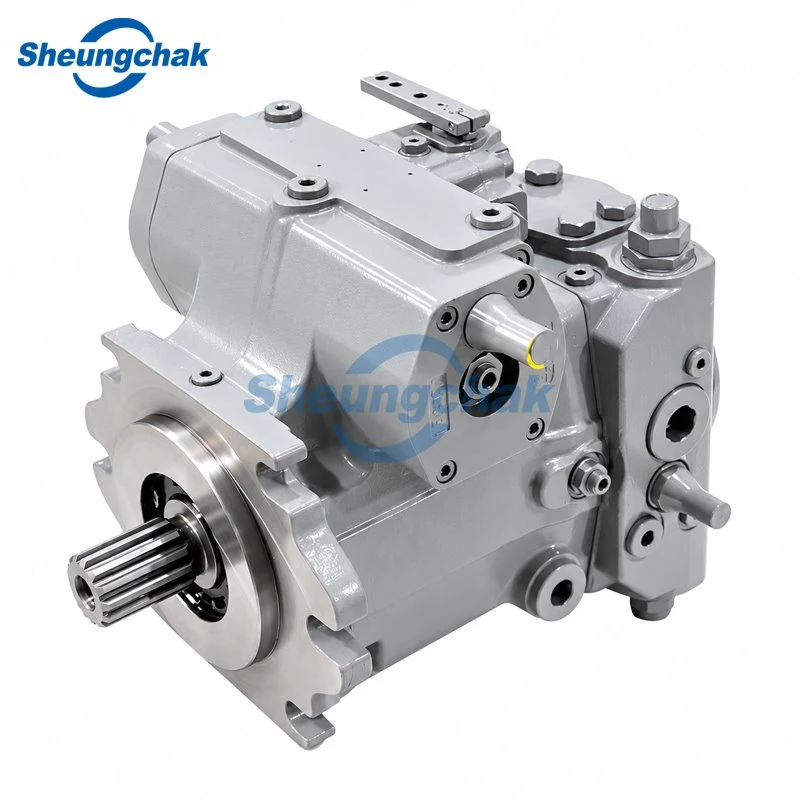
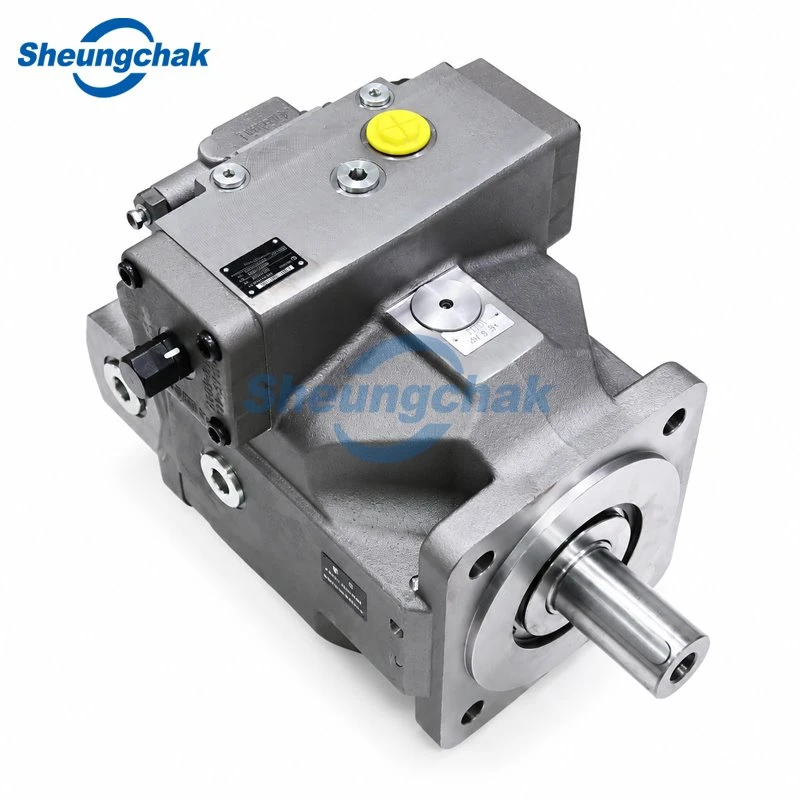
In a swashplate axial piston pump, the pistons are arranged parallel to the drive shaft inside a rotating cylinder block. Their slippers follow the angled swashplate as the block rotates, causing the pistons to reciprocate. This movement draws fluid into the cylinder bores and then pushes it toward the outlet.
Bent-axis axial piston pumps use a different geometric arrangement. The swashplate mechanism described here should not be applied to every axial piston design.
In a variable-displacement swashplate design, changing the swashplate angle changes the piston stroke and therefore the pump displacement.
This allows the pump to adjust its output flow while the drive speed remains relatively stable. Depending on the control configuration, the pump can respond to pressure, flow demand or load-sensing signals.
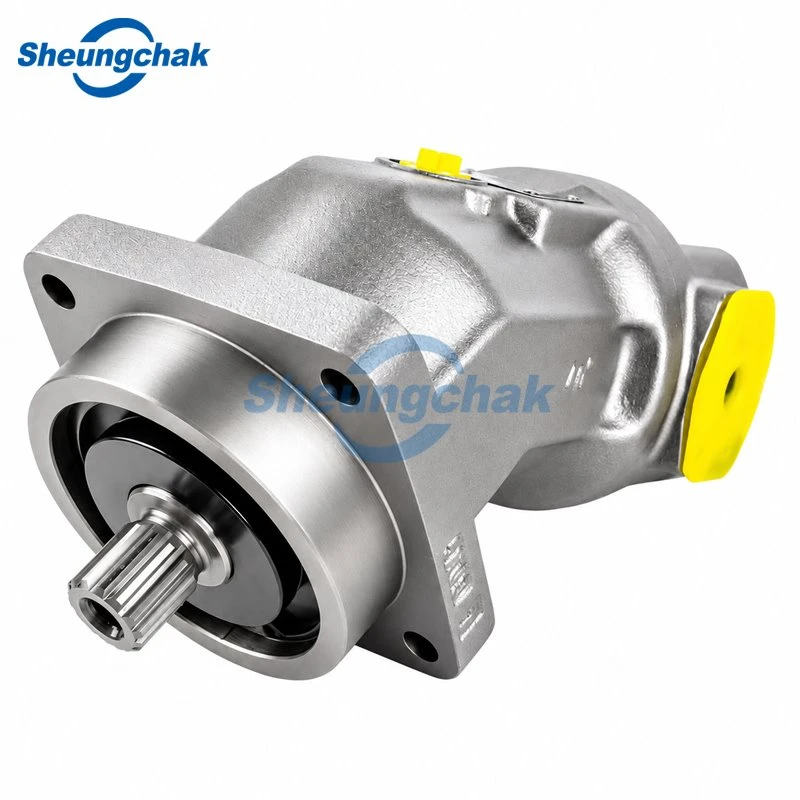
Not every piston pump is variable displacement. Fixed-displacement axial piston designs are also available, so pump architecture and displacement control must be evaluated separately.
Danfoss's PVH axial piston pump technical documentation provides model-specific performance and control information for that variable-displacement pump family.

Pressure and Flow Performance
Pressure capability is one of the most important differences buyers consider, but maximum pressure alone is not enough to determine suitability.
Continuous Pressure vs. Intermittent and Peak Pressure
Pump manufacturers may specify three different pressure conditions:
These ratings are not interchangeable.
The permitted duration and recurrence of higher-pressure operation must come from the selected model's documentation. Terms such as rated, continuous, maximum working and maximum pressure are not interchangeable across manufacturers. The Danfoss DDC technical information defines maximum working pressure as the highest recommended application pressure, explicitly not a continuous rating. Maximum pressure is the highest allowable application pressure under any circumstance. Operation above maximum working pressure requires duty-cycle analysis and factory approval. These DDC limits are pressure differences relative to low-loop charge pressure, not simply high-side gauge readings. Its conditions must not be treated as universal limits for other pumps.
A pump that can withstand a brief pressure peak is not necessarily suitable for operating continuously at that pressure.
The U.S. Army Corps of Engineers EM 1110-2-2610, dated 18 March 2025, describes general service ranges below 24 MPa for gear pumps and below 42 MPa for piston pumps in its civil works design context. These figures are broad engineering guidance, not universal pressure limits or directly comparable continuous ratings for every commercial pump.
Actual product specifications can differ considerably. For example, Sheungchak's published product listings include:
- PLP20 external gear pumps with continuous pressure up to 250 bar on specified sizes.
- A10VSO axial piston pump configurations listed at 280 bar.
- Custom A4VSO axial piston pump configurations listed at 350 bar continuous pressure.
These figures appear in Sheungchak's gear pump listings and piston pump listings. They are supplier-published product ratings, not results from a comparative test between equivalent pump sizes. The exact size, model code, operating conditions and manufacturer data sheet must be checked before selection.
Flow Capacity and Displacement Control
Flow determines how quickly hydraulic actuators move. A pump must therefore provide sufficient flow at the required operating speed and pressure.
For a positive-displacement pump, theoretical flow is related to displacement and rotational speed. Actual delivered flow also accounts for volumetric efficiency.
The relationship is:
Where:
- Q = delivered flow in L/min
- Vg = displacement in cm³/rev
- n = rotational speed in rpm
- ηv = volumetric efficiency, entered as a decimal
For a variable-displacement pump, use the actual displacement at the operating stage being evaluated, rather than automatically using the maximum rated displacement. Use a decimal such as 0.90 for 90% efficiency; this is an input example, not a claimed pump efficiency.
A fixed-displacement gear pump can change its delivered flow when its drive speed changes. However, its displacement per revolution remains fixed.
A variable-displacement piston pump can change displacement independently of drive speed. This provides additional flexibility when equipment requires different flow rates during different operating stages.
For example, an industrial press may require high flow during rapid cylinder movement but substantially less flow while maintaining pressure during a forming or holding stage.
The correct pump must satisfy both the required pressure profile and the actual flow demand throughout the operating cycle.
Main Differences for Pump Selection
| Selection factor | Axial piston pump | External gear pump |
|---|---|---|
| Pumping mechanism | Reciprocating pistons; swashplate or bent-axis design | Two meshing gears carrying oil around the housing |
| Displacement | Fixed or variable, depending on design | Generally fixed |
| Pressure suitability | Often a starting point for demanding high-pressure duties; verify model ratings | Can suit high-pressure duties within the selected model's ratings |
| Flow control | Variable designs change displacement; controls depend on the model | Normally changed through drive speed or circuit arrangements |
| Energy at changing demand | Variable displacement may reduce surplus output with suitable controls | Depends on speed control, unloading, bypass and the duty cycle |
| Oil cleanliness | Follow the model and system requirements | Follow the model and system requirements |
| Maintenance and repair | Check service procedures, control setup, parts and repair support | Check service procedures, parts and whether repair is supported |
These are selection tendencies. They do not replace a comparison of the actual pump models under the same operating conditions.
Efficiency and Energy Consumption
Efficiency should be compared at the operating conditions where the pump will actually work, rather than by relying on a single percentage associated with a pump category.
Volumetric Efficiency vs. Overall Efficiency
Volumetric efficiency measures how much of the theoretical displacement becomes actual delivered flow.
Internal leakage reduces the amount of oil reaching the outlet. As operating pressure increases, leakage losses can become more significant depending on the pump's internal clearances, design and condition.
Overall pump efficiency also includes mechanical losses such as friction.
The relationship is:
Where:
- ηt = overall efficiency
- ηv = volumetric efficiency
- ηm = mechanical efficiency
Piston pumps are commonly selected for applications requiring high pressure and high overall efficiency. The USACE engineering manual also describes piston pumps as having higher typical volumetric and overall efficiency in its hydraulic power system design context.
Nevertheless, a direct comparison requires performance data from the actual pump models at comparable speeds, pressures, fluid temperatures and displacement settings.
A worn piston pump may perform worse than a properly maintained gear pump. Pump condition matters as much as the general design category.
Fixed vs. Variable Displacement and Energy Consumption
The economic value of variable displacement becomes clearer when equipment operates under changing flow demand.
A fixed-displacement pump has a fixed theoretical displacement per revolution. At constant speed, its theoretical flow therefore remains approximately constant. If the hydraulic circuit requires less flow, the surplus may need to pass through a relief valve, bypass or throttling arrangement.
This can create unnecessary hydraulic losses and heat.
A variable-displacement pump equipped with an appropriate pressure compensator or load-sensing control can reduce its displacement when the system requires less flow.
This may reduce unnecessary pump output and energy consumption during partial-load or standby conditions.
However, variable displacement does not automatically guarantee lower energy consumption. A fixed-displacement system using suitable speed control or unloading can also reduce losses. The actual comparison depends on the control arrangement, load profile, operating hours, pump efficiency and the way each circuit handles unused flow.
For a meaningful comparison, assess both systems against the same machine pressure and flow demand over the same duty cycle. Use each pump's own delivered flow, pressure difference and efficiency at each stage.
Pump shaft input power can be estimated using:
Where:
- Pshaft = pump shaft input power in kW
- Q = actual flow delivered at the pump outlet in L/min
- Δp = pressure difference across the pump in bar
- ηt = overall pump efficiency at that operating point
Use decimal values for all efficiencies, including motor and drive efficiency. Pump outlet flow includes flow subsequently bypassed or relieved; using only the actuator's useful flow would understate pump input power in such a circuit. For a destroked standby condition with negligible delivered flow, use manufacturer loss data or measured input power rather than assuming that the pump consumes no power.
To estimate electrical energy consumption, account for motor and drive efficiency as well:
Here, the combined efficiency is:
Use efficiencies for the operating point being evaluated. If a supplied combined efficiency already includes drive losses, use that value directly rather than applying the drive efficiency again.
Annual electricity cost can then be estimated as:
Where:
- H = annual operating hours
- R = electricity price per kWh
If the machine operates under several different load conditions, calculate electrical energy for each stage using its own power and annual operating hours, then add the results. Include standby periods. If comparing the complete machine, account separately for cooling and other auxiliary electrical loads.
This approach provides a more useful comparison than assuming that one pump category always saves a fixed percentage of electricity.
The pump sizing equations are provided in the May 2024 Danfoss DDC technical documentation.
Purchase Cost and Total Cost of Ownership
An external gear pump is often the lower-purchase-cost starting point for a straightforward fixed-displacement duty. A comparable quotation still needs the same required pressure, flow, interfaces and supply scope. Bosch Rexroth's hydraulic pump overview, RE 00077/09.04, describes the economical design of external gear pumps; this historical manufacturer overview is not evidence of current prices or a like-for-like quotation.
A piston pump may require a larger initial investment, particularly when the application requires variable displacement, pressure compensation, load sensing or more complex control configurations.
However, the purchase price is only one part of the equipment cost.
A more complete comparison should consider:
| Cost factor | Gear pump | Piston pump |
|---|---|---|
| Initial purchase | Generally lower | Generally higher |
| Control configuration | Usually simpler | Can be more complex |
| Energy consumption | Depends on circuit and operating conditions | Can benefit from variable displacement under changing loads |
| Filtration | Model-specific requirements | Model-specific requirements |
| Serviceability and maintenance | Check approved service procedures, spare parts and repair versus replacement support | Check approved service procedures, spare parts, control-setting requirements and repair versus replacement support |
| Downtime | Depends on reliability, application and spare parts | Depends on reliability, application and spare parts |
| Replacement | Match mechanical and hydraulic interfaces and any integrated valves or controls | Match mechanical and hydraulic interfaces and the required control configuration |
A practical total cost of ownership calculation is:
Compare these costs over the same planned service period and operating hours, using quotations and equipment-specific assumptions rather than industry averages. Simpler construction alone does not establish that a unit is economical to rebuild. Confirm whether the supplier supports repairs and which parts and procedures are available.
For an OEM equipment manufacturer, the comparison should also consider the effect of pump selection on motor sizing, reservoir capacity, cooling requirements, control valves and the overall machine design.
For a replacement buyer, compatibility and installation costs can be just as important as the pump purchase price.
The lower-priced pump is not necessarily the lower-cost solution over the entire operating life of the equipment.
Maintenance and Operating Conditions
Pump selection should also reflect the quality of the hydraulic fluid, the operating environment and the maintenance capabilities available to the equipment owner.
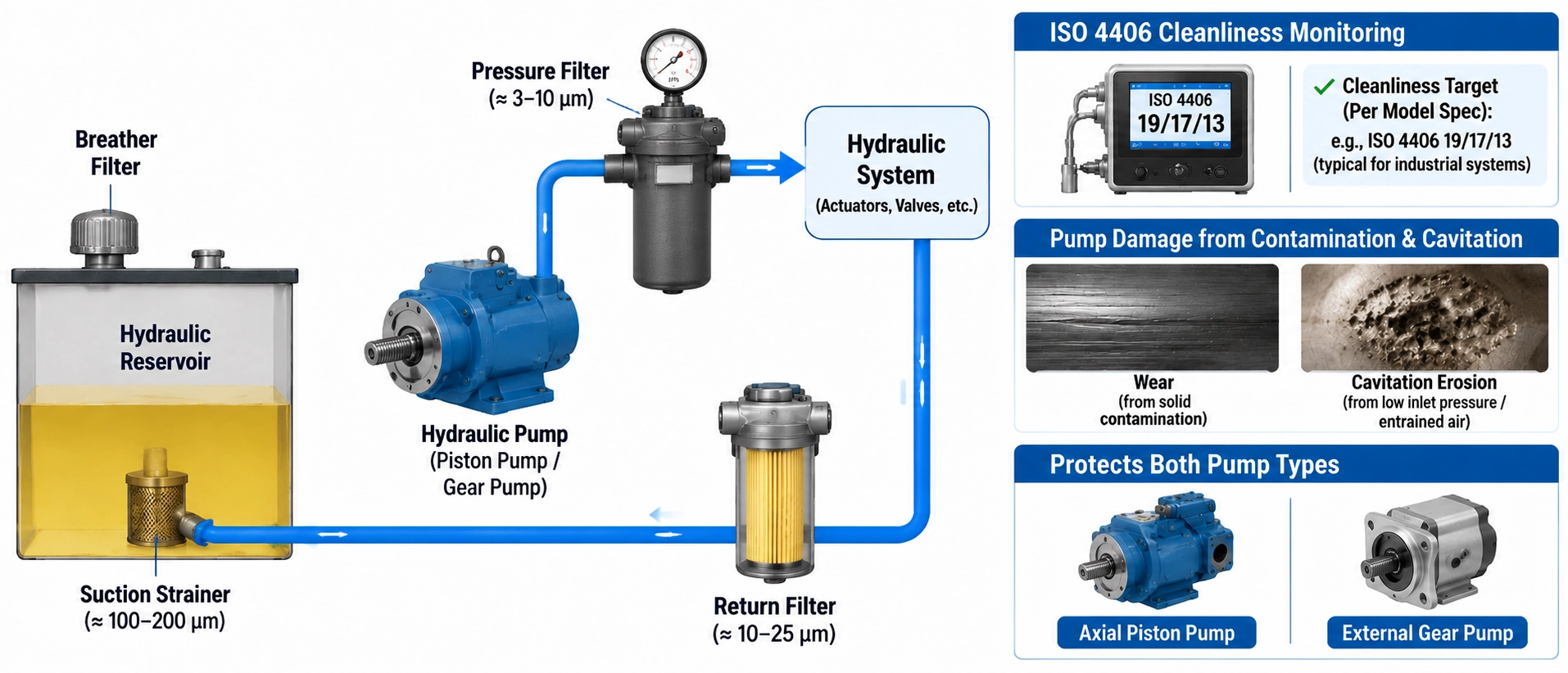
Oil Cleanliness and Filtration
Hydraulic oil contamination can damage internal components, increase wear and reduce pump performance.
However, it is not accurate to assume that every piston pump requires a cleaner oil supply than every gear pump.
The required cleanliness level depends on the specific product, operating pressure, internal design and other components in the hydraulic circuit.
For example, Danfoss's September 2018 hydraulic fluid cleanliness guidelines list ISO 4406 class 22/18/13 for both axial and radial piston pumps and gear pumps within the scope of that particular guidance.
Other manufacturers specify different cleanliness requirements for different pump series.
Parker's HY30-3301/UK documentation for PGP/PGM 500 specifies ISO 4406 class 19/17/13 for that product family. This is a separate manufacturer's requirement, not a direct contamination-tolerance test against the Danfoss products.
These examples demonstrate why filtration requirements should always be checked against the selected pump's technical documentation.
The relevant references are:
When replacing an existing pump, check whether the new model changes the system's filtration requirements. Do not assume that the existing filter arrangement is suitable without checking the manufacturer's specifications.
Wear, Fluid Viscosity and Operating Temperature
Both pump types depend on suitable hydraulic fluid viscosity and correct operating conditions.
Fluid that is too viscous during cold starts can increase inlet losses and place additional demands on the drive. Fluid that becomes too thin at high operating temperatures can increase internal leakage and reduce lubrication performance.
The following conditions should be checked:
- Recommended and permitted fluid viscosity ranges.
- Minimum and maximum operating temperatures.
- Suction pressure and inlet-line restrictions.
- Potential air ingress and cavitation.
- Filter condition and contamination levels.
- Pump speed and allowable operating pressure.
- Housing pressure and case-drain requirements where applicable.
Gear pumps have relatively straightforward internal construction, but they are not immune to contamination, cavitation or incorrect installation.
Parker's PGP500 operating documentation identifies contaminated fluid as a major cause of premature gear pump failures and emphasizes correct filtration and system cleanliness.
Piston pumps also require careful attention to their internal clearances, control mechanisms, fluid conditions and case-drain arrangements where the selected design uses them.
Noise and Heat Generation
Noise and heat should be evaluated at the system level rather than assumed from pump type alone. Compare noise at the same pressure, delivered flow, speed, fluid condition and installation arrangement, using the same measurement method.
Pump pressure ripple, rotational speed, mounting stiffness, pipe arrangement, fluid properties and operating pressure can all affect noise transmission.
Similarly, excess heat may result from internal leakage, relief-valve operation, throttling losses or an unsuitable control strategy.
A properly selected variable-displacement pump may reduce unnecessary flow losses in a variable-load application. However, the complete hydraulic circuit must be evaluated before claiming a reduction in operating temperature or cooling requirements.
Which Pump Is Better for Your Application?
The correct choice depends on what the machine needs to achieve and how its hydraulic circuit is designed. Sheungchak's hydraulic pump applications page organizes related product families by equipment and circuit function.
Industrial Hydraulic Systems
Industrial presses, forming machines and hydraulic power units may require high pressure combined with changing flow demand.
A variable-displacement axial piston pump can be suitable when the system needs high flow during rapid movement and reduced flow during pressure holding or other lower-demand stages.
Pressure-compensated and load-sensing controls can provide additional control options when the circuit is designed to use them.
For example, Sheungchak's published A4VSO replacement application page describes a four-column metal-forming hydraulic press using an open-circuit hydraulic power unit and a variable-displacement axial piston pump.
The selection focuses on press-cycle flow, pressure control, mounting dimensions, drive connections and hydraulic port compatibility.
This is a practical example of why matching displacement alone is insufficient when replacing an industrial pump.
See the A4VSO pump replacement example for a four-column hydraulic press.
Mobile Machinery
Mobile hydraulic equipment may use both pump types within the same machine.
A variable-displacement axial piston pump is commonly used for demanding main hydraulic functions or hydrostatic transmission systems where pressure, flow and displacement control are important.
Gear pumps may serve pilot, charge or auxiliary circuits that require simpler and more predictable flow delivery.
The actual arrangement depends on the machine's hydraulic architecture. An open-circuit implement pump and a closed-circuit travel pump must not be treated as interchangeable simply because both are piston pump designs.
Auxiliary Circuits and Simpler Hydraulic Power Units
Gear pumps are often a practical choice when the application requires a relatively consistent flow rate and does not need complex displacement control.
Examples include auxiliary hydraulic functions, simpler power units and selected mobile equipment circuits.
If the operating pressure and flow are within the specific gear pump's continuous ratings, a gear pump may provide the required performance without the additional cost and control complexity of a variable-displacement piston pump.
High-pressure gear pump variants should also be considered where their published specifications satisfy the actual operating conditions.

What to Check Before Selecting or Replacing a Pump
A pump should never be selected or replaced based only on its appearance, nominal displacement or maximum pressure.
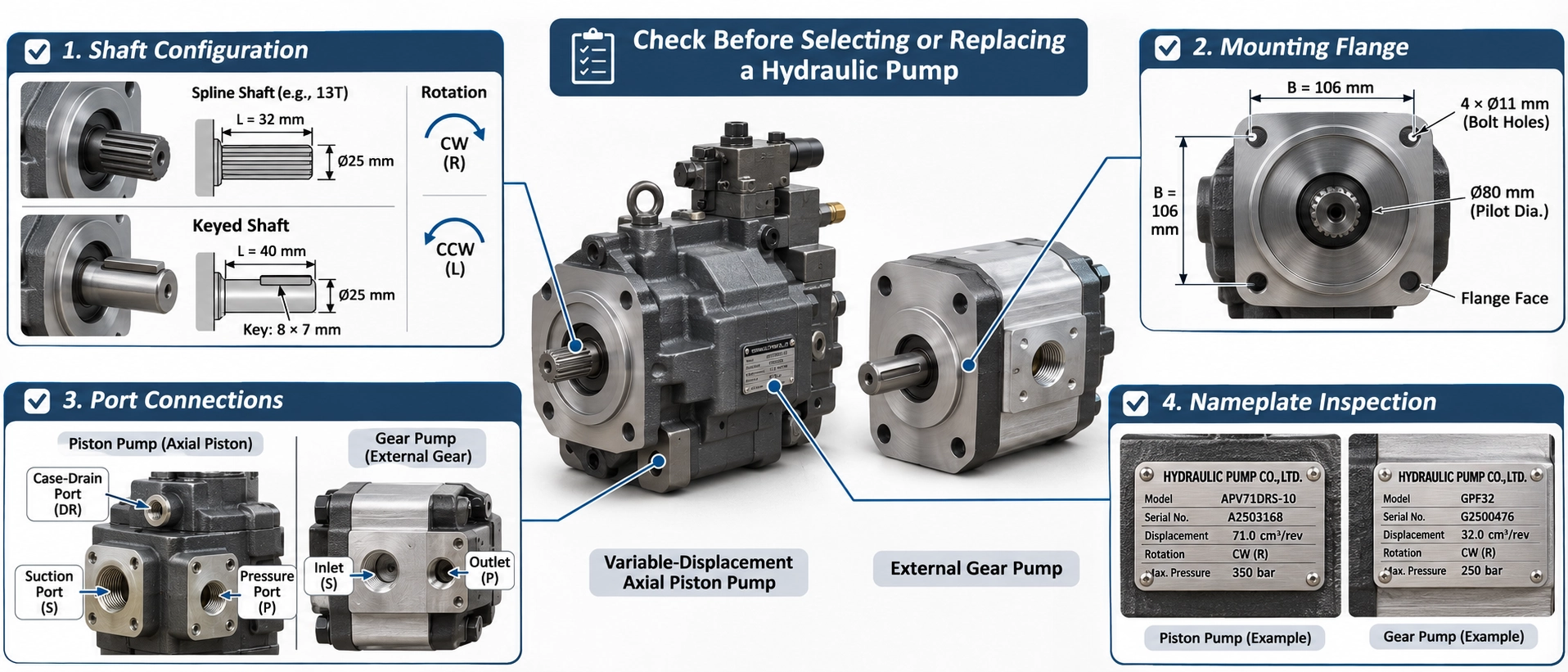
Before approving a selection or replacement, confirm the following information. If some details are unavailable when requesting a quotation, start with the existing pump's complete model code, nameplate photograph and application.
Hydraulic and Operating Specifications
- 1Required operating pressure: Record continuous, intermittent and peak pressure, including the duration and frequency of higher-pressure events.
- 2Required flow: Identify the actual flow demand during each operating stage.
- 3Pump displacement: Confirm the required displacement in cm³/rev.
- 4Operating speed: Check normal, minimum and maximum shaft speed.
- 5Duty cycle: Identify continuous operation, frequent start-stop cycles, standby periods and variable-load conditions.
- 6Circuit type: Confirm open-circuit or closed-circuit operation and the required control strategy.
Mechanical and Installation Compatibility
- 7Shaft configuration: Confirm shaft diameter, spline profile, keyway, shaft extension and coupling requirements.
- 8Mounting flange: Verify flange standard, pilot diameter, bolt pattern and mounting dimensions.
- 9Rotation direction: Confirm clockwise or counterclockwise rotation from the manufacturer's specified viewing direction.
- 10Port configuration: Match inlet and outlet positions, thread types, sizes and pressure ratings.
- 11Case drain and housing pressure: Check whether the replacement pump requires a case-drain connection and verify the permitted housing pressure.
- 12Installation space: Confirm overall dimensions, mounting orientation and clearance for pipe connections.
Fluid and Control Requirements
- 13Hydraulic fluid: Confirm oil type, viscosity range and operating temperature.
- 14Filtration: Check the required ISO 4406 cleanliness level and filter performance.
- 15Control configuration: Confirm pressure compensation, load sensing, displacement control and other regulator requirements.
- 16Drive capacity: Verify motor power, torque and speed against the pump's operating requirements.
For replacement projects, the original pump's complete model code and a clear nameplate photograph are useful starting points. The hydraulic schematic and installation drawings can help identify additional compatibility requirements. Changing between a gear pump and a piston pump may require changes to the drive, control circuit, suction line, drain line or mounting arrangement; matching displacement does not establish interchangeability.
For an equipment program requiring a particular shaft, flange, port or control configuration, review Sheungchak's OEM and ODM hydraulic manufacturing options and submit the relevant drawings. Available combinations depend on the pump series.
Piston Pump vs Gear Pump: Final Selection Guide
There is no universal winner. Each pump type has advantages under different operating conditions.
| Selection requirement | More suitable starting point |
|---|---|
| High-pressure operation with demanding flow requirements | Axial piston pump |
| Variable flow demand at relatively stable drive speed | Variable-displacement piston pump |
| Simple fixed-displacement hydraulic circuit | Gear pump |
| Lower initial equipment cost | Gear pump |
| Pressure-compensated or load-sensing control | Compatible variable-displacement piston pump |
| Compact auxiliary hydraulic circuit | Gear pump |
| Closed-circuit hydrostatic transmission | Compatible axial piston pump |
| High-pressure fixed-flow application | Compare the actual ratings of both pump families |
Before making a final decision, compare the specific pump models using the same pressure, flow, speed, fluid and operating-cycle assumptions.
For equipment manufacturers, distributors and replacement buyers, use the hydraulic pump product overview to identify candidate families, then compare the complete specifications.
Sheungchak provides both hydraulic piston pump and external gear pump product ranges, including A4VSO, A10VSO, AZPF, PLP20 and PLP30 series.
- Explore the Sheungchak hydraulic piston pump range for fixed and variable displacement options.
- Review the Sheungchak external gear pump range for external gear pump configurations.
For a replacement or OEM sourcing project, send the application, existing pump model or nameplate, required quantity and any known pressure, flow, displacement, speed and duty-cycle information.
Optional supporting specifications include circuit type, required controls, fluid and viscosity, oil cleanliness or filtration target, shaft and flange drawings, port type and position, and rotation direction. A hydraulic schematic is useful when changing pump type or control function.
If complete specifications are unavailable, start with the nameplate and application information. These details provide a basis for identifying candidate configurations and the information still needed for selection and quotation.
Request a hydraulic pump selection and quotation. Supporting nameplate photographs, schematics and installation drawings can be sent to info@hydraulicsc.com.