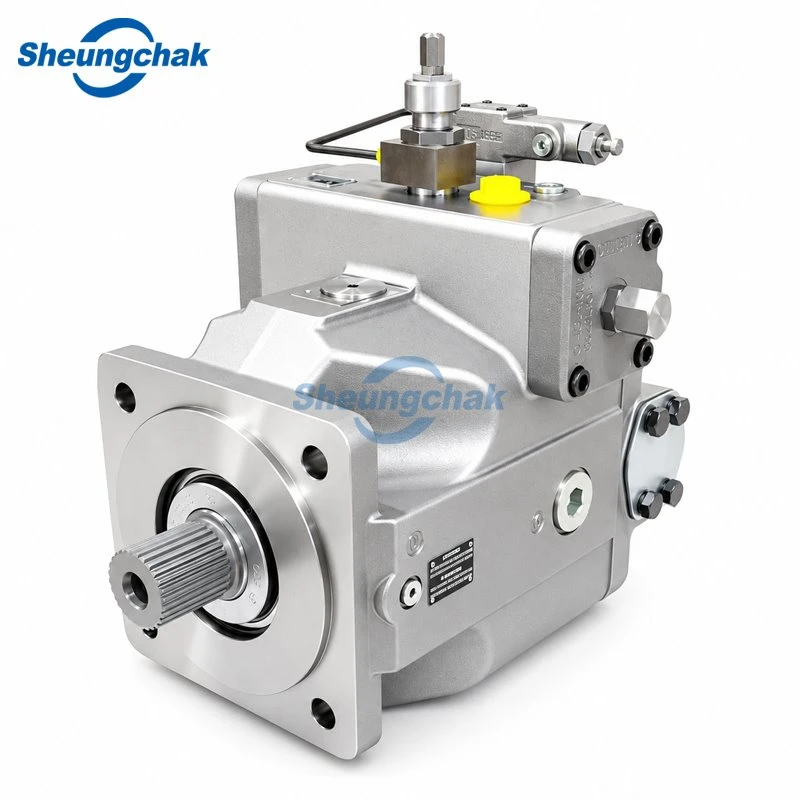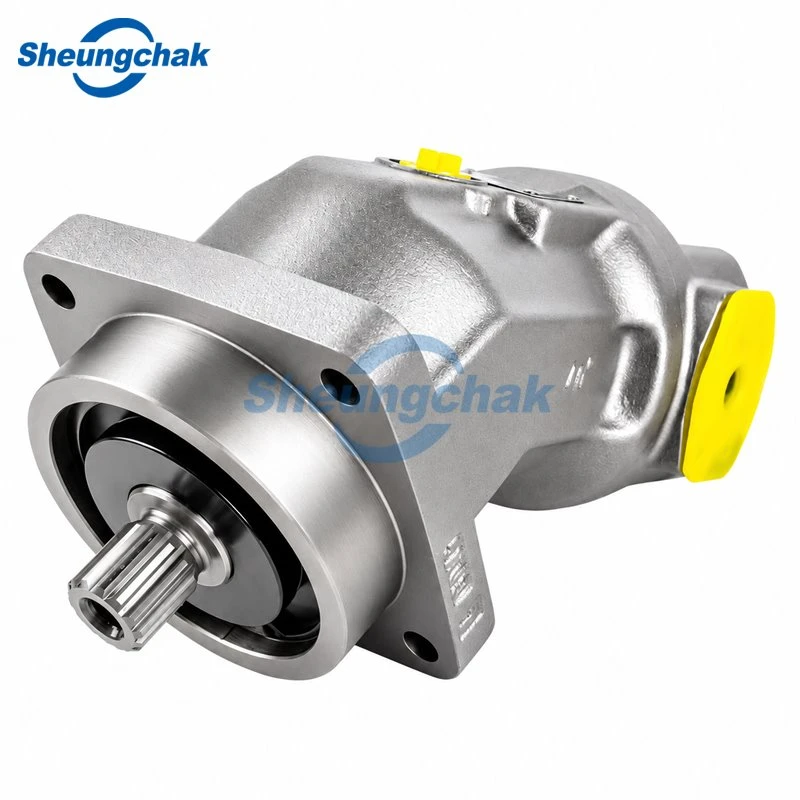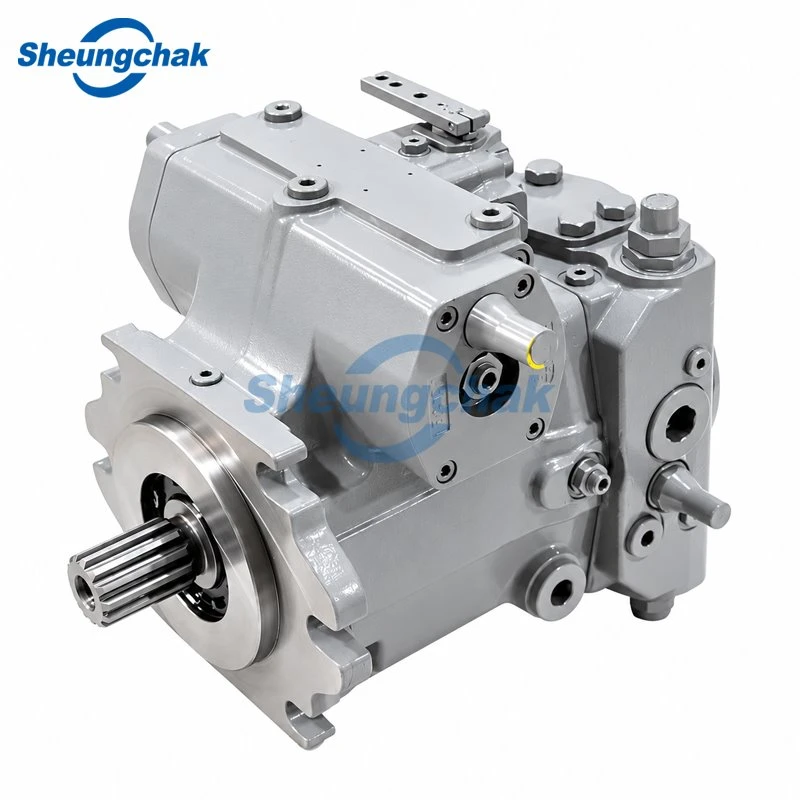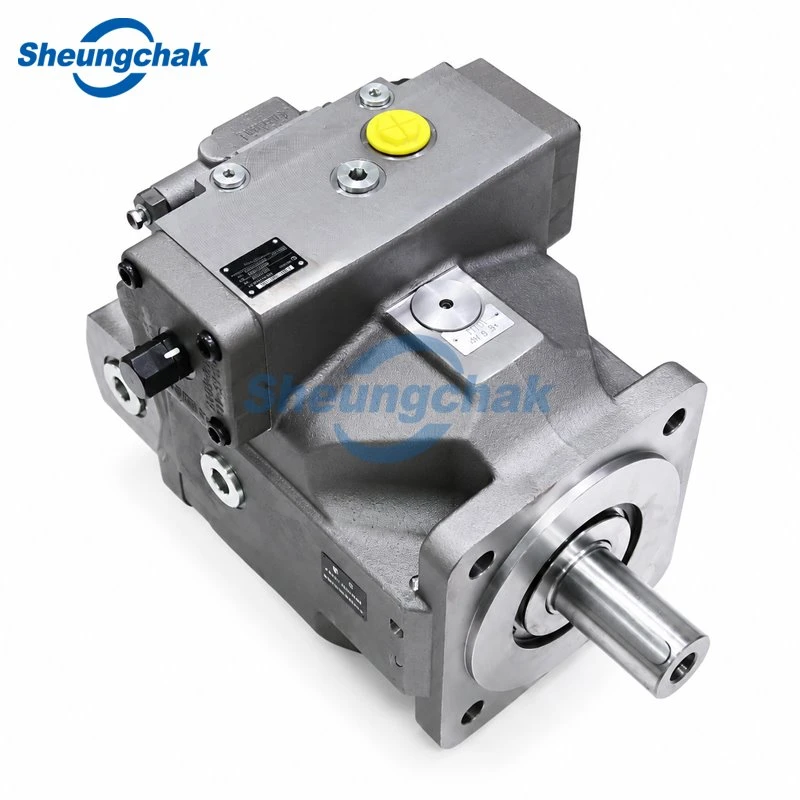

"K3V112" on a nameplate does not point to one parts list. Kawasaki builds the pump as a single, tandem or parallel unit, in clockwise and counter-clockwise rotation, with or without a PTO. Parts sellers list several drive-shaft splines, tilting-pin lengths and pilot-pump types under the same name. Those variants are where an order for K3V112 pump parts goes wrong, even when the part name is right.
This guide is for repair shops, parts buyers and maintenance leads who already know they have a K3V112 and need to decide what to buy. It covers which parts belong to which assembly, which ones change with the pump version, how to compare a seal kit, a rotary group, single parts and a replacement pump, and what the pump needs once it is back together. It does not cover disassembly steps or regulator adjustment. Kawasaki's catalogue says the pump should not be taken apart without its approval and, where that is unavoidable, only by an authorised person, so that work belongs with the service manual issued for your exact model.
Disclosure: Sheungchak supplies new non-OEM replacement pumps and is not affiliated with Kawasaki Heavy Industries. "K3V112" is used here only to identify the pump.
Which K3V112 pump do you have?
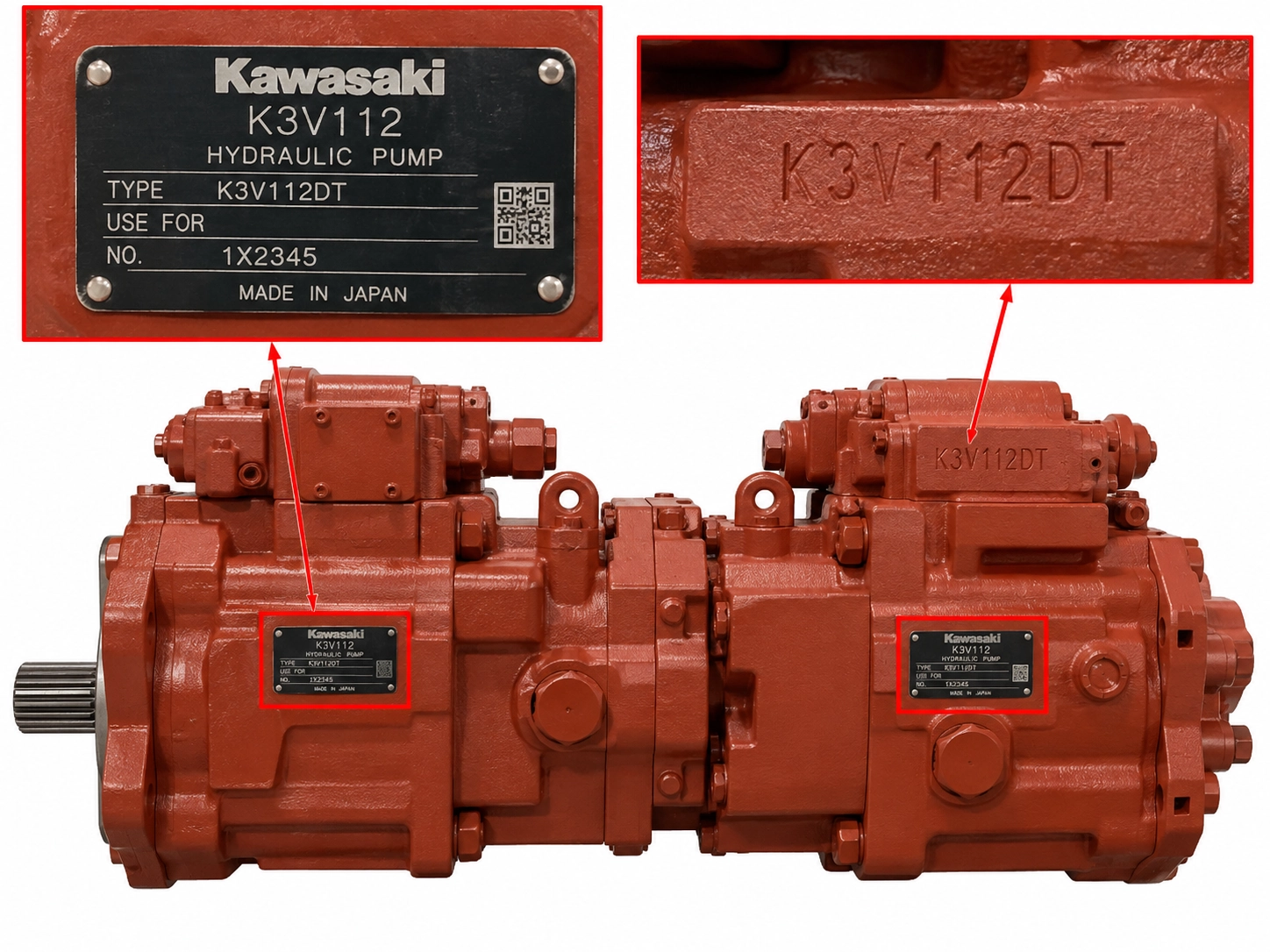
The characters after "K3V112" decide which parts list applies, so record the whole model code before you look at any part. Kawasaki's K3V/K5V catalogue sets out the code positions in this order (Kawasaki Heavy Industries, catalogue KPM1410, October 2014).
| Code position | Options in the Kawasaki catalogue | Why it matters when ordering |
|---|---|---|
| Pump configuration | S = single, DT = tandem double pump, DP = parallel double pump | Sets how many rotary groups the pump has and whether parts are listed as front and rear |
| Auxiliary option | No letter = standard, P = with PTO, H = with centrifugal pump | Adds parts outside the main pump, so a K3V112DTP list is not the same as a K3V112DT list |
| Pump design code | A number | Identifies the design revision; quote it in full |
| Rotation | R = clockwise, L = counter-clockwise, viewed from the shaft end | Decides which handed parts fit |
| Regulator code and regulator design code | A short code such as 2N or 9N, followed by a number | Identifies the regulator; quote both without abbreviating |
Not every option is offered in every size. For the 112 size, the catalogue's range chart shows K3V112S, K3V112DT, K3V112DTP and K3V112DP. Its regulator summary ties the regulator codes to control types such as total horsepower, negative flow, positive flow and load-sensing control. A supplier needs the code as printed, not your reading of it.
For orientation, Kawasaki lists the series at 34.3 MPa rated and 39.2 MPa peak pressure, and the 112 size at a maximum self-priming speed of 2,360 min⁻¹ (Kawasaki Heavy Industries). The catalogue attaches conditions to that speed: maximum displacement, and a suction pressure of −0.01 MPa or above. These are pump ratings, not acceptance values for parts.
If the nameplate is missing or unreadable, our guide to identifying a hydraulic pump from its nameplate covers the fallback methods.
K3V112 pump parts by assembly group
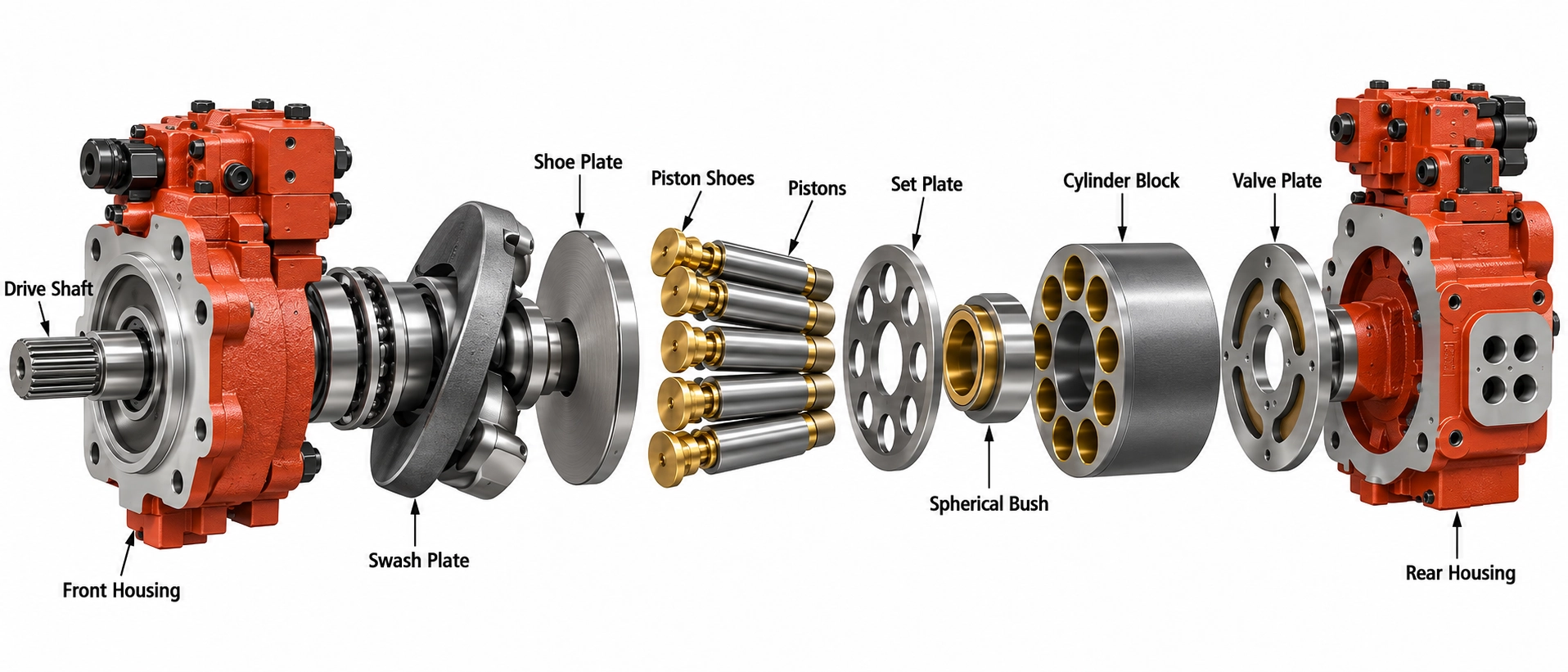
Ordering is easier, and quotes are easier to compare, when the parts are grouped by assembly instead of listed one by one. The grouping below is ours, built from the part names in sellers' published parts tables. It is an orientation map, not a bill of materials. Item numbers and per-pump quantities must come from the parts list for your exact model code.
| Assembly group | Main parts | What to know before ordering |
|---|---|---|
| Rotary group | Cylinder block, piston and shoe assemblies, set plate (also called retainer plate), spherical bush (ball guide), cylinder springs | A double pump has two; record which position each part came from |
| Valve plate and valve block | Valve plate, valve block, check valves | Sellers list the cylinder block and valve plate together as an assembly, in right-hand and left-hand versions |
| Swash plate group | Swash plate, tilting bush, shoe plate, swash plate support, tilting pin, servo piston | The tilting pin assembly is listed in more than one length |
| Shafts and bearings | Front and rear drive shafts, spline coupling, roller and needle bearings, bearing spacers | Spline tooth counts vary |
| Regulator | Complete regulator assembly | Identified by the regulator code; a tandem pump carries one per pump |
| Auxiliary pump and PTO | Pilot gear pump, PTO parts | Listed in several types |
| Seals | O-rings and shaft seals | Confirm which pump configuration the kit covers |
The variants that cause wrong orders
Four part types are sold in more than one version, and each needs a check against the old part before you order. The versions below are what two aftermarket parts sellers publish, checked on 9 October 2026 (Mission Hydraulics; Hydra Parts USA). Both are commercial sources with parts to sell, and neither list is exhaustive. They are also related: Mission names Hydra Parts USA as its online retail distributor, so one listing does not independently confirm the other. They show that the versions exist. They do not show which one fits your pump.
| Part | What the seller listings show | What to record |
|---|---|---|
| Cylinder block and valve plate assembly | Two items: 013 marked R (CW/RH) and 014 marked L (CCW/LH), quantity one each in Mission's table | The position the old assembly came out of, any marks on the old valve plate, and the full model code |
| Front drive shaft | 12, 14 or 17 spline teeth | Tooth count, with a photo square-on to the shaft end |
| Rear drive shaft | 12 or 13 spline teeth; one reference column in Mission's table shows a 14 instead, so treat the list as incomplete | Tooth count, with a photo |
| Tilting pin assembly | 114.7 mm or 121 mm | A photo of the old pin against a rule or caliper with both ends visible |
| Pilot gear pump | "Many different types" | Photos of the pump and its mounting face |
On the first row, the hand belongs to the valve plate. Mission's product page for the assembly lists one cylinder block and one right-hand (clockwise) valve plate (Mission Hydraulics). Neither seller says which assembly goes in the front or the rear pump, or how R and L map to a given pump rotation. Do not infer that from the labels. Confirm it by part number against the parts list for your model code.
On the shafts, Kawasaki's catalogue dimension table gives a 14-tooth JIS B 1603 spline for the K3V112 shaft end. The other counts in the seller lists are the reason to count the teeth on the shaft you have.
On the tilting pin, the listing gives two lengths without saying which two points the length is measured between. Ask the supplier which dimension the figure refers to before you match it to your measurement.
Bench tip: Mark front and rear on regulators, valve plates and rotary group parts before they leave the bench. Then check in the manual for your model which of them are position-specific.
What to read off the nameplate and the old part
This is the identification record. Collect it before you ask anyone for a quote:
- The full model code and serial number from the nameplate, including both design codes.
- Rotation, R or L, viewed from the shaft end.
- For a double pump, whether each part is for the front or the rear pump.
- Spline tooth counts on the front and rear shafts.
- Tilting pin length, with the photo described above.
- The regulator code, and whether the regulator is front or rear.
- Whether a pilot gear pump or PTO is fitted, with a photo.
- The machine make, model and serial number, and the machine maker's pump part number if you have it.
Items 4 and 5 need the pump open. If it is still on the machine, send the rest and say so.
If you are replacing the complete pump instead of repairing it, the nine-spec pump replacement checklist covers the interface checks this list leaves out.
Inspect first: replace, rework or leave
Kawasaki's public catalogue gives operating limits but no wear limits and no replace-or-rework rules. Those sit in the service manual for the specific model, so each decision below is framed as what to look up and what it changes in the order.
Bearings
A footnote to the rated pressure in the catalogue singles out bearing life as the exception when it describes durability (Kawasaki Heavy Industries, catalogue KPM1410). Make the bearing decision before the quote, not after. Look up whether the manual for your model allows a bearing that has been pulled off a shaft to go back on. If it does not, add the roller and needle bearings to the order.
Rotary group
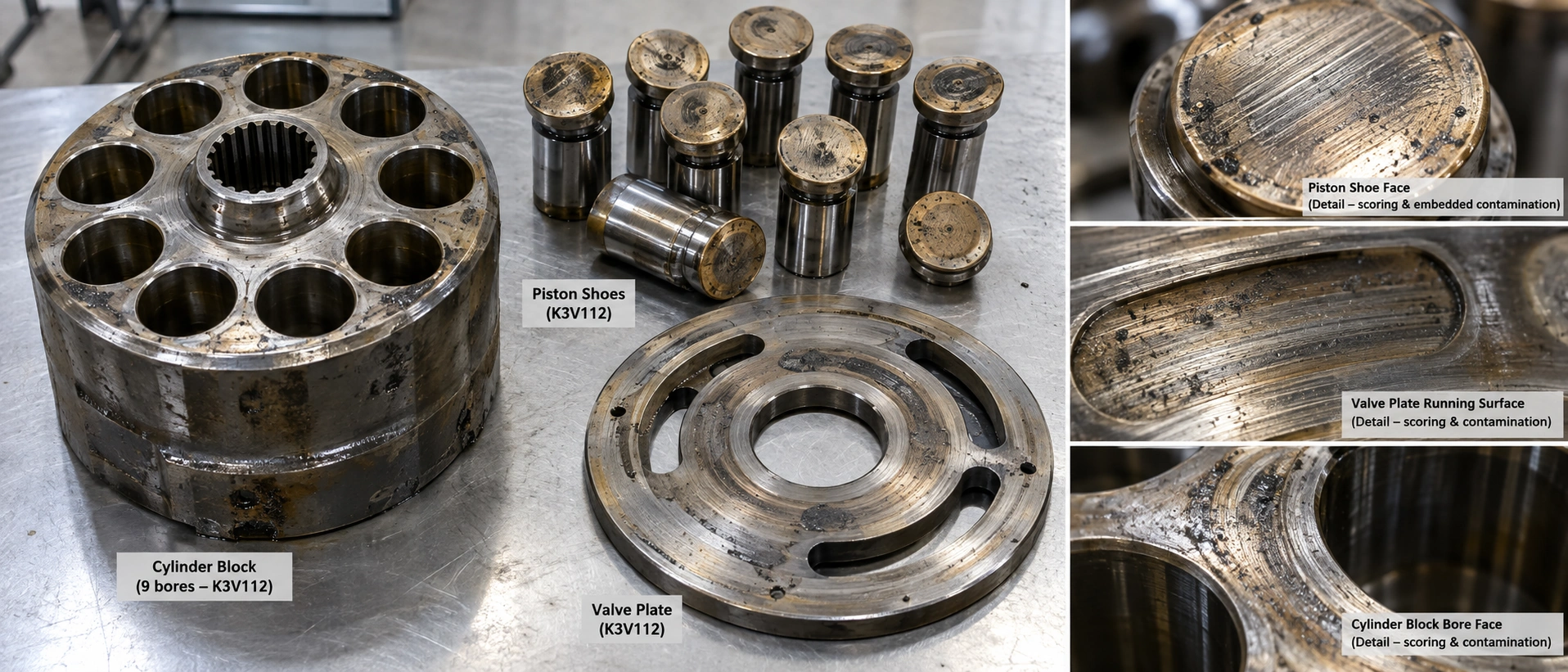
Look up whether the manual treats damage to the cylinder block, pistons or shoes as a reason to replace the group as a set. A 2016 Fluid Power World article on hydraulic components in general says lapping may be suitable for internal wear where surfaces are still within acceptable tolerances, and that otherwise barrels, pistons and other internal parts are remanufactured or replaced (Fluid Power World). That is a general statement, not a K3V112 allowance. Applied here:
- Visible damage on the block, pistons or shoes, such as scoring, pitting, cracks or seizure marks: expect replacement, and ask for both a single-part and a complete-group quote.
- Light wear: rework is a possibility only if every dimension is inside the manufacturer's limits, and only a shop holding those limits for your model can make that call.
This guide does not reproduce wear limits.
Regulator and pilot gear pump
Look up whether the manual treats these as serviceable or as items replaced complete, and settle that before you buy a regulator seal kit. Leave adjusting screws and lock nuts as found unless the manual for your model directs otherwise.
What you find inside also points to a cause, and the cause has to be fixed or the new parts fail the same way. The patterns below come from a 2021 Power & Motion article on variable piston pumps in general, written by a manager at a company that sells repair services (Power & Motion). Read them as clues, not as a diagnosis.
| Possible cause | Damage the article associates with it |
|---|---|
| Contaminated oil | Scored valve plate, scratches on the piston barrels and piston faces, pistons seized in the cylinder bores |
| Transient pressure spikes | Pistons broken at the neck, broken shafts, cracks in the block between the ports |
| Blocked or restricted inlet | Cavitation damage on the valve plate |
| Excessive case pressure | Gouged or scored swash plate, damaged shoes and shoe retainer, displaced shaft seal |
Seal kit, rotary group kit, single parts or a replacement pump
Buy to the level of the damage you found, not to the level of the symptom. The table is our reading of the sources in the previous section, not a manufacturer rule.
| Option | Fits when | What drives the cost | Main risk | What the quote must spell out |
|---|---|---|---|---|
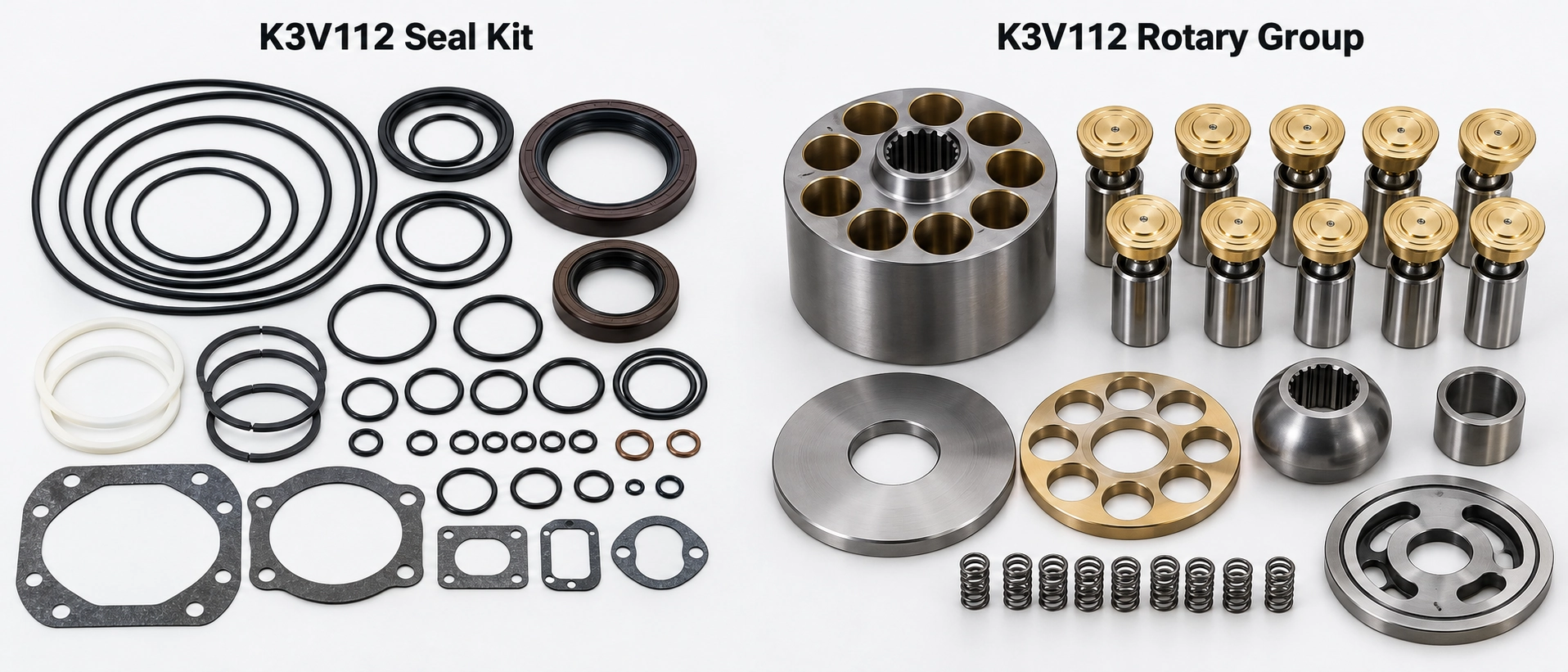
| Seal kit only | Leakage is external and the internal parts have been inspected and are sound | Low parts cost; strip and reassembly labour still applies | Does not restore pressure or flow lost to internal wear | Which pump configuration it covers, and whether regulator, gear pump and PTO seals are included |
| Single parts | One identifiable part is damaged, such as a shaft or tilting pin, and its mating parts are sound | The part plus labour | A version error, or a new part running against a worn mate | Part number, version (tooth count, length, hand) and quantity |
| Rotary group kit | The cylinder block, pistons or shoes are damaged | Most of the parts bill, usually with bearings and seals added | Repeat failure if the cause is still in the system; wrong hand ordered | Every part in the kit, the hand, and whether it covers one rotary group or both |
| Replacement pump | The housing is damaged, both rotary groups are damaged, or repair cost approaches replacement cost | Pump price, freight and lead time | The full model code and the machine interface must match | Full configuration of the unit offered, with a drawing |
A kit name does not tell you what is in the kit. On one seller's parts table, the row named "Complete Rotary Group Kit" carries a seal-kit part number and is described as seals and O-rings for the tandem pump, regulators, pilot gear pump and PTO. The same seller's product page of that name lists a cylinder block, valve plate, piston set, retainer plate, ball guide and springs (Mission Hydraulics table; product page, both checked 9 October 2026). Ask every supplier for a line-by-line list with part numbers, quantities, and what is excluded.
For the last row of the table, the same Fluid Power World article states a general rule: a repair makes sense if it costs no more than 60 to 70 percent of a new component. It adds an exception. If a new unit is not readily available and a critical machine is down, repair can still be practical at a higher cost. The rule covers hydraulic components in general and is not a threshold. To apply it, divide the full repair cost by the delivered price of a replacement pump. Count parts, bearings, seals, labour and testing in the repair cost, and ask for both quotes at the same time.
Worked example (assumed figures, any currency): if the repair totals 6,000 and a replacement pump is quoted at 10,000 delivered, the ratio is 6,000 ÷ 10,000 = 0.60, at the lower edge of that range. If the strip-down adds a second rotary group and the repair reaches 8,000, the ratio is 0.80, above it.
These numbers are invented to show the arithmetic. They are not prices. The ratio is one input. Set it beside the lead time for each option, the cost of the machine standing idle, and the warranty each supplier puts in writing.
If the comparison points to replacement, the K3V112 complete pump page lists the layouts we build. It is a starting point, not a fit confirmation. That comes from your full model code and a drawing check.
Before you order: confirm the pump is the problem
New internal parts will not fix a fault that sits in the drain line, the suction line or the filtration. Three checks are worth making before the order goes out.
Case drain flow
Kawasaki's catalogue gives no case drain flow limit. As a general guide, the Power & Motion article cited above says drain flow greater than 10 percent of the pump's total flow capacity indicates excessive wear. It also says the method is not valid for pumps with an internal check between the case and the suction. Treat a reading near that level as a reason to inspect, not as a reason to order. Compare readings only at the same pressure, speed and oil temperature.
Case pressure
Kawasaki's catalogue says casing pressure should not exceed 0.1 MPa normally and 0.4 MPa at its peak, and that the drain hose and drain filter should be sized to suit. The accompanying diagram draws the peak as a 0.1-second transient. A restricted drain line that holds the case above those values is a system fault, and it is the condition linked to shoe and swash plate damage in the table above.
Suction and filtration
Check the suction strainer and the return filter, including how the filter is assembled. In a 2015 thread on Heavy Equipment Forums, the thread starter, describing a Kobelco SK130-8 with repeated main pump failures, reported finding the filter bypass valve installed inverted, which let unfiltered oil through (Heavy Equipment Forums). It is one forum user's unverified account and the pump model is not stated. It is included because it shows the kind of fault a parts order cannot solve.
Genuine, aftermarket and remanufactured parts: what to ask for
A part's label tells you less than the paperwork a supplier is willing to send with it. Three questions are often run together and should be asked separately:
Origin
Who manufactured the part, and is it sold as genuine Kawasaki, remanufactured or compatible?
Traceability
What documents link this part to that manufacturer: packaging, part number, batch or inspection record?
Authorisation
If the seller describes itself as an authorised Kawasaki channel, what shows it?
The third is a question about the seller, not the part. A part bought outside an authorised channel is not thereby non-genuine, and an authorisation letter does not confirm that the version is right for your pump.
Whatever the origin, also ask in writing:
- Whether the cylinder block and valve plate are supplied together, and for which hand.
- What inspection record comes with the sliding surfaces, and whether an assembled rotary group or pump was tested before shipping.
- What the warranty covers, for how long, and what happens if the version turns out to be wrong.
These questions cover parts only. For judging the supplier as a whole, see our comparison of original and aftermarket hydraulic pumps.
After the rebuild: the conditions the new parts need
The rebuilt pump has to run inside Kawasaki's published conditions for oil and installation. The values below are from catalogue KPM1410, dated October 2014, which was the edition linked from Kawasaki's K3V/K5V product page on 9 October 2026 (Kawasaki Heavy Industries). The catalogue describes its technical data as typical values, not guaranteed ones.
| Condition | What the catalogue states |
|---|---|
| Fluid | Anti-wear hydraulic fluid; consult Kawasaki for other fluids |
| Viscosity range | 10 to 1,000 mm²/s |
| Oil temperature range | −20 to +95 °C |
| Cleanliness | At least NAS 1638 Class 9 (ISO 4406 -/18/15), with continuous filtering |
| Filtration | Nominal 10 μm filter in the return line; 80 to 150 mesh strainer in the suction line |
| Case pressure | No more than 0.1 MPa normally and 0.4 MPa at its peak |
| Mounting and drain | Shaft horizontal; drain taken from the upper drain port, looped above the top of the pump case, in pipe no smaller than the port |
| Before starting | Fill the pump case with system fluid through the case drain connection; the case must remain full |
| Drive connection | Flexible coupling; parallel error within ±0.03 mm; no radial or thrust load at the shaft end |
The viscosity and temperature figures are the outer ranges the catalogue lists, not a recommended operating point.
Filling the case is the step to protect. The Japanese text of the same bilingual catalogue adds that, without oil in the case, internal parts may seize from lack of lubrication.
The catalogue gives installation conditions, not a commissioning sequence. For first start, flushing and acceptance after a rebuild, follow the procedure in the pump manual for your model and the machine maker's instructions.
Order checklist and next step
A supplier can only confirm K3V112 pump parts against what you send, so send all of it in one message:
- The identification record from the list above, with the nameplate photo
- Quantity of each part or kit, the date you need it by, and the delivery destination
- Parts requested, grouped by assembly, and the option you want quoted: seal kit, single parts, rotary group or complete pump
- A request for a line-by-line kit list with part numbers, quantities and exclusions
- The evidence you want with the parts: origin, traceability documents, inspection record, warranty terms
- Strip-down findings and photos of the valve plate, cylinder block face and shoes, if the pump is already open
- System checks done so far: case drain flow, case pressure, strainer and filter
- A request for a complete-pump price alongside the parts quote, so you can work out the repair ratio
You do not need to open the pump to send a first inquiry. The model code, rotation, regulator code, quantity and destination are enough to start.
This list works with any parts supplier. Sheungchak's published K3V112 range is complete pumps in the S, DT, DP and DTP layouts. If your comparison points to replacement, send the nameplate photo and the identification record through our inquiry form. Ask for a model check, a drawing check and a quotation that states the full configuration of the pump offered.